
Make a Payment
850-572-3443
Divorce brings a storm of emotions that can cloud your judgment and drain your energy. Without proper emotional support, you may make decisions you later regret or struggle to move forward.
At Christine Sue Cook, LLC, we believe that addressing your emotional wellbeing alongside your legal needs creates the strongest foundation for your future. This guide shows you where to find the support you need right now.
Divorce triggers a predictable cascade of emotional responses, and understanding them helps you avoid making choices you’ll regret. The American Psychological Association identifies denial, anger, bargaining, depression, and acceptance as the core stages, though they rarely follow a neat timeline. Most people experience multiple emotions simultaneously-sadness mixed with relief, anger alongside exhaustion. Research from Butkutė et al. (2023) shows that in the first year after separation, many people describe life as falling apart, experiencing what researchers call temporal self-disruption where your sense of identity fractures. This isn’t weakness; it’s a normal response to one of life’s most stressful events.
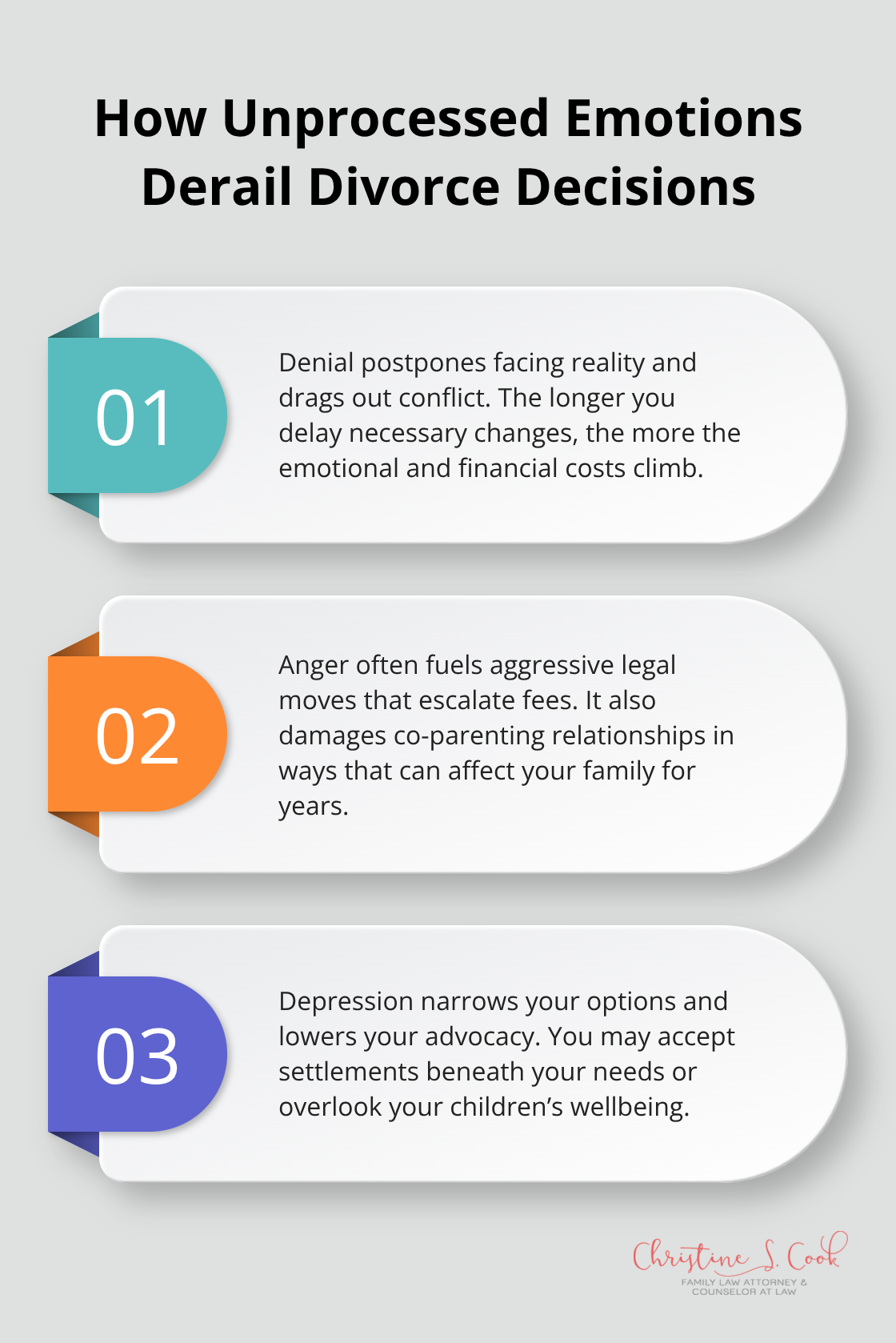
Unprocessed emotions directly sabotage your decision-making. When you remain in denial about the reality of your situation, you delay accepting necessary changes and extend conflict unnecessarily. When anger dominates, you make aggressive legal moves that escalate costs and damage co-parenting relationships for years. When depression clouds your thinking, you accept settlements far worse than you deserve or fail to advocate for your children’s wellbeing.
A UC Berkeley study from the Greater Good Science Center found that journaling about stressful events for just 15 minutes, twice weekly, significantly reduced depression, anxiety, and hostility-especially in people experiencing high distress. This simple tool costs nothing and works because it creates distance between you and your emotions, allowing clearer thinking.
Waiting until you’re falling apart to seek help multiplies your suffering and legal expenses. According to the CDC, about 19.2 percent of adults received mental health treatment in 2019, yet many people in divorce delay professional support because they view it as optional.
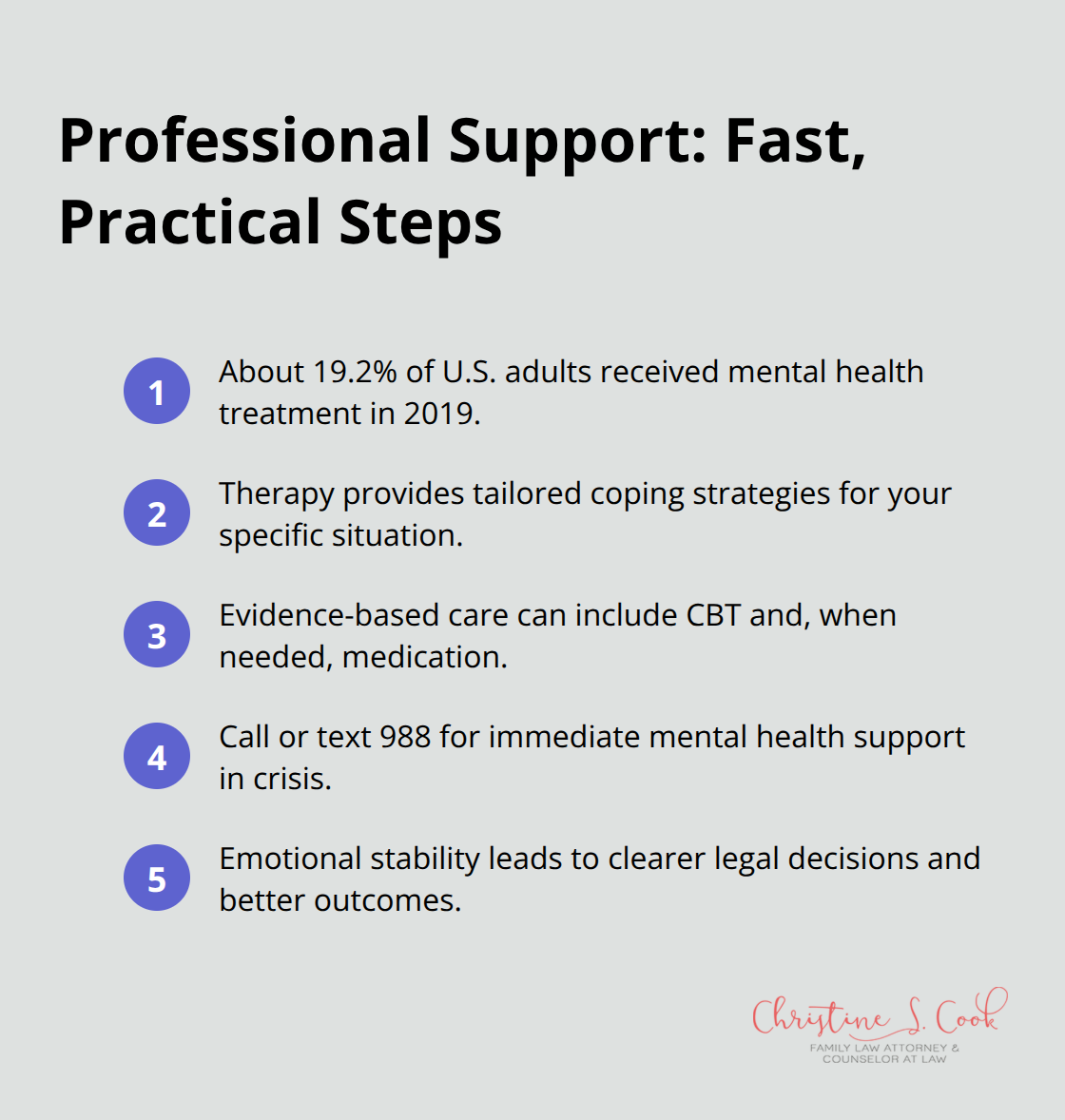
It isn’t. A therapist or counselor provides specific coping strategies tailored to your situation, not generic advice from well-meaning friends.
Individual therapy helps you address attachment patterns and relationship dynamics that led to divorce, preventing repeated mistakes in future relationships. For more severe emotional disruption, licensed psychiatric care offers evidence-based options like medication or specialized therapies when mood issues interfere with your ability to make decisions. You need someone trained to help you distinguish between what you want emotionally and what serves your actual interests legally. When you feel overwhelmed, crisis resources like calling or texting 988 provide immediate support.
The cost of professional mental health support pales against the cost of a settlement negotiated while you’re emotionally reactive. Your emotional stability directly impacts your legal outcomes-clearer thinking produces better settlements and stronger custody arrangements. This foundation of emotional clarity positions you to work effectively with your legal team, which brings its own set of communication challenges and opportunities.
The support you need exists, but finding the right fit matters more than finding everything at once. Start with what addresses your most pressing need today. If you’re spiraling emotionally, individual therapy should come first. If you feel isolated, a support group creates immediate connection with people who understand your exact situation. If you have children, family involvement becomes non-negotiable. Most people make the mistake of waiting for the perfect support system to materialize instead of activating one resource immediately. A therapist you see weekly beats the ideal therapist you never call.
Individual therapy works faster than you expect when you choose the right person. A licensed therapist or counselor trained in divorce transitions teaches you specific skills for managing emotional reactivity, not generic wellness advice. Look for therapists who specialize in divorce or life transitions rather than general counseling. Many offer virtual sessions, which removes scheduling barriers and lets you attend from home when you’re emotionally drained.
Your first session should clarify what you want to address and whether this person fits your needs. If they don’t, switch immediately. The American Psychological Association recommends evidence-based approaches like cognitive-behavioral therapy, which directly tackles the thought patterns that fuel anxiety and depression during divorce. For more severe mood disruption, psychiatric care involving medication or specialized therapies addresses neurological components of depression that talking alone cannot fix. Most therapists can refer you to psychiatrists when medication becomes necessary.
Divorce support groups, whether in-person or online through organizations like DivorceCare or local community centers, serve a different function than individual therapy. These groups normalize your experience and provide practical coping strategies from people currently navigating the same challenges. The peer connection reduces isolation more effectively than friends can, because group members share the specific stressors you face.
Many groups meet weekly and cost little to nothing, making them accessible regardless of financial strain. Your attorney can recommend local groups, or search your city plus “divorce support group” to find options meeting at times that fit your schedule.
Family and close friends form your third support layer, though this requires clear boundaries. Confide fully only in people you absolutely trust and who won’t weaponize your vulnerability or take sides in ways that complicate your legal case. Your ex’s family members should never hear sensitive details about your feelings or your case.
Trusted friends and family members can provide practical help like childcare during therapy appointments, meals when you cannot cook, or simply listening without judgment. However, they cannot replace professional support. Friends mean well but lack training to help you process trauma, distinguish emotional wants from legal needs, or recognize when your thinking has become distorted by depression. Use them for connection and practical assistance, not emotional guidance.
Your attorney plays a critical role in your emotional stability during this process. When you work with a lawyer who understands how emotional reactivity damages settlements and custody arrangements, you gain an ally who helps you stay grounded in what actually serves your interests. This partnership between your emotional support network and your legal representation creates the stability you need to move forward effectively. The next section explores how to work with your legal team in ways that reinforce rather than undermine your emotional wellbeing.
Your attorney functions as more than a legal representative during divorce-they directly influence whether you remain emotionally grounded or spiral into reactive decision-making. When your lawyer understands that emotional stability produces better settlements, they become a partner in protecting both your interests and your wellbeing. The attorney-client relationship should reinforce the emotional work you’re doing with your therapist, not undermine it. This means selecting representation that aligns with your values about how conflict gets resolved.
Collaborative law, where both attorneys commit to settlement-focused negotiation rather than courtroom combat, reduces the adversarial intensity that keeps your nervous system in crisis mode. Attorneys trained in collaborative practice understand that prolonged legal warfare escalates emotional trauma, which damages your decision-making capacity and increases overall costs. When you interview potential attorneys, ask directly whether they use collaborative methods and how they help clients avoid emotional reactivity during negotiations. An attorney who says your emotions are irrelevant to legal strategy is giving you bad information-your emotional state directly impacts the quality of decisions you make about custody, support, and asset division.
Communication with your attorney requires the same intentionality you bring to therapy. Schedule regular check-ins rather than crisis calls, which prevents emotional escalation from driving legal decisions. Before each meeting, write down your questions and concerns so you stay focused on actionable items instead of venting.

Tell your attorney explicitly about your emotional support system-your therapist, your support group-so they understand your decision-making process and can help you distinguish between what you want emotionally and what serves your actual interests.
If your attorney recommends a settlement term that conflicts with advice from your therapist, that signals a need to pause and discuss both perspectives before deciding. Your attorney should explain the realistic outcomes for custody, support, and property division based on your state’s laws, not on what feels fair emotionally. This clarity reduces the shock and emotional devastation that comes from unrealistic expectations.
Request that your attorney communicates settlement offers in writing with time for you to review and discuss with your support network before responding. Pressured decisions made in the moment often become regrets that damage your long-term wellbeing. Your attorney should give you space to think through major decisions rather than pushing for immediate answers. The partnership between your emotional support team and your legal team creates stability that allows you to move through divorce with intention rather than reactivity.
Divorce reshapes your life, but it doesn’t define your future. The emotional support you build now-whether through therapy, support groups, trusted relationships, or your legal team-creates the foundation for genuine healing and forward movement. Research shows that people who actively seek emotional support during divorce recover faster, make better decisions about custody and finances, and build healthier lives afterward. You’re not waiting until the divorce ends to heal; you’re healing while moving through it.
The work you do with a therapist teaches you skills that extend far beyond this crisis. You learn to recognize when emotions drive your choices versus when clear thinking guides them. You understand your attachment patterns and relationship dynamics, which prevents repeating the same mistakes. A support group connects you with people who genuinely understand what you’re experiencing right now, reducing the isolation that makes divorce feel unbearable.
Call a therapist this week, search for a local support group and attend one meeting, and contact an attorney who practices collaborative law and understands that your emotional stability directly impacts your legal outcomes. We at Christine Sue Cook, LLC recognize that divorce involves both legal complexity and emotional upheaval, and we combine compassionate guidance with practical solutions to help you navigate this transition with confidence. Schedule your free consultation to discuss your specific situation without pressure and take the first concrete step toward your new chapter.