Dying without a will in Florida means the state takes control of your estate. The probate court decides who gets your assets, how much it costs, and how long the process takes.
At Christine Sue Cook, LLC, we’ve seen families struggle through intestate succession when a clear plan could have prevented it. This guide shows you exactly what happens and why an estate plan matters.
Florida Statutes Chapter 732 sets a rigid formula for intestate succession that leaves no room for personal preference. When you die without a will, the probate court does not consider what you might have wanted-it follows a statutory hierarchy that prioritizes your spouse, then children, then parents, then siblings, and finally more distant relatives. If you are married with no children or all children are also children of your surviving spouse, your spouse inherits everything under Florida Statutes 732.102(1). But if you have children from a prior relationship, your spouse receives only the first $60,000 plus half of the remaining estate, with your children splitting the other half. This distribution happens regardless of whether your spouse needs the money or your children are financially independent. The probate court has no discretion to adjust these shares based on family circumstances, special needs, or your actual wishes.
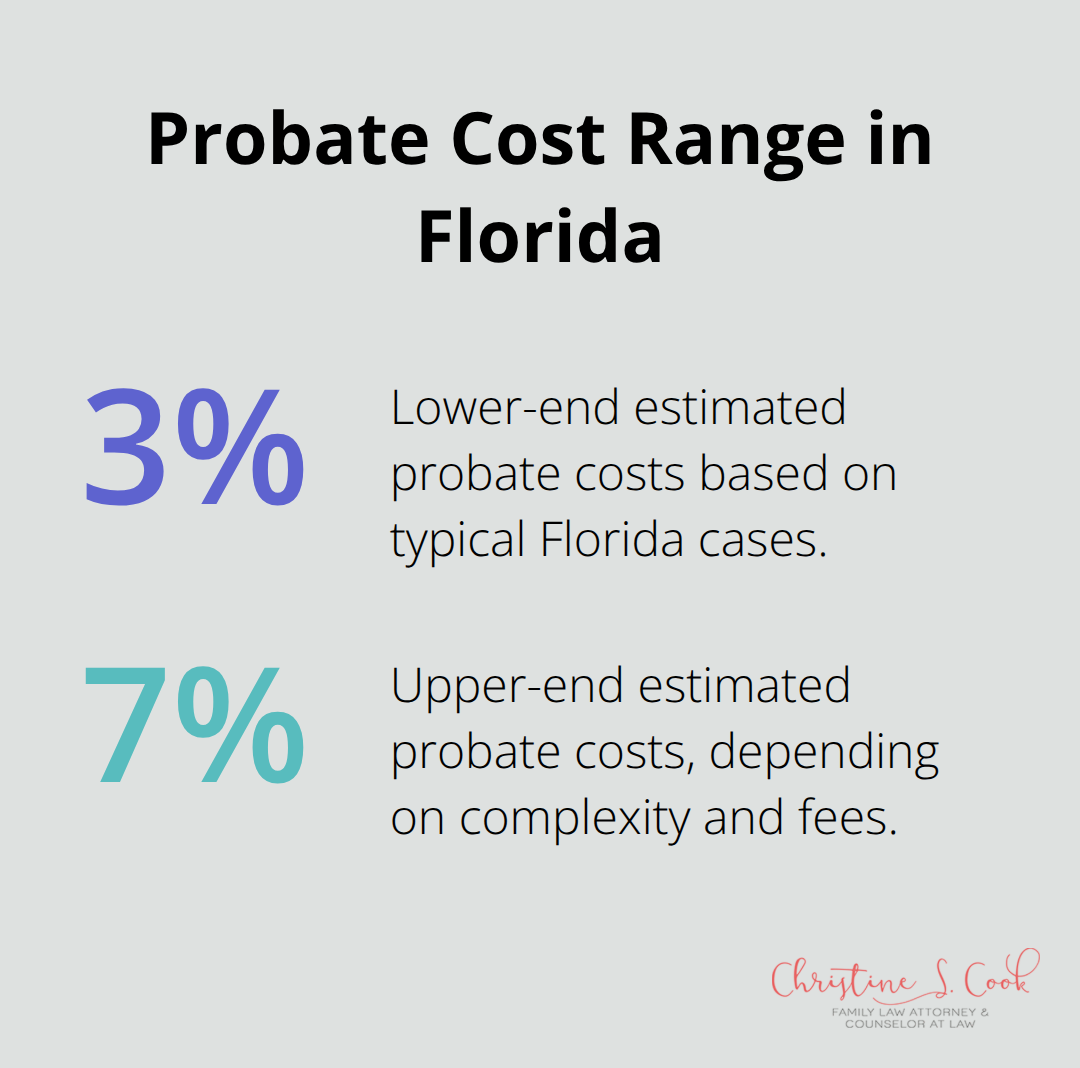
The probate process itself adds significant time and expense to intestate succession. Florida probate takes a minimum of three months but typically stretches six to twelve months, depending on asset complexity and court schedules in your county. Court filing fees, personal representative compensation, attorney fees, and accounting costs typically consume 3 to 7 percent of the estate value according to the American Bar Association. For a $500,000 estate, that means $15,000 to $35,000 in direct costs before anyone receives a dime.
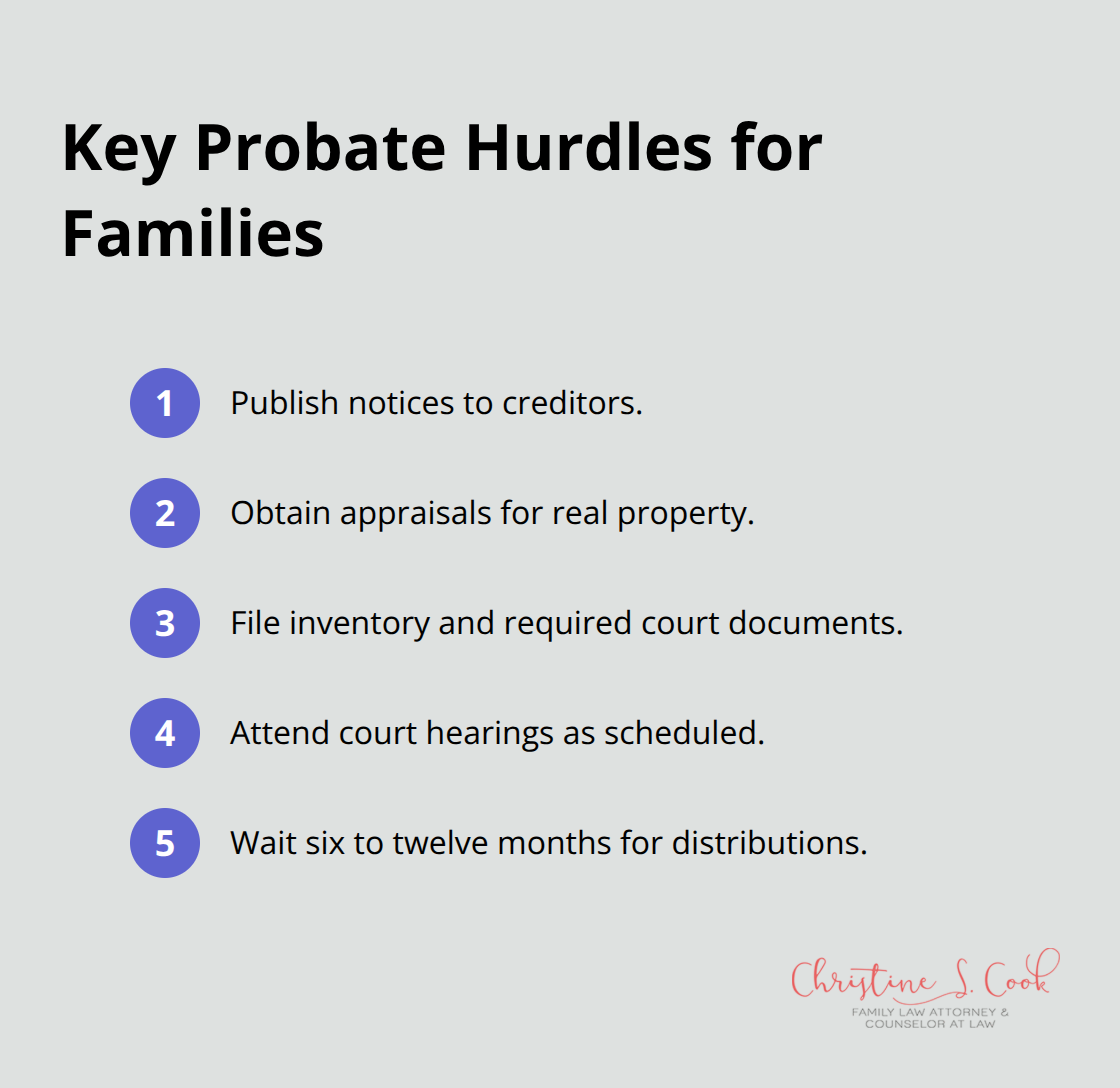
During the entire probate period, assets remain frozen-your spouse cannot access funds to pay the mortgage, your children cannot receive their inheritance, and creditors can file claims against the estate. The probate court must inventory all assets, publish notices to creditors, obtain appraisals for real property, and file multiple documents before distribution occurs. This administrative burden falls on your family at a time when they are grieving and managing your affairs.
Non-probate assets like life insurance with named beneficiaries, transfer-on-death accounts, and jointly owned property with right of survivorship bypass this entire process and pass directly to beneficiaries. This distinction matters far more than most people realize-updating beneficiary designations on retirement accounts, life insurance policies, and bank accounts can protect your family from months of delay and thousands in costs. Your spouse and children could receive these assets within weeks instead of waiting for probate to conclude.
The difference between intestate distribution and a planned estate becomes clear when you understand how much control the state exercises over your assets and how much time and money the process consumes. Your family’s financial security and peace of mind depend on whether you take action now or leave these decisions to Florida law.
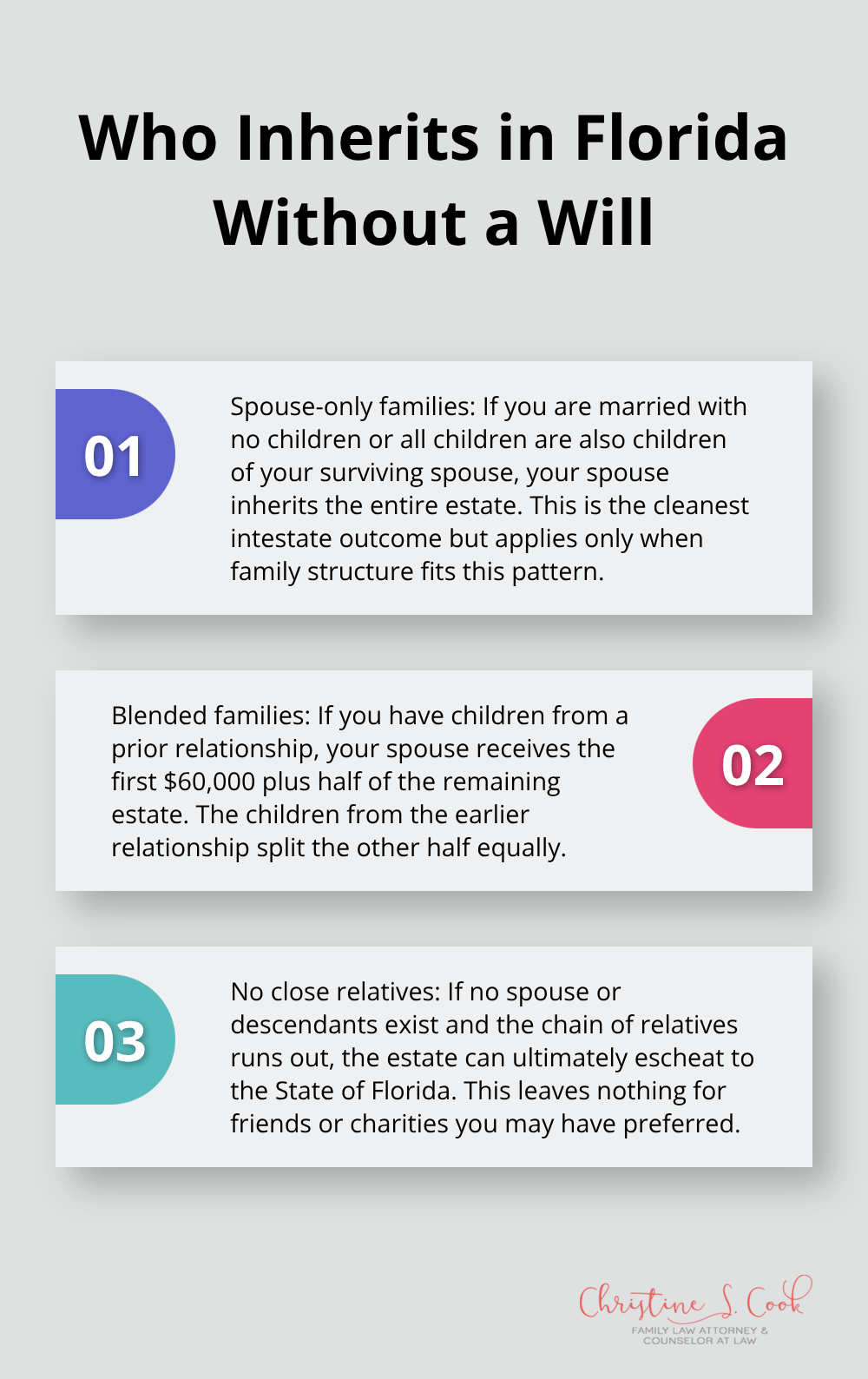
Florida’s intestacy law creates a rigid hierarchy that determines exactly who receives your assets, and the order matters far more than most people understand. If you are married with no children or all children are also children of your surviving spouse, your spouse inherits the entire estate under Florida Statutes 732.102(1). This scenario represents the cleanest intestate outcome, but it applies only when your family structure matches this specific pattern. If you have children from a prior relationship, the rules shift dramatically-your spouse receives only the first $60,000 plus half of the remaining estate, while your children from the earlier relationship split the other half equally.
This division happens automatically regardless of whether your spouse is financially dependent on you or your adult children are wealthy and independent.
The probate court cannot adjust these percentages based on family circumstances, special needs, or what you actually would have wanted. A surviving spouse who owns a home and has substantial retirement savings receives the same statutory share as a spouse with no income and significant medical expenses. The law makes no distinction between these situations.
Florida Statutes 732.103 extends the distribution hierarchy further-if you have no surviving spouse, your children inherit everything per stirpes, meaning descendants of a deceased child receive that child’s share. Parents inherit if you have no spouse or children, followed by siblings and their descendants, then grandparents, aunts, uncles, and cousins in descending order of relation. Each step down this chain represents a more distant family connection, yet the law treats all heirs at the same level identically.
The intestacy chain terminates when no relatives exist to claim your estate. At that point, your entire probate estate escheats to the State of Florida under Florida Statutes 732.107. This rarely discussed outcome means your life’s accumulated assets go to state government rather than to friends, charities, or any organization you valued. The state can reopen administration to assert this claim for up to ten years after payment, creating additional uncertainty and potential delays for anyone who might contest the escheat.
This outcome is entirely preventable through a will or trust that directs assets to beneficiaries of your choosing. The distinction between statutory heirs and chosen beneficiaries represents the fundamental reason why intestacy planning fails-Florida law assumes a family structure and priority order that may bear no resemblance to your actual relationships or values. A spouse you married recently receives the same priority as a spouse of thirty years. A child you rarely see inherits alongside a child you supported financially throughout adulthood. The state receives your assets if you have no legal relatives, regardless of how many meaningful relationships you maintained.
These outcomes reveal why relying on intestacy defaults creates unnecessary conflict and expense. Your actual wishes remain unknown to the probate court, which follows only the statutory formula. The next section examines the specific consequences your family faces when intestacy controls your estate distribution.
Intestate succession creates immediate practical problems for your family that extend far beyond the courtroom. When you die without a will in Florida, your loved ones cannot simply access your bank accounts, sell your home, or distribute your belongings. Instead, the probate court appoints a personal representative to manage everything, and this person must follow strict court procedures that consume months and thousands of dollars. Probate administration typically costs between 3 and 7 percent of estate value, meaning a $300,000 estate loses $9,000 to $21,000 in fees alone.
Your family members who need immediate funds to pay the mortgage, medical bills, or living expenses must wait until the probate court authorizes distribution, often six to twelve months after your death. This delay creates genuine financial hardship for surviving spouses who depended on your income and minor children who need support. The court must publish notices to creditors, obtain property appraisals, file inventory documents, and hold hearings before your assets can move to heirs.
Meanwhile, your home may sit vacant, your business operations may stall, and investment accounts remain frozen. If you own property in multiple states, your family faces ancillary probate in those states as well, multiplying costs and delays exponentially. The probate process itself adds significant time and expense to intestate succession. Florida probate takes a minimum of three months but typically stretches six to twelve months, depending on asset complexity and court schedules in your county.
Guardianship of minor children under intestacy reveals an even more troubling consequence that most parents overlook until it is too late. When you die without naming a guardian in a will, the court decides who raises your children, and this decision may conflict entirely with your preferences. The court considers what it determines to be in the child’s best interest, not what you would have chosen.
Your ex-spouse, a relative you would never trust with your children, or even a stranger could petition for guardianship, and the court may award custody based on factors the judge considers important rather than your values and judgment. Your children enter a guardianship proceeding that costs additional legal fees and creates uncertainty during an already traumatic period.
You lose the ability to specify educational choices, religious upbringing, medical decisions, and the person your children will call parent. This outcome is entirely preventable through a will that nominates your chosen guardian, giving the court clear direction and your children stability. Without this document, your family’s most precious relationships remain subject to court authority and potential dispute among relatives competing for guardianship rights. A will ensures your voice shapes your children’s future even after you are gone.
A will transfers direct control over your assets to beneficiaries you select and in amounts you specify. You nominate a personal representative you trust to manage your estate, designate guardians for your children, and direct exactly how your property should be distributed. This document costs far less than probate administration and provides the clarity your family needs to avoid conflict and delay.
Trusts offer advantages that wills alone cannot provide, allowing your assets to pass to beneficiaries outside probate and avoiding the months of court proceedings that intestacy requires. Your family receives their inheritance within weeks rather than waiting for the probate court to authorize distribution, and the privacy of a trust protects your financial information from public court records. Powers of attorney ensure your family can manage your affairs if you become incapacitated before death, eliminating the need for court authorization to access your accounts, pay your bills, or make medical decisions on your behalf.
Understanding what happens if you die without a will in Florida motivates action now rather than leaving your family to face costly consequences later. We at Christine Sue Cook, LLC in Pensacola tailor estate plans that reflect your specific circumstances and values, creating wills, trusts, and powers of attorney designed to protect your family and honor your wishes. Contact us for a free consultation to discuss your estate planning needs without financial pressure.