Child custody cases are emotionally demanding and legally complex. At Christine Sue Cook, LLC, we understand the stress families face when navigating custody arrangements in Pensacola.
This guide walks you through what to expect, from initial filings to court decisions, and explains how a Pensacola child custody lawyer protects your parental rights throughout the process.
Florida courts separate legal custody and physical custody (parental responsibility and time-sharing), and this distinction directly affects your rights and your child’s daily life. Legal custody determines who makes major decisions about education, healthcare, and religion, while physical custody controls where your child lives and how parenting time is divided. Florida Statute §61.13 establishes that courts can award three forms of parental responsibility: shared responsibility where both parents make decisions jointly, shared responsibility with one parent holding ultimate decision-making authority for tie-breaking situations, or sole responsibility granted to one parent.
The best interests standard guides all custody decisions, meaning courts evaluate factors like each parent’s involvement in the child’s daily life, the stability of each home environment, the quality of the parent-child relationship, and the ability of parents to cooperate. Courts also examine whether substance abuse, domestic violence, or other safety concerns exist, as these factors heavily influence outcomes. In Pensacola cases, judges consider local factors like proximity between homes in areas such as Gulf Breeze and Milton, school schedules in Escambia County, and each parent’s work flexibility. The court prefers arrangements that preserve meaningful relationships with both parents unless safety or welfare concerns mandate otherwise.
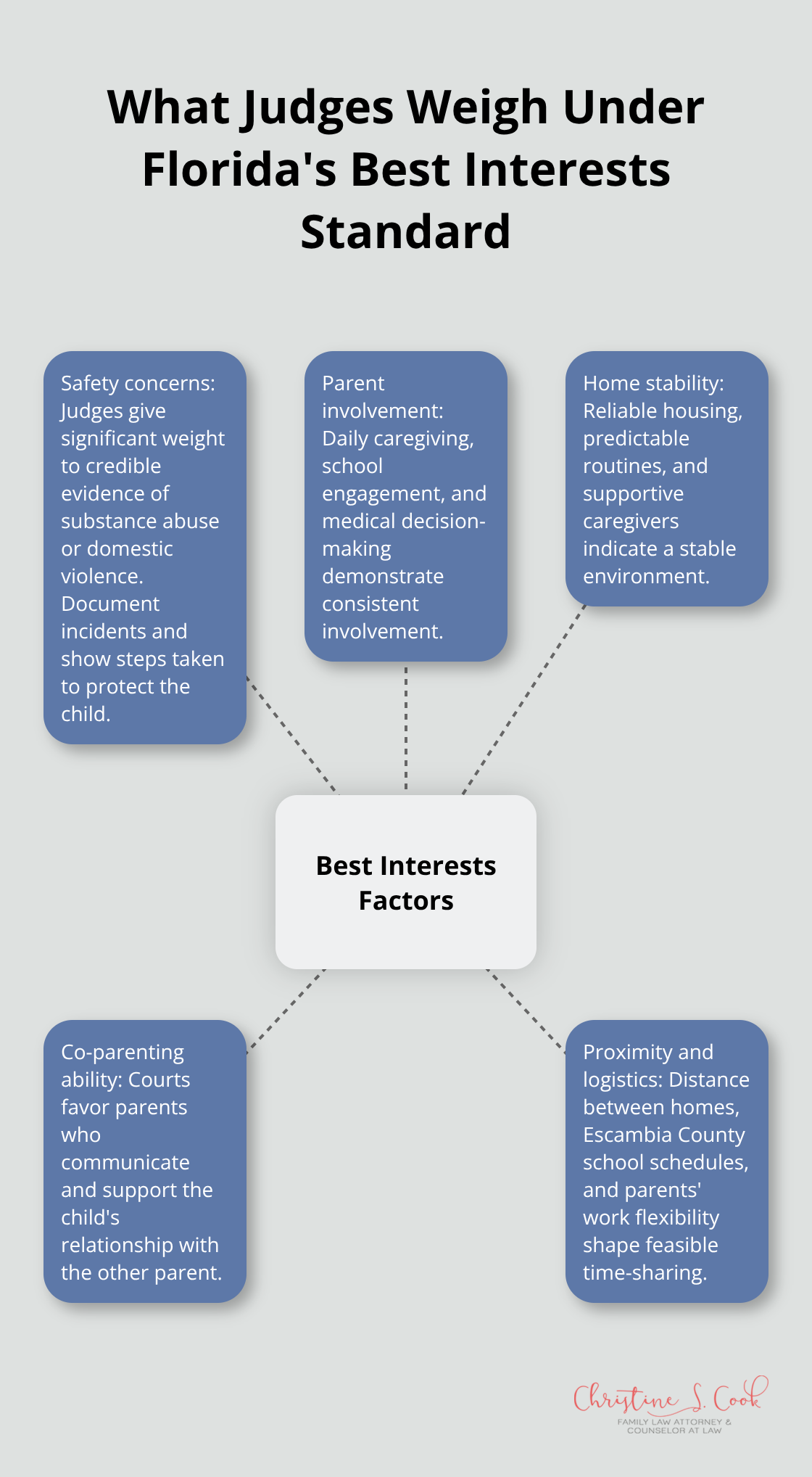
Time-sharing schedules in Pensacola typically divide weekdays, weekends, holidays, and school breaks, with practical attention to commuting distances and after-school programs that affect daily logistics. Courts recognize that geographic distance, work schedules, and the child’s age all influence what works practically. The child’s preferences matter based on age and maturity, though younger children’s stated preferences carry less weight than those of teenagers.
Sole custody is less common in modern Florida family law because courts generally favor shared parental responsibility, though sole arrangements may apply if one parent poses safety risks or demonstrates inability to cooperate. Joint custody works best when parents live reasonably close, can communicate effectively about the child’s needs, and show willingness to honor agreed schedules.
If you prepare for a custody case in Pensacola, you should gather documentation showing your involvement in school activities, medical appointments, and daily caregiving, as courts weight actual parenting history heavily. Your attorney will help you organize this evidence and develop a realistic parenting plan that serves your child’s interests while protecting your relationship. With these custody fundamentals in mind, the next step involves understanding how the actual legal process unfolds in Pensacola’s courts.
A custody petition filed in Escambia County Circuit Court starts a formal process that typically spans several months, depending on whether parents agree or dispute arrangements. You submit a petition and financial affidavit to the Family Law Division, then serve the other parent with court documents within a specific timeframe. The court assigns a case number and establishes initial deadlines for the other parent to respond, usually within 20 days. The process involves multiple phases: the initial filing, exchange of financial and parenting information, potential mediation, and if unresolved, court hearings before a judge. Escambia County follows local procedures that differ slightly from other Florida counties, so working with an attorney familiar with the M.C. Blanchard Judicial Building and local judges’ preferences accelerates timelines and prevents procedural missteps that delay resolution.
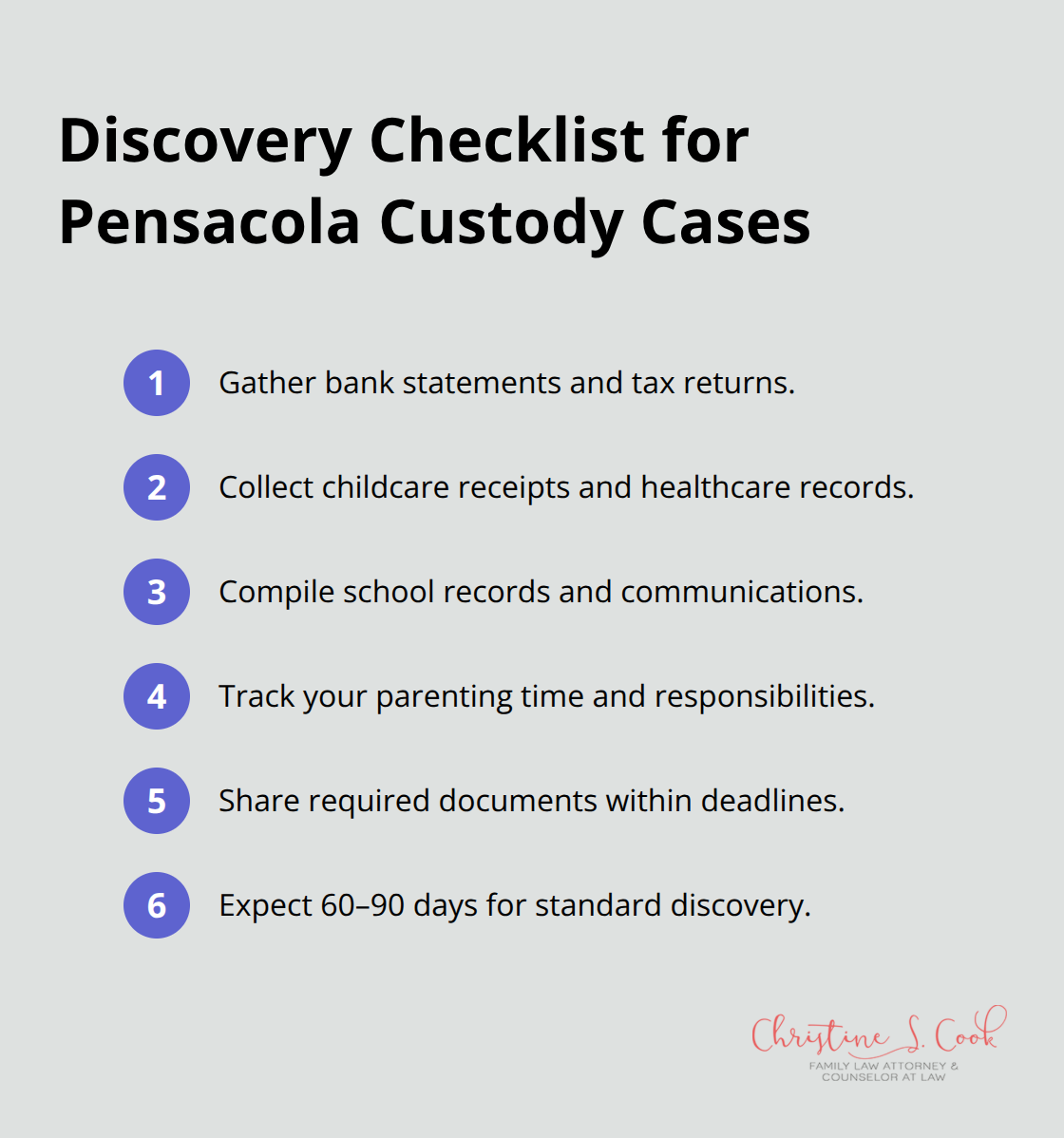
Both parents exchange financial documents, school records, medical information, and evidence of parenting involvement simultaneously with initial filings. Courts expect you to produce bank statements, tax returns, childcare receipts, and documentation of your participation in your child’s education and healthcare decisions. This phase typically lasts 60 to 90 days but can extend if either parent requests additional time or disputes arise over what information must be shared. You should organize this evidence carefully, as courts weight actual parenting history heavily when determining custody outcomes.
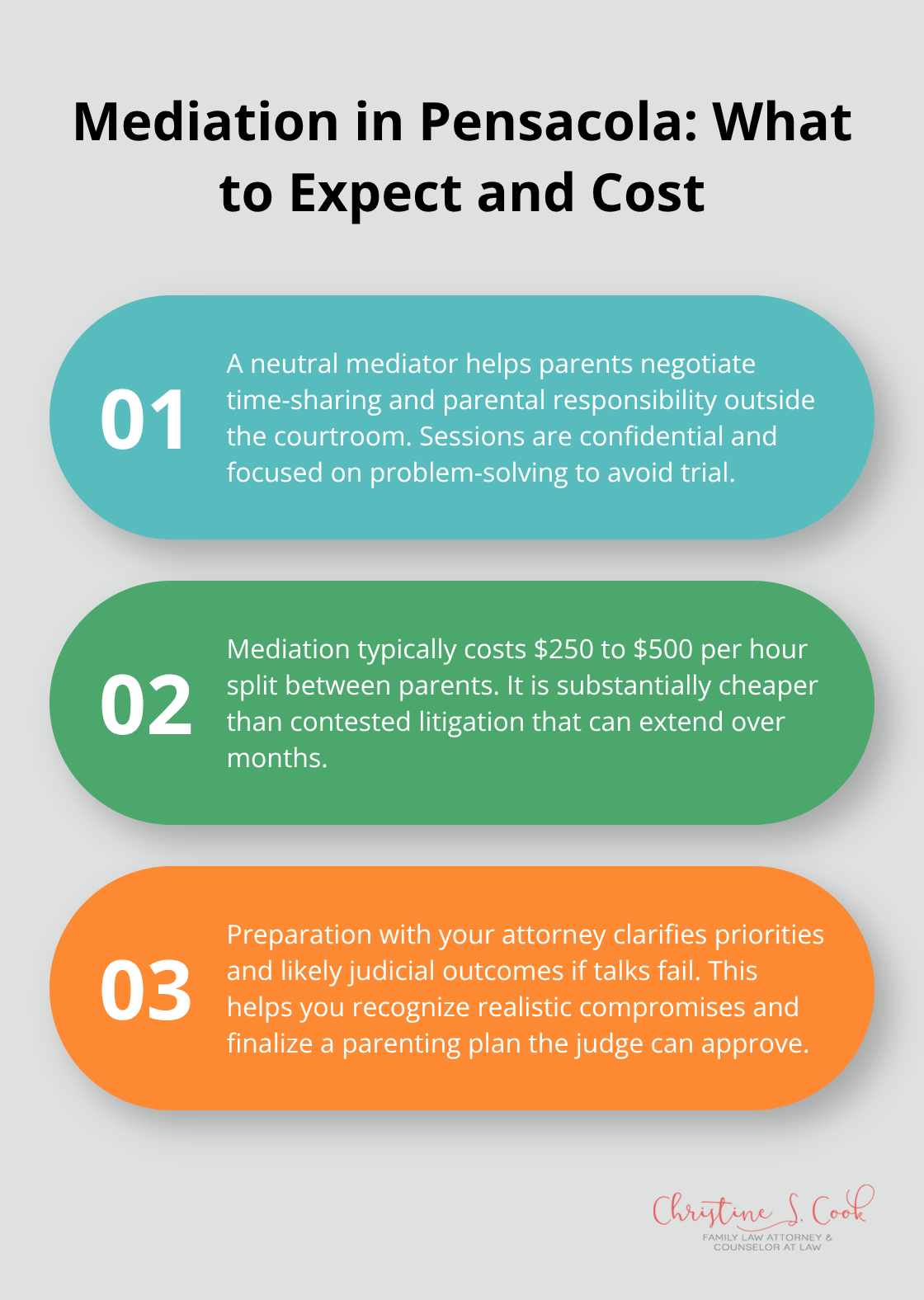
Mediation often follows discovery and occurs at the M.C. Blanchard Judicial Building with a Florida Supreme Court-certified Family Law Mediator, offering a structured opportunity for parents to negotiate time-sharing and parental responsibility outside the courtroom. Mediation costs typically range from $250 to $500 per hour and split between parents, making it substantially cheaper than contested litigation. If mediation produces an agreement, you avoid trial altogether and reach a final parenting plan that the judge approves. This approach reduces emotional strain and allows both parents to maintain control over the outcome rather than leaving decisions to a judge.
When parents cannot agree, the case proceeds to temporary hearings (addressing immediate custody while the case continues) and eventually a final hearing where a judge decides time-sharing, parental responsibility, and related issues. Final hearings in Pensacola custody cases vary in length from a few hours for straightforward disputes to multiple days for high-conflict situations (involving allegations of substance abuse, domestic violence, or relocation disputes). Courts prioritize the child’s best interests throughout, meaning judges weigh your involvement history, home stability, ability to cooperate with the other parent, and any safety concerns before issuing a final order. Understanding what judges expect at each stage helps you prepare testimony and evidence that clearly demonstrates your commitment to your child’s welfare and your ability to provide a stable home environment.
A Pensacola custody attorney handles the procedural complexity that catches most parents off guard. Florida family law involves strict filing deadlines, discovery rules that demand specific documents in precise formats, and local court procedures unique to Escambia County that differ from other Florida jurisdictions. Missing a deadline or submitting incomplete financial affidavits results in default judgments against you, meaning the court decides custody without hearing your side. An attorney ensures your petition includes all required information, that you respond to the other parent’s filings within the 20-day window, and that your evidence reaches the judge in admissible form.
Courts expect organized documentation of your parenting involvement, school records, medical appointments, and financial contributions to your child’s care. An attorney helps you gather and present this evidence persuasively, showing judges concrete examples of your daily involvement rather than vague claims about your commitment. During discovery, the other parent will request extensive financial and personal information; your attorney screens these requests for reasonableness and protects your privacy where legally permitted.
At mediation, an experienced attorney negotiates from a position of strength, knowing what judges in Escambia County typically award for time-sharing and parental responsibility. Mediation typically costs $250 to $500 per hour split between parents, substantially less than contested litigation that can extend over months. A skilled attorney prepares you for mediation (clarifying your priorities, explaining what judges would likely order if the case went to trial, and helping you recognize realistic compromises).
If the case reaches trial, your attorney examines witnesses, cross-examines the other parent’s evidence, and presents testimony that directly addresses the best interests factors judges must consider. The stakes justify the investment-custody decisions shape your relationship with your child for years, and poor legal strategy can result in time-sharing arrangements that fail to reflect your actual parenting role or your child’s needs.
If the other parent refuses to cooperate or poses safety risks, your attorney aggressively pursues your rights in court, presenting evidence of substance abuse, domestic violence, or parental unfitness that judges must weigh heavily under Florida’s best interests standard. An attorney also identifies opportunities to resolve your case outside the courtroom, reducing emotional strain and allowing both parents to maintain control over the outcome rather than leaving decisions to a judge. Christine S. Cook, LLC offers free consultations where you can discuss your situation without financial pressure, allowing you to assess whether an attorney’s approach aligns with your family’s needs and goals.
Pensacola custody cases demand careful preparation, strategic thinking, and professional guidance to protect your parental rights and your child’s future. Courts evaluate your actual involvement in your child’s daily life, the stability you provide, and your willingness to support the other parent’s relationship with your child, so documentation and clear communication matter throughout. A Pensacola child custody lawyer handles the procedural complexity that trips up parents navigating this process alone, ensuring deadlines are met and evidence is organized persuasively.
The cost of professional representation typically ranges from $254 to $500 per hour, but the investment protects your relationship with your child and prevents costly mistakes that delay resolution or result in unfavorable custody arrangements. The right attorney combines deep knowledge of Florida family law with understanding of local Escambia County procedures and judges’ preferences, listens to your family’s specific circumstances, and helps you recognize realistic compromises that serve your child’s best interests. Free initial consultations allow you to compare options and assess whether an attorney’s approach aligns with your goals without financial pressure.
Schedule a consultation with Christine S. Cook, LLC to discuss your custody situation and take control of your case. Contact the firm at 850-404-7263 to speak with an attorney who listens to your family’s needs and protects your parental rights.