Property division in Florida divorces often goes wrong because people don’t understand the state’s equitable distribution rules. Many miss hidden assets, undervalue retirement accounts, or fail to document what they own.
At Christine Sue Cook, LLC, we’ve seen how these mistakes cost people thousands in settlements. This guide walks you through property division tips for Florida so you can protect your financial future.
Florida rejects the 50/50 split that many states use. Instead, Florida Statute §61.075 mandates equitable distribution, which means fair but not necessarily equal. The court starts by classifying every asset and debt as either marital or nonmarital, then divides only the marital portion. This distinction is everything.
A house purchased during the marriage is marital regardless of whose name appears on the deed. An inheritance received during the marriage stays nonmarital unless you mixed it with marital funds, which is called commingling. The cut-off date for determining what counts as marital is the earliest of three dates: when you separated, when you signed a separation agreement, or when the divorce petition was filed.
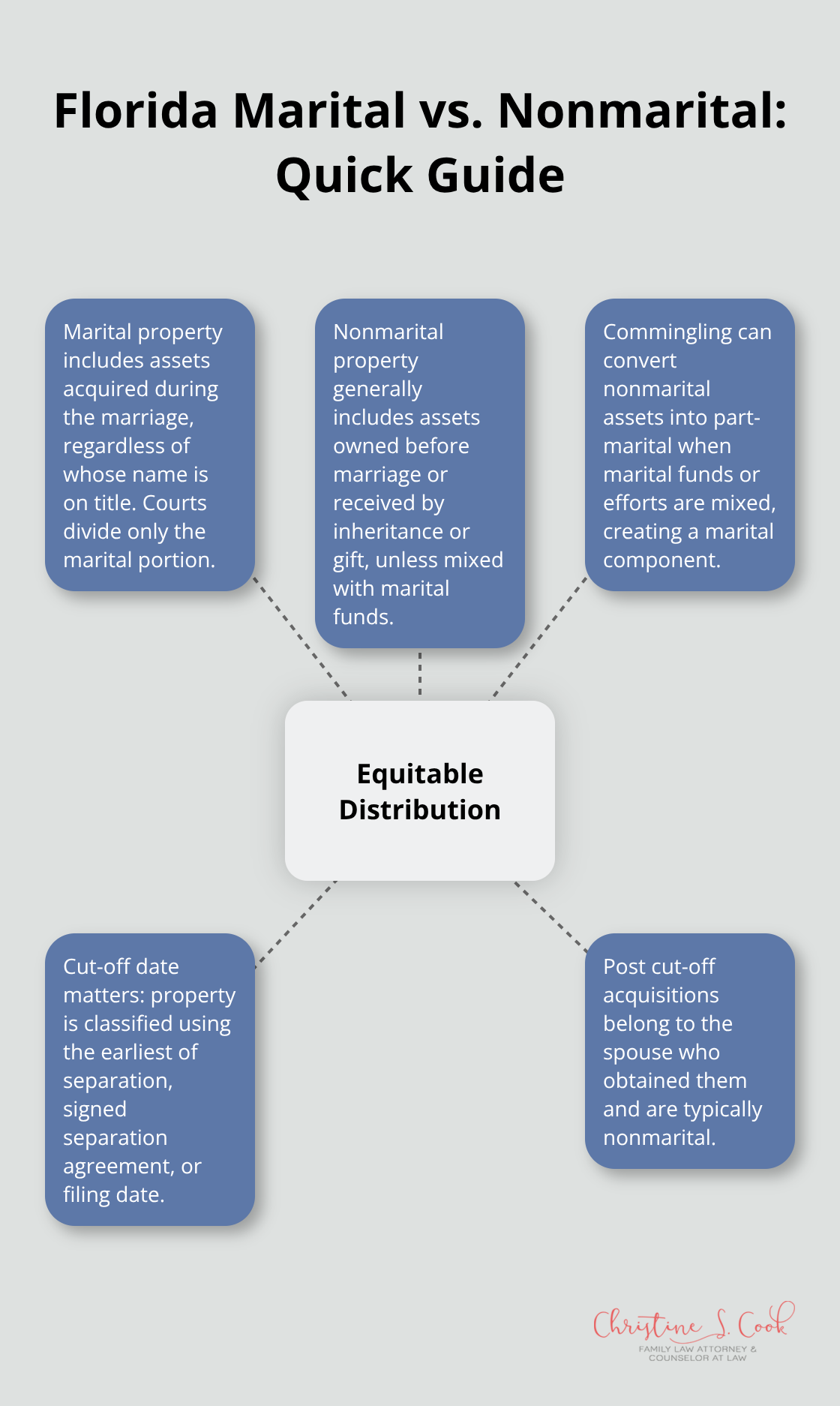
Assets acquired after that date belong to the spouse who acquired them.
Marital assets include anything acquired or increased in value during the marriage through either spouse’s efforts or funds. A retirement account funded during the marriage is marital. A home purchased with a down payment from an inheritance but with marital income paying the mortgage contains both nonmarital and marital components. Active appreciation of a nonmarital asset becomes marital if marital funds or effort enhanced it. For example, if you owned rental property before marriage and used marital income to renovate it significantly, the added value is marital. Passive appreciation from market forces alone stays nonmarital. Real property held as tenants by the entireties (a form of ownership available only to married couples in Florida) is always marital regardless of when purchased. This presumption is powerful and shifts the burden to whoever claims the property is nonmarital to prove it with clear evidence.
The judge weighs ten statutory factors outlined in Florida Statute §61.075(1)(a) through (j). The duration of your marriage matters significantly. A 25-year marriage with one spouse as homemaker triggers different considerations than a 3-year marriage where both spouses worked. The court examines each spouse’s financial and non-financial contributions, including childcare, education support, and homemaking. Career interruptions weigh heavily. If one spouse left a law degree program to support the other through medical school, that sacrifice factors into the division. Intentional waste of marital assets within two years before filing or after filing counts against the spouse who dissipated them.
The court also considers whether keeping certain assets intact serves a dependent child’s best interest, such as maintaining the family home. Economic circumstances at the time of division, not just during the marriage, influence the outcome. A spouse with significantly higher earning capacity may receive a smaller asset share but higher alimony obligations. The judge must write findings explaining how these factors led to the specific division ordered, not just announce a result. Understanding these factors positions you to protect your assets and anticipate how the court will evaluate your situation. The next section covers the mistakes that derail property division and how to avoid them.
Incomplete financial disclosure destroys more divorce settlements in Florida than any other single factor. Florida Statute §61.075 requires sworn financial affidavits listing every asset, liability, bank account, retirement fund, and investment. Courts take this mandate seriously. Hiding assets-whether unreported cash income, forgotten retirement accounts, digital currencies, or newer investment vehicles-nearly always backfires. When discovered, hidden assets trigger sanctions, attorney fee awards against the hiding spouse, and credibility damage that influences how judges view other testimony. Spouses who attempt concealment often end up with worse settlements than they would have received with full disclosure. The court doesn’t just penalize the hidden asset itself; it punishes the behavior by adjusting the overall division unfavorably.
Your bank statements, tax returns for the past three years, pay stubs, retirement account statements, and investment account statements form the foundation of accurate disclosure. Many people forget about old 401(k) accounts from previous employers, small brokerage accounts, or life insurance cash surrender values. These dormant accounts still count as marital property if funded during the marriage.
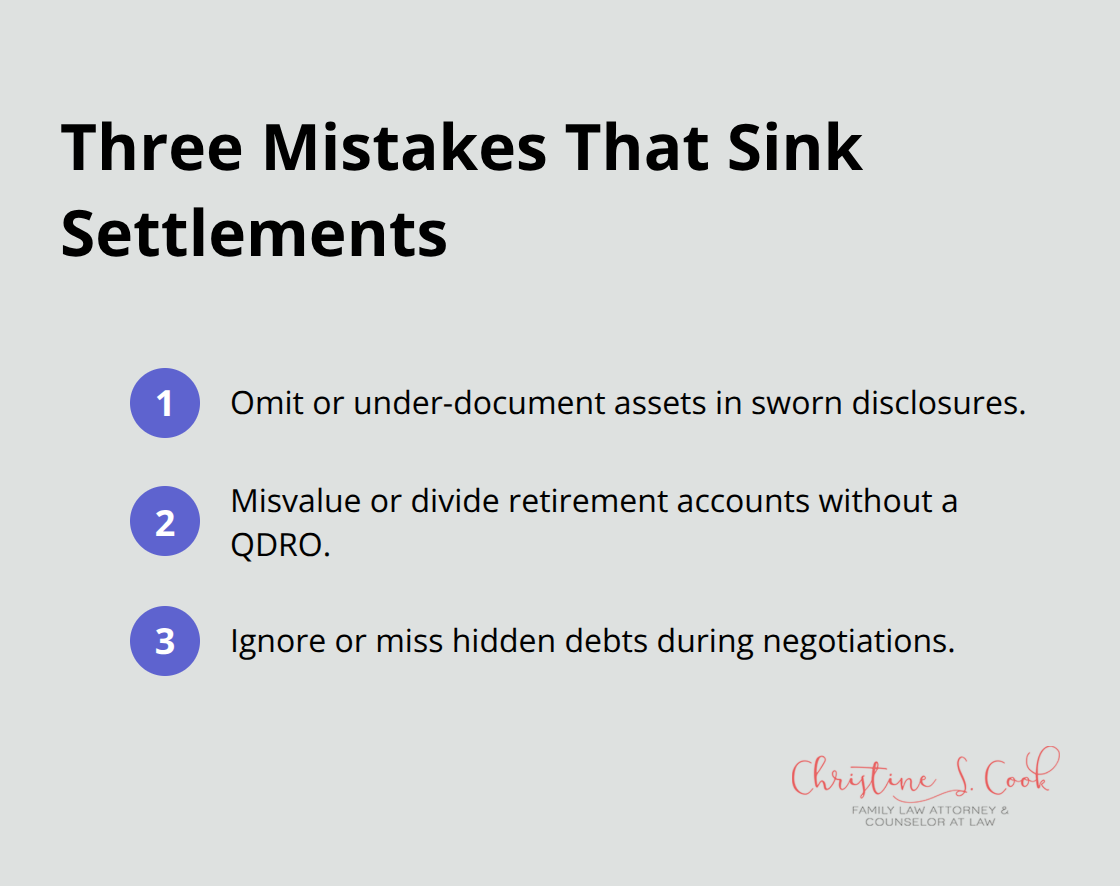
Retirement accounts represent the second-largest asset category in most Florida divorces after real estate, yet spouses routinely undervalue or improperly divide them. A 401(k) or pension accrued during the marriage is marital property, but the portion funded before marriage remains nonmarital. Vested and nonvested benefits both count. The present value of a pension isn’t simply half the current balance; it requires careful actuarial analysis considering the employee’s age, life expectancy, and retirement date. Improper division of retirement accounts can trigger immediate tax penalties and administrative delays that extend years beyond the divorce.
A qualified domestic relations order is the only legally correct way to divide most retirement plans without triggering tax consequences. Courts frequently see settlements where one spouse receives a lump-sum payment intended to offset retirement assets, but the calculation ignored that retirement funds grow tax-deferred while cash payments do not. Over 20 years, this mistake can cost tens of thousands in lost growth.
Hidden debts present an equally dangerous blind spot. Spouses sometimes conceal credit card debt, personal loans, or business liabilities because they hope to avoid responsibility. In Florida, marital debts incurred during the marriage are divided equitably just like assets. If one spouse accumulated significant debt without the other’s knowledge, the court still allocates responsibility based on the ten statutory factors. The spouse who didn’t incur the debt may still owe a portion. Failure to identify and allocate these debts in the final judgment leaves the other spouse vulnerable to collection actions after divorce. Your creditor doesn’t care about your divorce decree if your name remained on the account.
The next section covers the practical steps you can take right now to protect your interests and position yourself for a fair division.
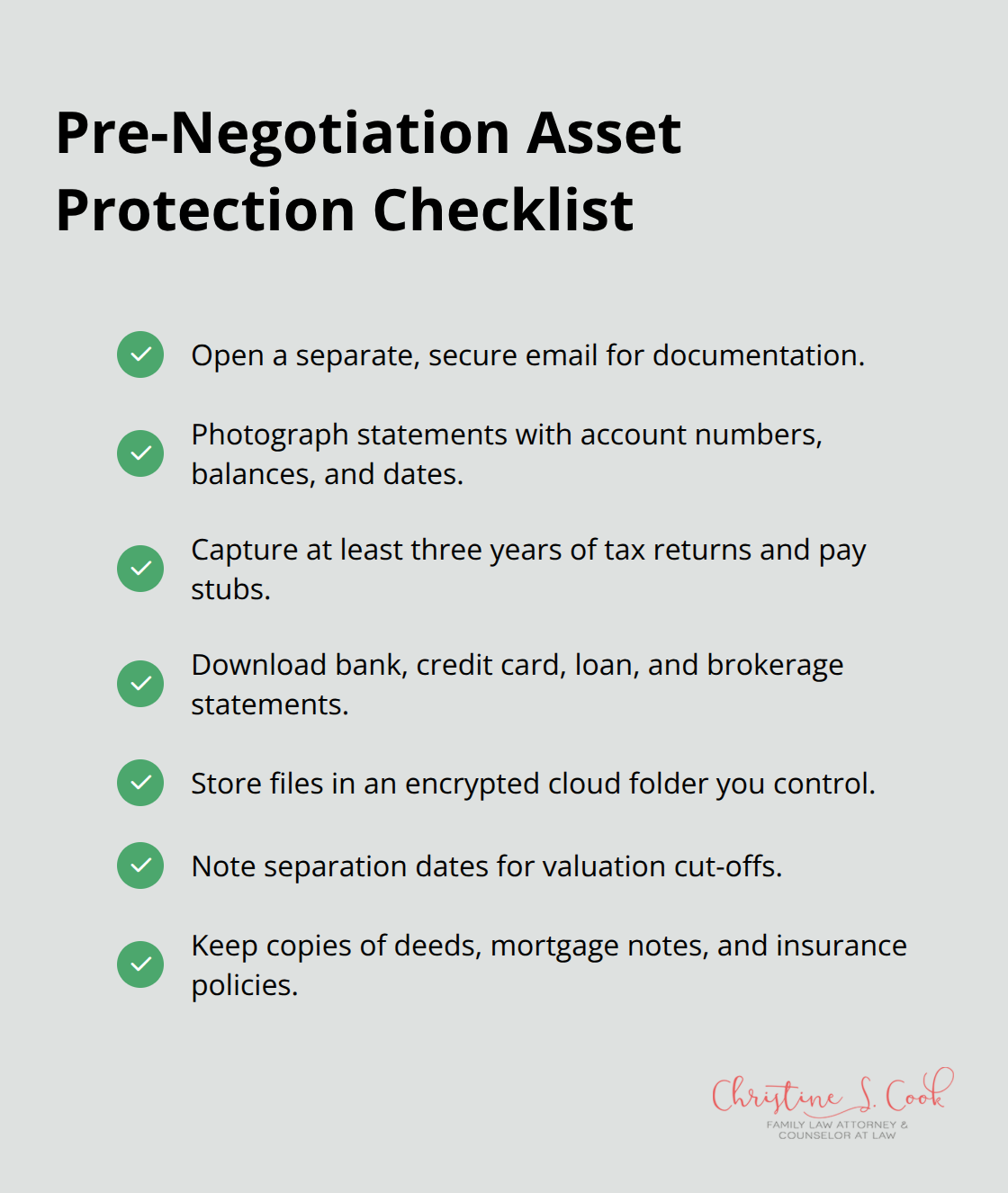
Start documenting everything immediately, not after you file for divorce. Open a separate email account and photograph every financial statement you can access: bank accounts, investment statements, retirement account balances, property deeds, mortgage documents, and insurance policies. Use your phone to capture timestamped photos of statements showing account numbers, balances, and dates. Store these images in a secure cloud folder separate from your home computer. Many people wait until their spouse controls access to accounts, then find they cannot retrieve critical information. The moment you decide divorce is likely, secure copies of the past three years of tax returns, all pay stubs, credit card statements, and loan documents. These records form the foundation of your financial disclosure and prevent your spouse from later claiming assets were hidden. Florida courts expect this documentation to support your sworn financial affidavit, and judges view spouses who scramble to reconstruct information after filing as less credible.
Valuation matters more than possession. A house worth $400,000 with a $250,000 mortgage has $150,000 in equity, but many divorcing spouses negotiate based on perceived value rather than actual equity. Obtain a professional appraisal for real estate, not a real estate agent’s estimate.
Appraisals typically cost $400 to $800 and provide a defensible, court-ready valuation. For retirement accounts, request a present value calculation from the plan administrator showing the account balance as of your separation date. This number becomes the basis for your qualified domestic relations order and prevents disputes later. Investment accounts and brokerage statements show current value directly, but if accounts contain restricted stock or illiquid holdings, hire a valuation expert. For business interests, professional business valuations run $2,000 to $5,000 but prevent catastrophic undervaluation. Many spouses accept their spouse’s verbal estimate of business worth, then discover years later the actual value was double or triple. Try professional valuations for any asset exceeding $50,000 in value.
Work with professionals who understand Florida property division. A forensic accountant costs $150 to $300 per hour but identifies hidden accounts, unreported income, and asset transfers that would otherwise escape notice. These specialists review bank deposits against tax returns, analyze credit card statements for unusual patterns, and trace funds through multiple accounts. If your spouse receives cash income, operates a business, or recently made large transfers, a forensic accountant pays for itself many times over. Christine S. Cook, LLC can connect you with qualified forensic accountants and appraisers who understand Florida’s equitable distribution requirements and prepare reports courts recognize and rely upon.
Property division tips for Florida divorces rest on three core principles: classify assets correctly, document everything, and hire professionals who understand equitable distribution. The mistakes outlined in this guide-incomplete disclosure, undervalued retirement accounts, and hidden debts-are entirely preventable with proper planning. You now understand that Florida’s system rewards spouses who prepare thoroughly and punishes those who cut corners or hide information.
The ten statutory factors the court applies directly affect your financial security for decades after divorce. A spouse who contributed to the other’s career advancement, managed the household, or raised children has legitimate claims to marital assets that courts recognize and enforce. Conversely, a spouse who dissipated marital funds or concealed assets faces judicial skepticism that extends far beyond the hidden asset itself.
Your next step involves securing financial records and obtaining professional valuations for major assets. These upfront investments in documentation and professional analysis typically cost far less than litigation or accepting an unfavorable settlement based on incomplete information. Contact Christine Sue Cook, LLC for a free consultation to discuss your specific situation and protect your financial future.