Divorce is one of life’s most challenging transitions, and how you navigate it shapes your future. At Christine Sue Cook, LLC, we’ve seen firsthand how the right approach makes all the difference between a process that drains you and one that protects your interests.
Divorcing well in Pensacola means making informed decisions rather than reactive ones. This guide walks you through common pitfalls, practical strategies, and the resources available to help you move forward with confidence.
Emotion and divorce operate on opposite frequencies. When anger, fear, or guilt takes the steering wheel, your decisions stop serving your interests and start serving your feelings. This plays out constantly: a spouse accepts unfavorable property splits because they want the process over, or they reject reasonable custody arrangements out of spite toward their ex-partner. The American Bar Association research shows mediated divorces typically cost 40 to 60 percent less than litigation, yet many people reject mediation entirely because they’re too upset to consider it.
Courts in Florida don’t care about your emotional state when dividing assets or determining custody. They care about equitable distribution and the best interests of your children. The moment you let feelings dictate your legal strategy, you’ve handed control to your emotions instead of protecting what matters most. Your attorney exists to think clearly when you cannot, which is precisely why separating emotional decisions from legal ones saves money and protects your future.
Financial documentation determines the outcome of your divorce more than almost anything else. Without organized records of bank statements, tax returns, investment accounts, and property deeds, you cannot accurately identify marital versus separate property or negotiate fair alimony. Florida uses equitable distribution, meaning assets get divided fairly but not equally, and that fairness depends entirely on what you can prove you own.
People who wait until their attorney asks for documents waste weeks and create unnecessary friction. Start now: pull the last three years of tax returns, current statements from every bank and investment account, mortgage documents, and any business valuations if applicable. One spouse often controls financial information in marriages, and that advantage disappears the moment you have documentation. A financial neutral can help you understand the long-term tax implications of how you divide property, because a settlement that looks good today can cost you thousands tomorrow.
Pensacola divorce cases that move quickly share one common trait: both parties came prepared with complete financial information from day one. This preparation also extends to your parenting plan. Track and document your involvement with your children (time spent, activities, and related expenses) to support custody discussions. Create a detailed proposed parenting plan that includes custody arrangements, visitation schedules, and decision-making processes before negotiations begin.
The collaborative divorce process rewards this preparation. When you and your spouse work with a neutral team and arrive with organized information, the entire process becomes more efficient and less adversarial.
Collaborative divorce operates on a simple principle: both parties and their attorneys commit to resolving disputes outside court before litigation ever starts. In Florida, this process aligns with Florida law because it reflects the state’s preference for settlement and reduces the burden on already-crowded court dockets. The process works by eliminating court fees, discovery costs, and the unpredictability of a judge’s ruling.
You and your spouse each hire a collaborative attorney who signs an agreement stating that if negotiations fail, both attorneys must withdraw from the case. This creates real incentive to reach agreement rather than posture for trial. The process typically involves four-way meetings between you, your spouse, and both attorneys, where everyone sits down to discuss property division, custody arrangements, and support obligations face to face. Florida courts recognize collaborative agreements as binding settlements, which means once you reach terms, you avoid the 20-day waiting period complications that plague contested cases.
Neutral experts transform problem-solving by bringing specialized knowledge to your case. You bring in a child specialist when custody matters are complex, a financial advisor to analyze asset division and tax consequences, or a mental health professional to help both parties communicate effectively. This contrasts sharply with litigation, where each side hires experts to attack the other side’s position rather than find common ground.
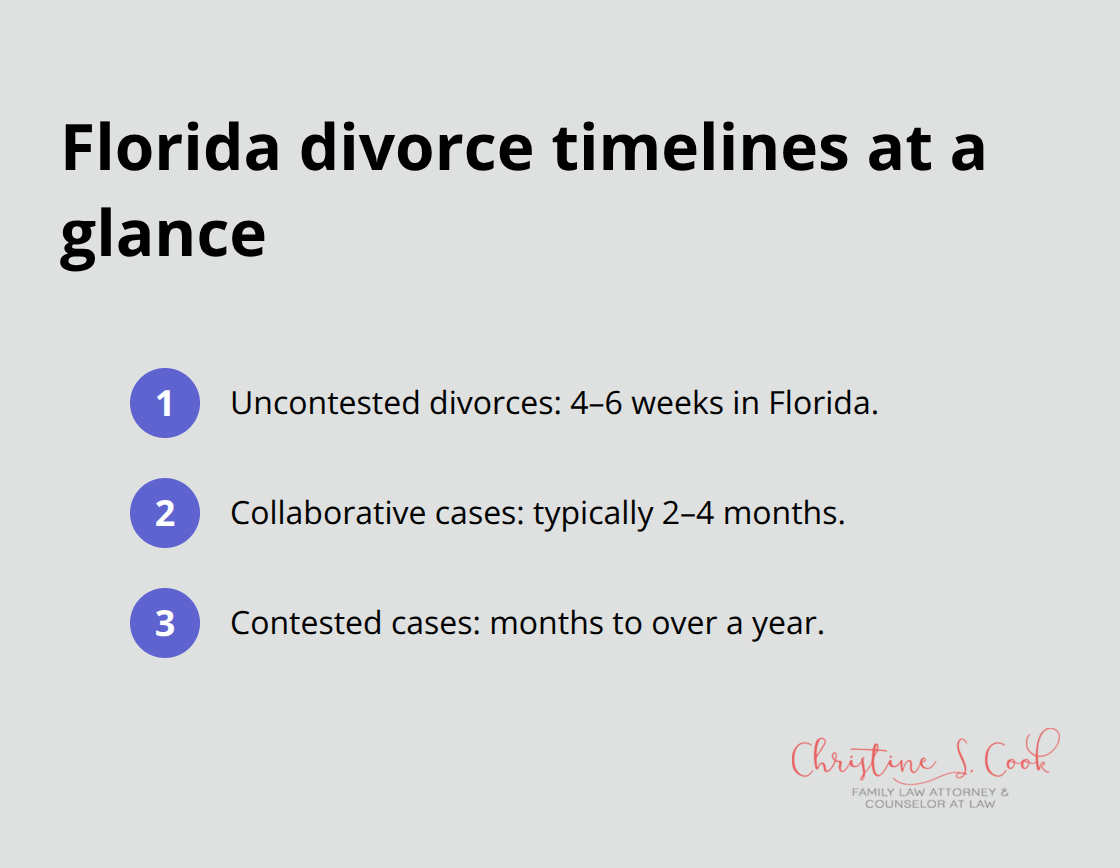
Pensacola families using collaborative divorce report faster resolution because the neutral experts provide objective analysis that both parties trust, eliminating the need to litigate every detail. The timeline advantage matters enormously: uncontested divorces finish in 4 to 6 weeks in Florida, while contested cases drag on for months or over a year depending on court schedules. Collaborative cases typically conclude in 2 to 4 months because you control the schedule instead of waiting for court dates.
Collaborative divorce works best when both parties genuinely want to separate amicably, when children are involved and you want to preserve co-parenting relationships, or when your assets are moderately complex but neither party wants scorched-earth litigation. It fails when one spouse refuses to negotiate in good faith or when domestic violence is present, because the process requires honest disclosure and respectful communication.
The decision between collaborative divorce and litigation depends on your specific circumstances. If you and your spouse can communicate respectfully and both prioritize efficiency over conflict, collaborative divorce protects your interests while preserving your family relationships. If your spouse shows signs of bad faith negotiation or if safety concerns exist, you need a different strategy-one that protects you through aggressive court representation when necessary.
Your financial security after divorce depends on identifying every asset and liability in your marriage, not just the obvious ones. Most people know about the house and retirement accounts, but they miss jointly held life insurance policies, investment accounts in their spouse’s name that they funded, or business interests that appreciate over time. Florida uses equitable distribution, which means the court divides marital property fairly but not necessarily equally, and that fairness hinges entirely on what assets the court knows exist.
Gather and organize financial documents, including bank statements, investment account statements, mortgage documents, property deeds, and any business valuations. If your spouse controlled finances during your marriage, you have the legal right to demand complete disclosure through your attorney, and hiding assets in Florida carries serious consequences including contempt of court charges.
A financial neutral can analyze whether taking the house means you’ll struggle with property taxes and maintenance costs, or whether accepting retirement accounts now versus later changes your tax bracket significantly. This analysis prevents costly mistakes that surface years after your divorce finalizes. One settlement that looks good today can cost you thousands tomorrow if you ignore tax consequences.
The structure of your property division matters enormously. A financial advisor helps you compare scenarios: keeping the family home versus selling it, taking retirement accounts now versus spreading them over time, or accepting a lump sum versus ongoing support payments. These decisions shape your financial stability for decades.
Address child custody and support with the same rigor you apply to property division. Florida courts focus on the best interests of the child, and they consider factors including the time each parent spends with the child, each parent’s involvement in the child’s education and healthcare, and the financial resources of each parent.
Track the hours you spend with your children weekly, note which parent attends school events and medical appointments, and record your contributions to childcare expenses. This documentation becomes your evidence when custody and support negotiations happen. Courts in Florida calculate child support using a statutory formula based on both parents’ income and parenting time plans, so knowing the exact calculation removes guesswork from negotiations.
Property division in collaborative divorce works differently than litigation because both parties control the outcome instead of leaving decisions to a judge who knows nothing about your family’s values. You can agree that one spouse keeps the family home because they have primary custody, while the other receives retirement accounts and investment accounts of equal value, rather than forcing a house sale that harms your children’s stability.
This flexibility protects interests that courts cannot see: your desire to stay in the family home, your need to maintain financial independence, or your commitment to keeping your children in their current schools. Christine S. Cook, LLC helps clients structure settlements that address not just legal requirements but the real-world consequences of those decisions.
Divorcing well in Pensacola starts with one decision: to approach your divorce strategically rather than emotionally. The choices you make now determine your financial security, your relationship with your children, and your ability to move forward with confidence. Everything in this guide points to a single truth-preparation and professional guidance transform your divorce from a destructive process into a manageable transition.
Pensacola offers substantial resources that support every stage of your divorce. Florida’s four-hour Parent Education and Family Stabilization Course helps parents understand the divorce process and its impact on children, while approximately 141 therapists in the area specialize in divorce-related counseling, offering individual, family, and co-parenting support through both in-person and online options. These resources, combined with collaborative divorce techniques and aggressive court representation when necessary, create a framework for protecting your interests and your family relationships.
Contact Christine S. Cook, LLC to discuss your situation without financial pressure. We offer free consultations and utilize collaborative law techniques to achieve amicable settlements while providing aggressive court representation when necessary, ensuring your interests stay protected throughout the process.