Alimony calculations in Florida follow specific legal guidelines, but the process isn’t one-size-fits-all. Courts weigh multiple factors including income, marriage length, and standard of living to determine what’s fair for your situation.
At Christine Sue Cook, LLC, we help clients navigate these complex calculations and protect their financial interests during divorce proceedings.
Florida courts apply eight specific statutory factors when calculating alimony, and understanding them gives you a realistic picture of what a judge will likely award. The first two factors-income sources and overall financial resources-carry substantial weight in the decision-making process. Courts focus on net income rather than gross income, meaning they examine what each spouse actually has available after expenses. This distinction matters significantly: a spouse earning $100,000 gross but spending $60,000 annually on legitimate business expenses has $40,000 net income available for alimony, not $100,000. Net worth also signals ability to pay, so judges examine investment accounts, real estate equity, retirement plans, and other assets when assessing whether a spouse can actually write the check each month.
The length of your marriage directly impacts both the type of alimony available and its duration. Marriages lasting less than three years cannot receive durational alimony at all. For moderate-length marriages between 10 and 20 years, durational alimony typically lasts up to 60 percent of the marriage length. Long-term marriages of 20 years or more allow durational alimony lasting up to 75 percent of the marriage duration. The standard of living you maintained during marriage sets the baseline for what the court considers reasonable post-divorce needs. If you lived on $8,000 monthly as a couple, a judge won’t approve $12,000 monthly in alimony support for one spouse.
Age and health directly influence earning capacity and independence. A 55-year-old spouse returning to the workforce faces different employment prospects than a 30-year-old, and courts recognize this reality. Health conditions affecting work ability receive serious consideration, particularly chronic illnesses or disabilities that limit job options.
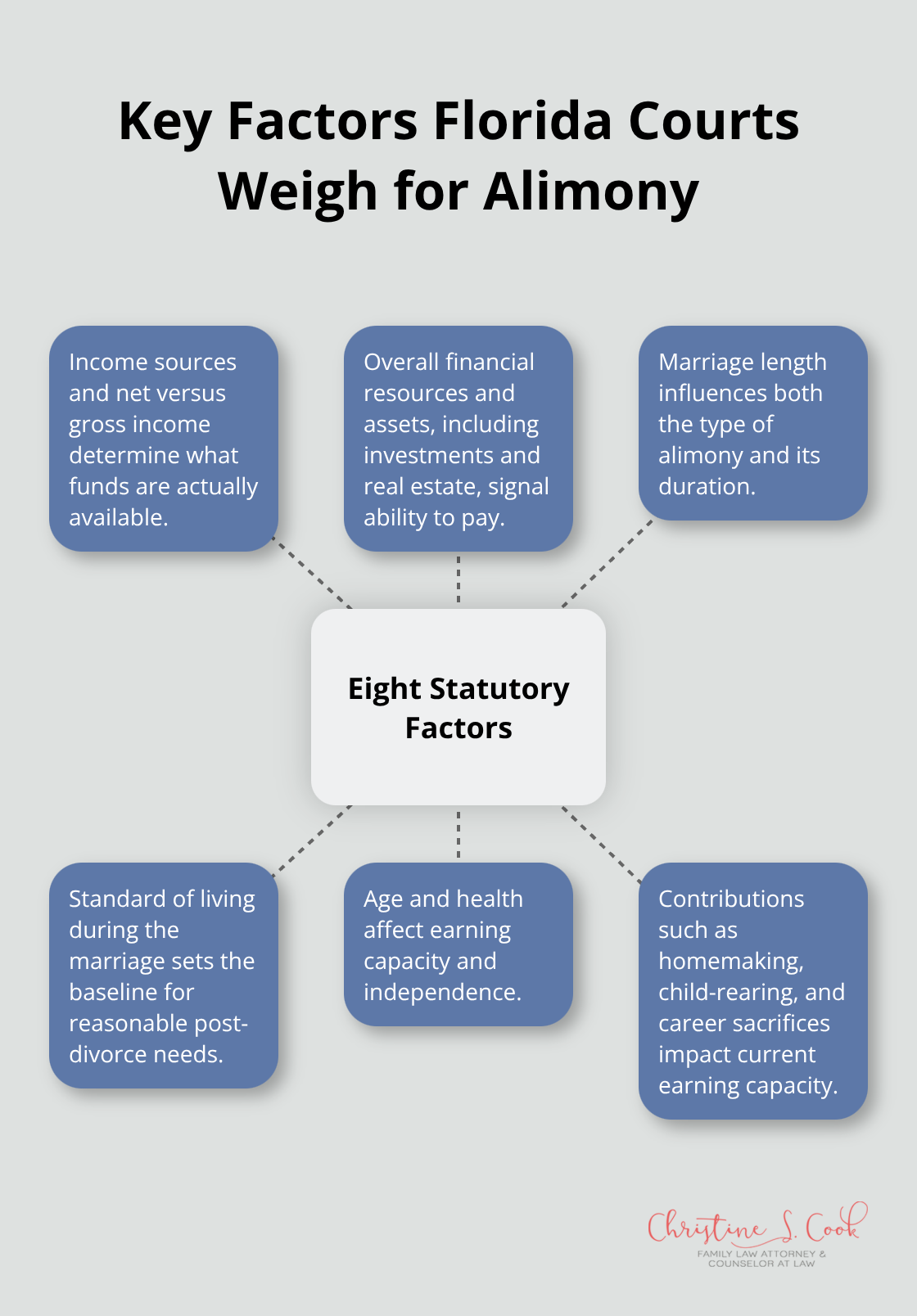
Contributions to the marriage extend beyond paychecks to include homemaking, child-rearing, and career sacrifices. A spouse who left a career to raise children may have reduced earning capacity now, which courts factor into alimony calculations.
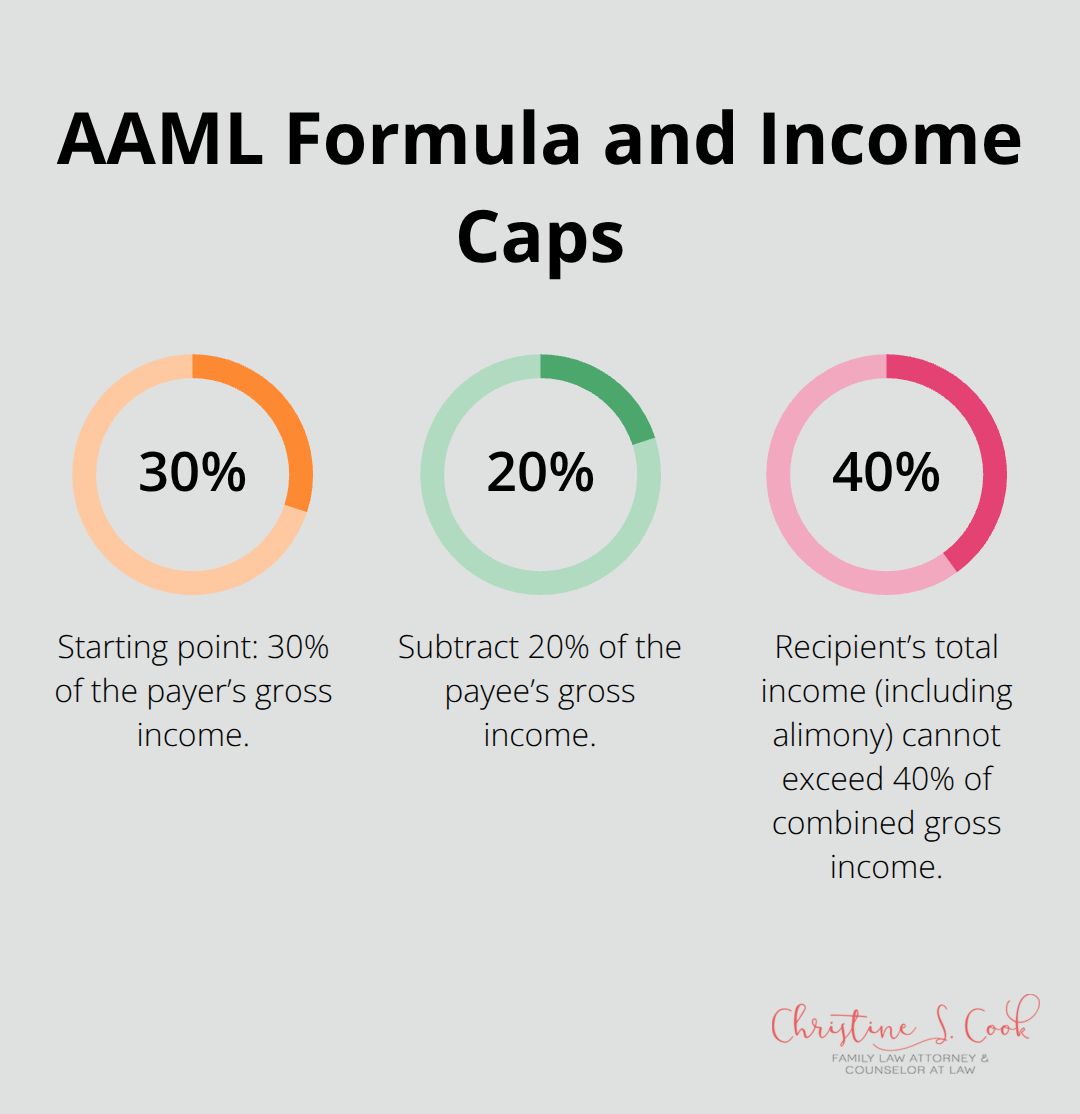
The American Association of Matrimonial Lawyers provides a guideline suggesting 30 percent of the payer’s gross annual income minus 20 percent of the payee’s gross annual income as a starting estimate, though courts exercise discretion and may deviate substantially based on these eight factors. Courts must also verify that alimony recipients don’t end up with more than 40 percent of the combined gross income of both parties. Education level, employment history, and post-divorce earning potential also factor into the analysis.
Documentation matters enormously when courts evaluate these factors. Compile detailed financial records showing at least three years of tax returns, recent paystubs, business statements if self-employed, and documentation of any special expenses related to health or education. This evidence directly supports your position on net income, earning capacity, and reasonable needs. With these eight factors clearly understood, you can now examine how Florida courts structure different types of alimony to fit specific situations.
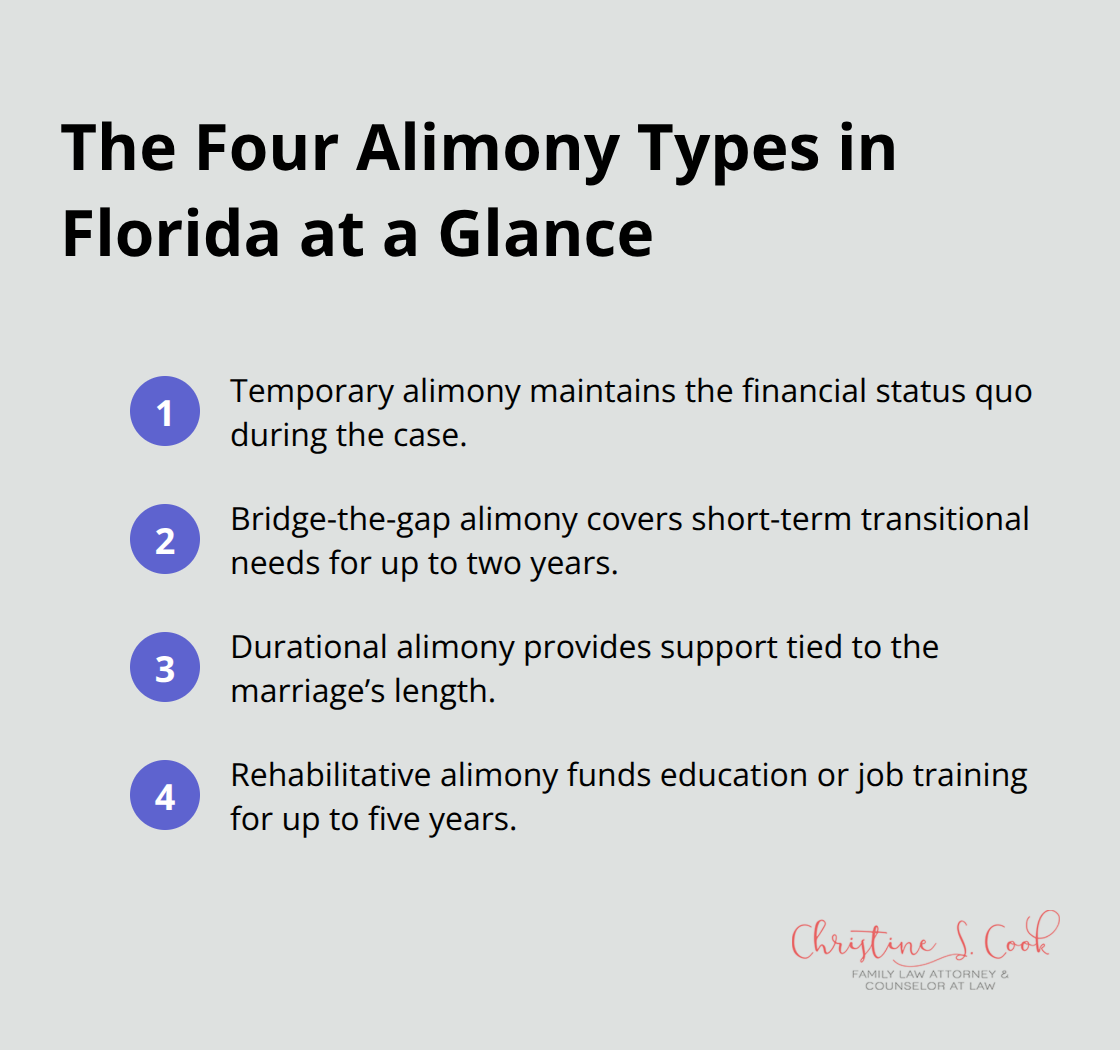
Florida eliminated permanent alimony in July 2023, replacing it with four distinct structures designed to match your specific circumstances. Temporary alimony maintains the financial status quo while your divorce proceeds through the court system and terminates automatically when the final decree is entered. This type exists solely to prevent financial hardship during the divorce process, typically lasting anywhere from several months to two years depending on case complexity. Courts award temporary alimony based on the same income and need analysis used for other types, so the calculation method remains consistent even though the duration is fixed.
Bridge-the-gap alimony addresses short-term transitional expenses like security deposits, moving costs, or reentry into the workforce and cannot exceed two years regardless of circumstances. This type is non-modifiable once ordered, meaning the amount and duration remain fixed even if circumstances change dramatically. If the receiving spouse remarries or either party dies, bridge-the-gap alimony terminates automatically without requiring a court petition. The non-modifiable nature makes this option attractive when both parties want certainty and finality.
Durational alimony applies to moderate-length marriages and provides economic support for a set period tied to the marriage’s length rather than indefinitely. For marriages lasting 10 to 20 years, durational alimony typically lasts up to 60 percent of the marriage duration, while marriages exceeding 20 years allow alimony lasting up to 75 percent of the marriage length. The amount cannot exceed 35 percent of the difference between your net incomes. If your net income is $3,000 monthly and your spouse’s is $5,000, durational alimony cannot exceed approximately $700 monthly.
Rehabilitative alimony funds education or job training for up to five years and requires a detailed plan specifying the training location, duration, costs, and expected post-training earnings. This type serves spouses who need specific skills or credentials to become self-supporting, and courts modify it if the recipient abandons the plan or completes training early.
The key advantage of rehabilitative alimony is its focus on independence rather than indefinite support, making it increasingly common in modern Florida divorce settlements. Understanding which alimony type applies to your marriage sets the stage for calculating the actual monthly amount the court will order.
Florida courts start with the American Association of Matrimonial Lawyers guideline, which calculates alimony by taking 30 percent of the payor’s gross income and subtracting 20 percent of the payee’s gross income. This formula serves as a starting point only, not a binding rule. Courts then apply adjustments based on the eight statutory factors already discussed, meaning two judges handling identical income situations might arrive at different amounts.
The critical adjustment involves net income rather than gross income. If the payer earns $120,000 annually but has $35,000 in legitimate business expenses or professional costs, the court calculates alimony on approximately $85,000 net income, not the full $120,000.
Self-employed individuals face particular scrutiny, as judges examine whether claimed expenses are reasonable and necessary. The payee’s income also reduces the alimony obligation significantly. A spouse earning $30,000 annually receives substantially less alimony than an unemployed spouse, even when the payer’s income remains constant. Courts also enforce an income cap: the receiving spouse’s total income including alimony cannot exceed 40 percent of the combined gross income of both parties. This prevents situations where alimony creates a financial advantage rather than addressing need.
For durational alimony specifically, the 35 percent rule caps monthly payments at 35 percent of the difference between net incomes, though the actual amount awarded typically falls below this maximum based on demonstrated need. If one spouse nets $4,000 monthly and the other nets $2,000, the difference is $2,000, making the maximum alimony approximately $700 monthly. Courts rarely award the maximum; most awards land between 20 and 30 percent of the income difference when need is moderate. Deviations from guideline amounts occur frequently and legitimately when specific circumstances warrant adjustment. A spouse with significant separate property, substantial inheritance, or hidden income may face higher alimony despite guideline calculations suggesting less. Conversely, a payer facing substantial child support obligations, serious health conditions requiring expensive treatment, or recently reduced earning capacity receives consideration for downward deviation.
The Ogle v. Ogle decision from Florida’s Court of Appeals clarified that temporary alimony paid during divorce proceedings does not automatically credit toward future durational alimony, though interim post-marriage payments can be credited where appropriate. Documentation determines whether courts accept your income figures and adjustments. Provide at least three years of tax returns, recent paystubs covering the last two months, and year-to-date earning statements. Self-employed individuals should submit business tax returns, profit and loss statements, and documentation of business expenses. Bank statements showing actual spending patterns strengthen arguments about net income and legitimate expenses (health-related costs, childcare, mortgage payments on separate property all reduce available income for alimony). Courts increasingly demand verification through financial affidavits that itemize income sources, monthly expenses, and asset values. Incomplete or inconsistent documentation weakens your position regardless of the actual numbers involved.
Florida alimony calculations rest on two foundational requirements: the recipient’s demonstrated need and the payer’s ability to pay. Courts apply eight statutory factors to reach fair outcomes, starting with the AAML guideline but adjusting based on your specific circumstances. Net income, not gross income, determines what actually gets awarded, and marriage length dictates which alimony type applies and for how long.
How alimony is calculated in Florida involves more than plugging numbers into a formula-judges exercise discretion when legitimate reasons exist to deviate from guidelines. A spouse with substantial separate assets, significant health expenses, or reduced earning capacity may face different calculations than the guideline suggests, while hidden income or undisclosed assets can trigger upward adjustments. The complexity increases when multiple alimony types combine in a single case or when retirement, remarriage, or cohabitation later changes circumstances.
Navigating these calculations alone creates serious financial risks, from underestimating your need to overestimating your ability to pay. Christine Sue Cook, LLC provides expert guidance on alimony matters throughout Florida and offers free consultations to discuss your specific situation without financial pressure.