Property division ranks among the most complex aspects of any divorce proceeding. The division of property after divorce involves navigating intricate legal frameworks that vary significantly across states.
We at Christine Sue Cook, LLC understand that couples face emotional and financial challenges when splitting assets accumulated during marriage. This guide provides practical steps to protect your interests throughout the property division process.
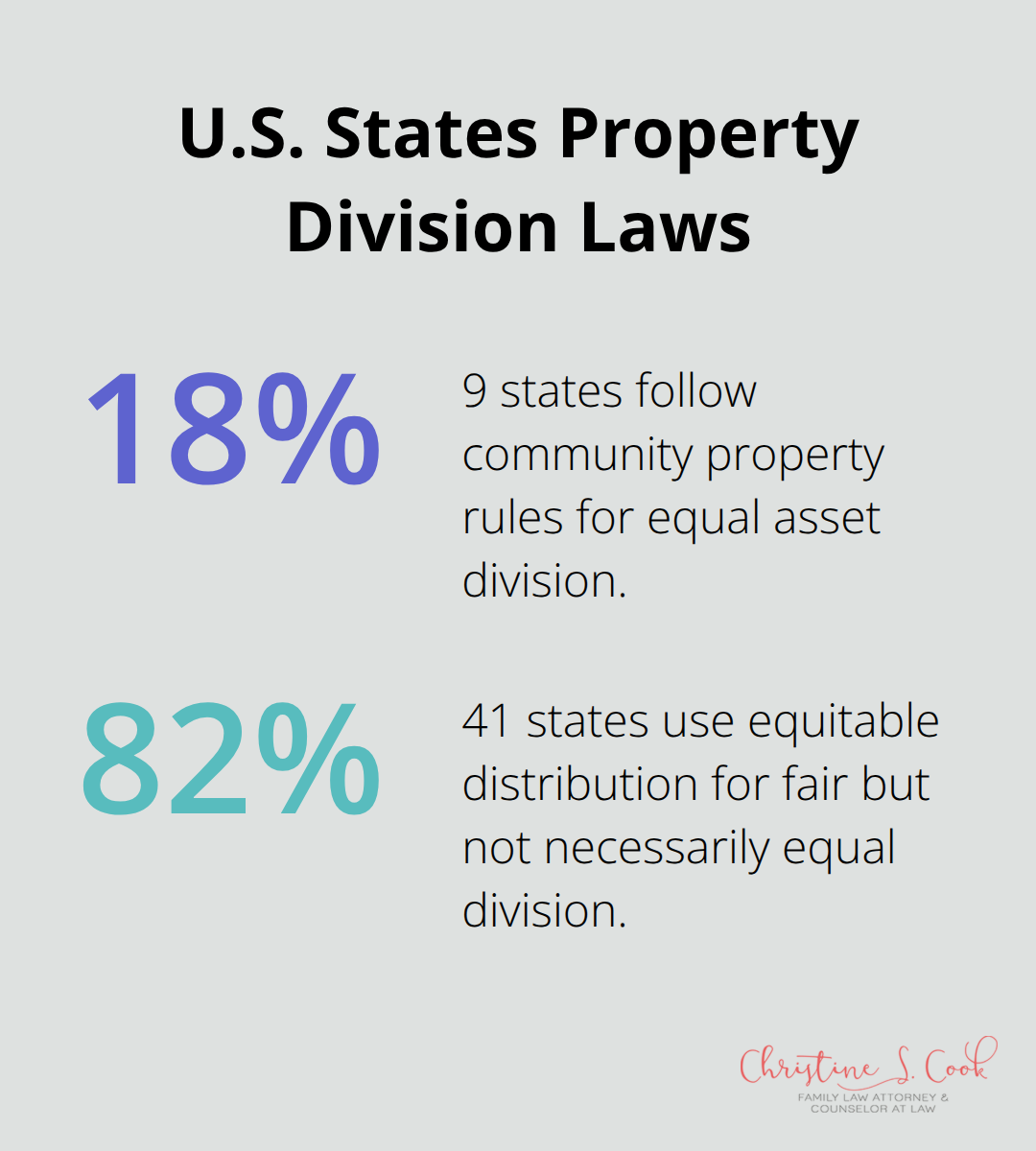
Property division laws vary dramatically depending on your state’s legal framework. Nine states follow community property rules where assets acquired during marriage split equally between spouses regardless of who earned them. These states include California, Texas, Arizona, Nevada, Washington, Idaho, New Mexico, Louisiana, and Wisconsin. The remaining 41 states use equitable distribution, which means fair division but not necessarily equal splits.
Community property states presume all income and acquisitions during marriage belong equally to both spouses. California courts award 100% of hidden assets to the non-offending spouse when fraudulent concealment occurs. Equitable distribution states consider multiple factors including marriage length, each spouse’s economic circumstances, and household contributions. Judges in these states can award unequal distributions based on financial need, care responsibilities, and future income potential.
Separate property includes assets owned before marriage, inheritances, and gifts received individually. However, mixed separate funds with marital assets can convert them to community property. For example, deposited inheritance money into joint accounts often loses separate property protection. Documentation proves ownership time and source. Keep inheritance funds in individual accounts with clear paper trails. Prenuptial agreements provide the strongest protection for separate assets.
Courts weigh specific elements when they determine fair distribution based on factors such as age, health, length of the marriage, occupation and income of the parties. Marriage duration significantly impacts awards, with longer marriages typically result in more equal splits. Each spouse’s income capacity and contributions to household income influence decisions. Asset waste by one spouse can reduce their awarded portion. Professional appraisals determine accurate values for real estate, businesses, and collectibles since courts require precise asset valuations for equitable division.
The next step involves the practical process of inventory and asset identification to prepare for successful property division.
Document every asset and debt within 30 days of divorce filing. The American Academy of Matrimonial Lawyers reports increased divorce cases that require thorough asset documentation. Create spreadsheets that list bank accounts, investment portfolios, real estate, vehicles, household items, and business interests. Include account numbers, current balances, and acquisition dates. Document debts including mortgages, credit cards, student loans, and business obligations with exact balances and payment histories.
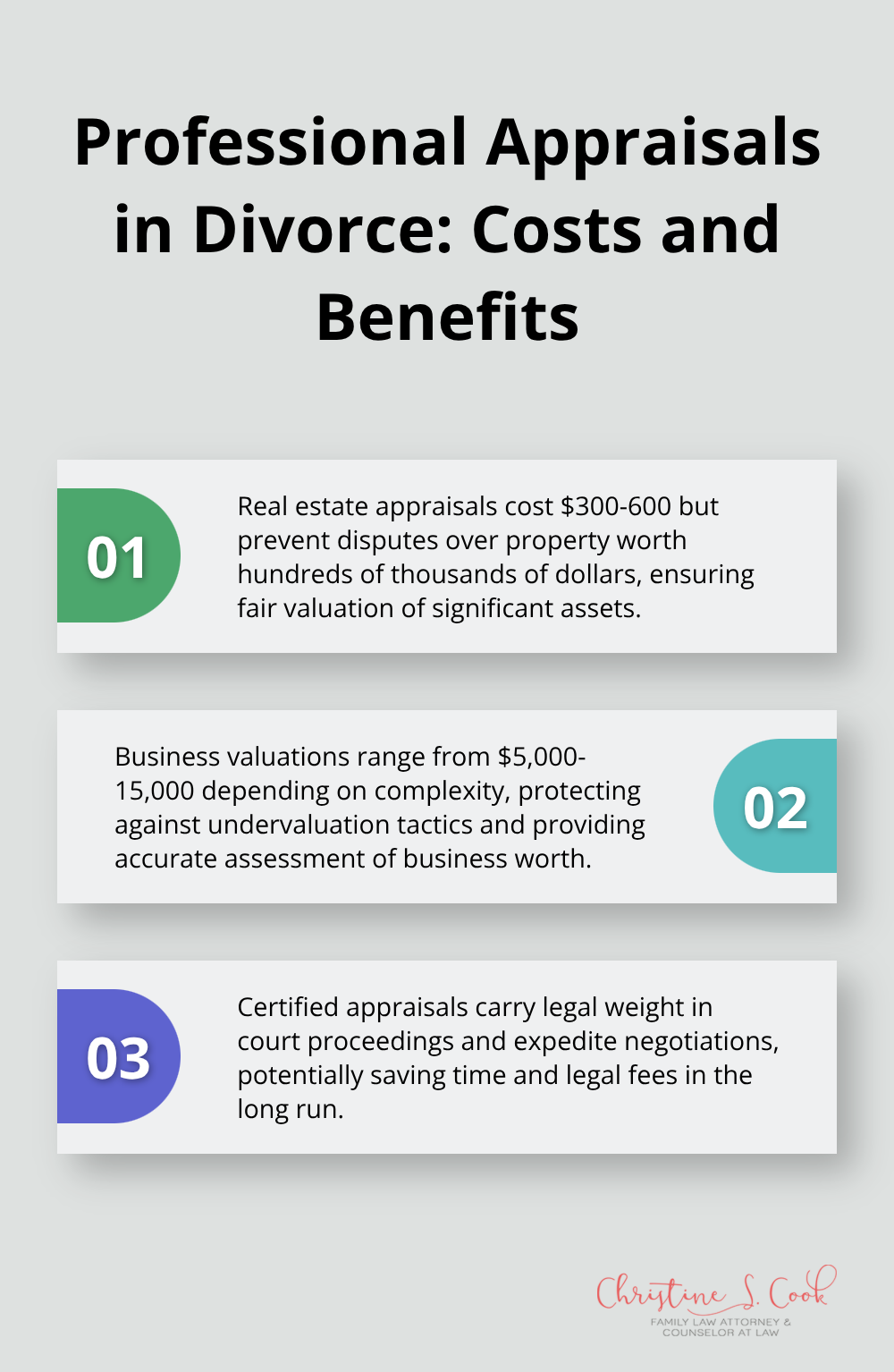
Obtain certified appraisals for real estate, businesses, collectibles, and retirement accounts that exceed $5,000 in value. Real estate appraisals cost between $300-600 but prevent disputes over property worth hundreds of thousands. Business valuations range from $5,000-15,000 (depending on complexity) but protect against undervaluation tactics. Retirement account divisions require Qualified Domestic Relations Orders to avoid tax penalties. Professional appraisals carry legal weight in court proceedings and expedite negotiations.
Choose mediation over litigation to control property division outcomes and reduce legal expenses by 40% compared to contested court battles. Mediators charge $150-300 per hour while contested divorces average $15,000-30,000 in legal fees. Collaborative law involves both spouses who work with trained attorneys to reach agreements outside court. This approach resolves 85% of cases without trial according to the International Academy of Collaborative Professionals. Schedule mediation sessions after you complete asset inventories and obtain appraisals to maximize negotiation effectiveness.
Courts typically use asset values from the date of separation or divorce filing (not the final decree date). Stock portfolios and retirement accounts fluctuate daily, so establish clear valuation dates early in the process. Real estate markets can shift significantly during lengthy divorce proceedings, which makes timing appraisals important for fair distribution.
Hidden assets and complex property structures present the next major challenge that divorcing couples must address to achieve equitable settlements.
Asset concealment affects high-net-worth divorces according to forensic accounting specialists. Spouses hide assets through offshore accounts, cryptocurrency wallets, business partnerships, and family member transfers. Forensic accountants charge $200-500 per hour to trace hidden assets through bank records, tax returns, and business transactions. These professionals recover an average of $50,000-200,000 in concealed assets per case.

Digital forensics experts examine deleted files, cryptocurrency transactions, and cloud storage accounts that reveal undisclosed assets. Courts impose severe penalties when they discover concealment, including asset forfeiture and contempt charges. Professional investigators use specialized software to track financial patterns and identify suspicious transfers. Bank subpoenas reveal account histories that spouses attempt to hide from discovery processes.
Business assets demand specialized valuation methods that standard appraisers cannot handle properly. Certified Business Appraisers charge $8,000-25,000 but prevent costly undervaluation disputes. Professional service businesses like medical practices require different approaches than retail operations or manufacturing companies. Revenue multiples, asset values, and market comparisons determine accurate worth for equitable distribution.
Retirement accounts need Qualified Domestic Relations Orders to split funds without penalties. 401k divisions cost $500-1,500 in administrative fees but preserve tax-deferred status for both parties. Stock options and restricted shares require specific timing strategies to maximize value. Pension plans follow different rules than individual retirement accounts (IRAs) and demand careful legal documentation.
Family homes generate the strongest emotional responses but represent poor financial decisions in 60% of cases. Single incomes cannot sustain property taxes, maintenance, insurance, and mortgage payments that couples previously shared. Sell the house and split proceeds rather than assume crushing debt obligations that destroy post-divorce financial stability.
Sentimental items like family heirlooms and photo collections cause disproportionate conflict over minimal financial value. Focus negotiations on high-value assets first, then address personal items through separate discussions. Set strict time limits for sentimental property decisions to prevent endless delays that increase legal costs and emotional stress.
Strategic property division after divorce demands thorough documentation, professional appraisals, and realistic financial expectations. Courts require complete asset inventories within 30 days of filing, while certified appraisers prevent costly valuation disputes. Mediation reduces legal expenses by 40% compared to contested litigation and provides better control over outcomes.
Professional legal guidance becomes essential when you navigate complex state laws that differ dramatically between community property and equitable distribution frameworks. Forensic accountants recover an average of $50,000-200,000 in hidden assets per case, while business valuations protect against undervaluation tactics. Focus on practical financial decisions rather than emotional attachments to protect your long-term stability.
The division of property after divorce affects your financial future for decades, so prioritize high-value assets over sentimental items. Update estate plans, establish separate credit accounts, and build emergency funds with three to six months of expenses (this creates post-divorce financial security). We at Christine Sue Cook, LLC provide legal support for property division cases through collaborative techniques and court representation when necessary.