
Make a Payment
850-572-3443
Many Florida families put off estate planning because they think it’s only for the wealthy or too complicated to handle. The truth is that living trust Florida benefits can make a real difference for families at any income level, especially when it comes to avoiding probate and protecting what matters most.
At Christine Sue Cook, LLC, we’ve seen firsthand how the right estate plan gives families peace of mind. A living trust is one of the most practical tools available to accomplish that goal.
A living trust is a legal document you create during your lifetime that holds ownership of your assets and outlines exactly how they should be managed and distributed after you pass away. You act as the grantor, meaning you create the trust, and you typically serve as the trustee, giving you complete control over your assets while you’re alive and able. When you become incapacitated or pass away, a successor trustee you’ve named steps in to manage everything without court involvement. The key advantage is that assets titled in the trust’s name bypass probate entirely, moving directly to your beneficiaries according to your instructions, though a simple “pour over” will may be needed to transfer any probate assets to the trust after death.
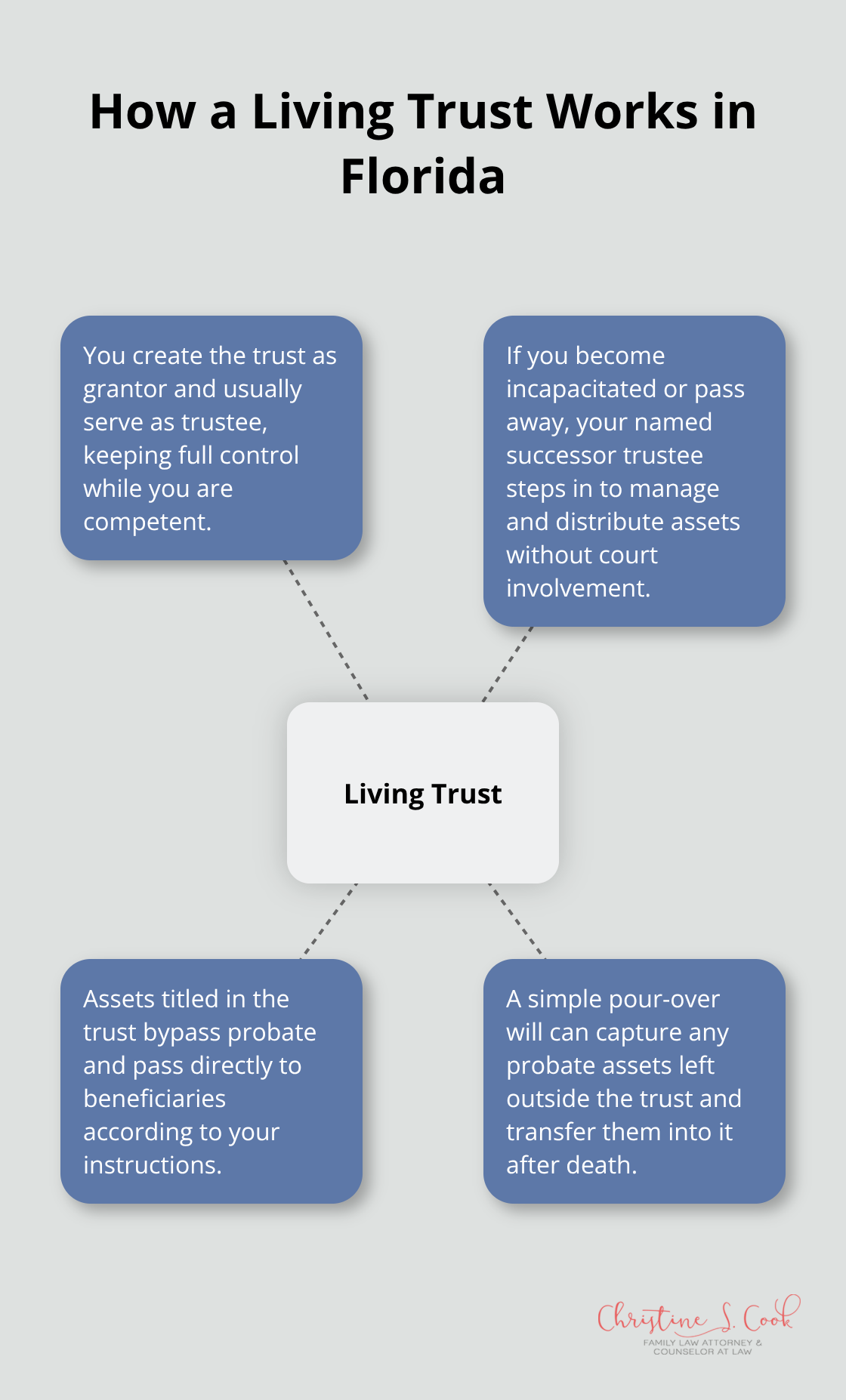
You maintain complete control during your lifetime, which means you can modify or revoke the trust whenever you want as long as you’re competent, giving you flexibility that a will simply doesn’t offer. Funding is everything, and this is where most people stumble. You must actually retitle your assets into the trust’s name during your lifetime, whether that’s your home, bank accounts, investment accounts, or other property. If you don’t fund the trust properly, those assets still go through probate, which defeats the entire purpose.
A living trust provides automatic incapacity planning that avoids court intervention. If you become mentally or physically unable to manage your affairs, your successor trustee takes over immediately without needing a guardianship hearing or court approval (which would cost thousands of dollars and take months in Florida probate court). Unlike a will, which only takes effect after death and requires a judge to validate it, a living trust is active the moment you sign it and continues working if you become incapacitated. This makes it the superior choice for families who want to avoid the lengthy probate process that can take significant time and cost money in executor compensation. Understanding these three features sets the stage for exploring the specific benefits that make living trusts so valuable for Florida families.
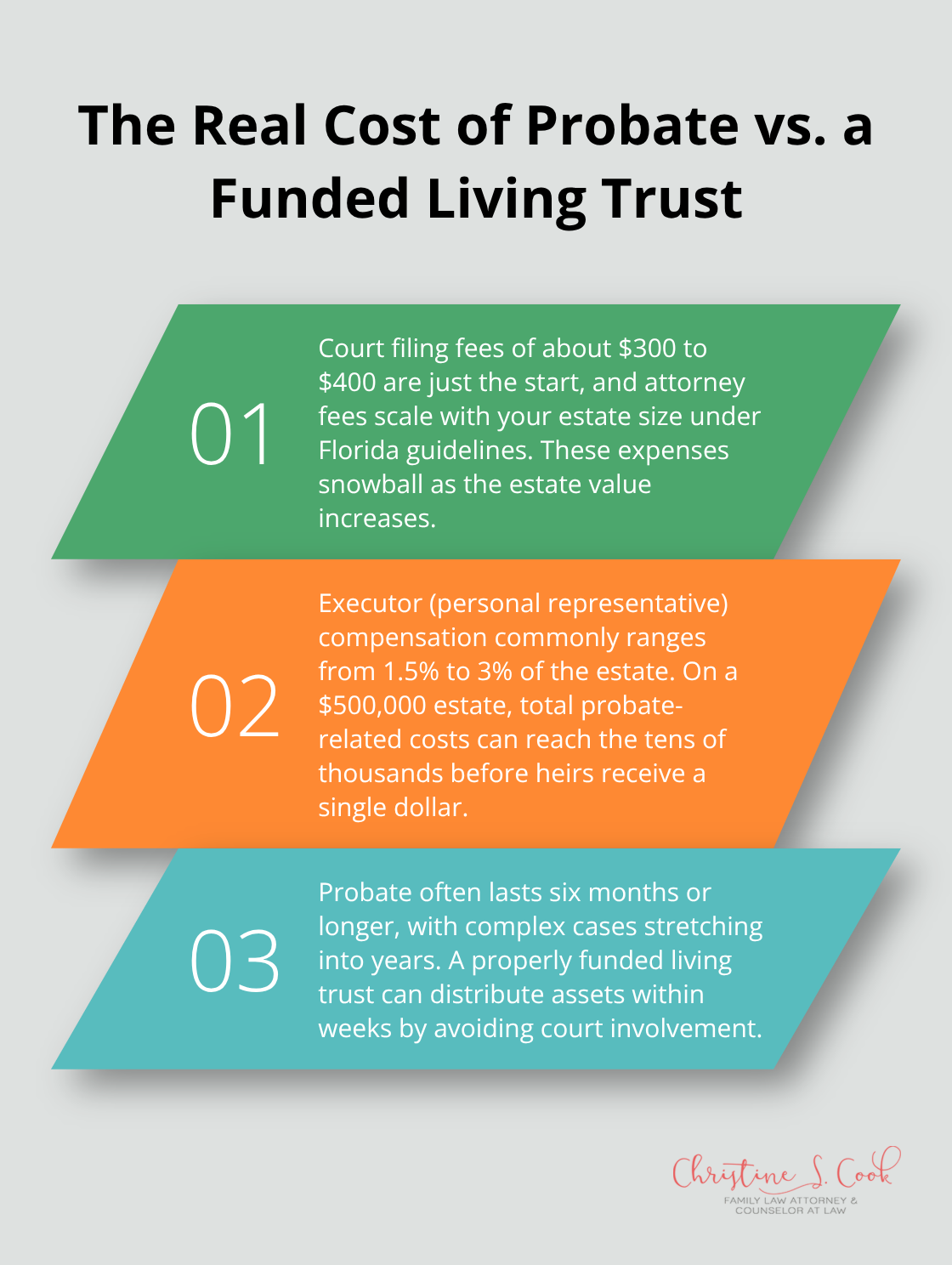
Probate in Florida costs real money, and the numbers add up fast. Court filing fees run about $300 to $400, but that’s just the beginning. Executor compensation typically ranges from 1.5% to 3% of your estate value according to Florida Statutes 733.617 and 733.6171(3), and attorney fees follow statutory guidelines that scale with your estate size. For a $500,000 estate, you face tens of thousands in combined costs before your beneficiaries receive a single dollar. A living trust funded during your lifetime moves those assets completely outside the probate system, eliminating court fees, executor compensation on trust assets, and lengthy delays. Probate in Florida typically lasts at least six months for straightforward cases, though complex situations routinely stretch to years. Your family waits while the court validates your will, creditors file claims, and administrators settle debts. With a living trust, your successor trustee distributes assets according to your instructions without court involvement, often within weeks.
Florida does offer summary administration for estates under $75,000 in non-exempt assets, which moves faster and costs less, but even that process involves court filing, creditor notice periods, and professional fees. A properly funded living trust bypasses all of that entirely.
Privacy matters significantly, and this is where a living trust delivers a genuine advantage that a will cannot match. Probate is a public court process, meaning your will, your asset list, your beneficiaries, and the amounts they receive become part of the public record. Anyone can walk into the courthouse and read those documents. A living trust keeps your financial information private because trust administration happens outside the court system. Your successor trustee distributes assets confidentially, and the trust document itself never becomes public unless a dispute forces it into court. For families concerned about privacy or managing beneficiary expectations after your death, this distinction matters significantly.
Living trusts provide genuine protection during incapacity that wills simply cannot offer. If you become incapacitated and assets remain in your individual name, your family faces a guardianship proceeding that costs thousands of dollars and takes months in Florida probate court. A living trust with a named successor trustee allows that person to step in immediately and manage your financial affairs without any court involvement whatsoever. Your bills get paid, your investments continue to be managed, and your family avoids the public guardianship process entirely. Additionally, if you hold assets in a living trust after death, beneficiaries may gain protection from some creditors, whereas assets passing through probate or held in your individual name lack that layer of protection. Florida creditors have up to two years from death to file claims, but trust assets held outside probate can provide better shelter for your beneficiaries’ inheritance.
For families with multiple properties, especially real estate in different states, a living trust simplifies administration dramatically. Out-of-state real estate normally requires separate probate proceedings in each state where property is located, multiplying costs and complexity. When real estate is titled in your living trust, your successor trustee can transfer it to beneficiaries without any additional probate proceedings, saving thousands in multi-state administration expenses. This efficiency becomes particularly valuable for families who own vacation homes, investment properties, or retirement residences across state lines. The ability to manage all real estate through a single trust document (rather than navigating multiple state probate systems) represents one of the most practical advantages a living trust offers. Understanding these financial and administrative benefits sets the stage for addressing the misconceptions that often prevent families from establishing a living trust in the first place.
Most people believe living trusts are only for the wealthy, but that misconception costs Florida families thousands in unnecessary probate expenses every year. A living trust makes sense for anyone with a home, retirement accounts, or assets they want to pass to loved ones without court involvement. You don’t need a seven-figure estate to benefit from probate avoidance. In fact, families with estates between $100,000 and $500,000 often see the greatest return on their investment because probate costs eat up a meaningful percentage of smaller estates. A $300,000 estate might lose $15,000 to $30,000 in probate fees, executor compensation, and court costs. A living trust costs significantly less to establish and eliminates those expenses entirely.
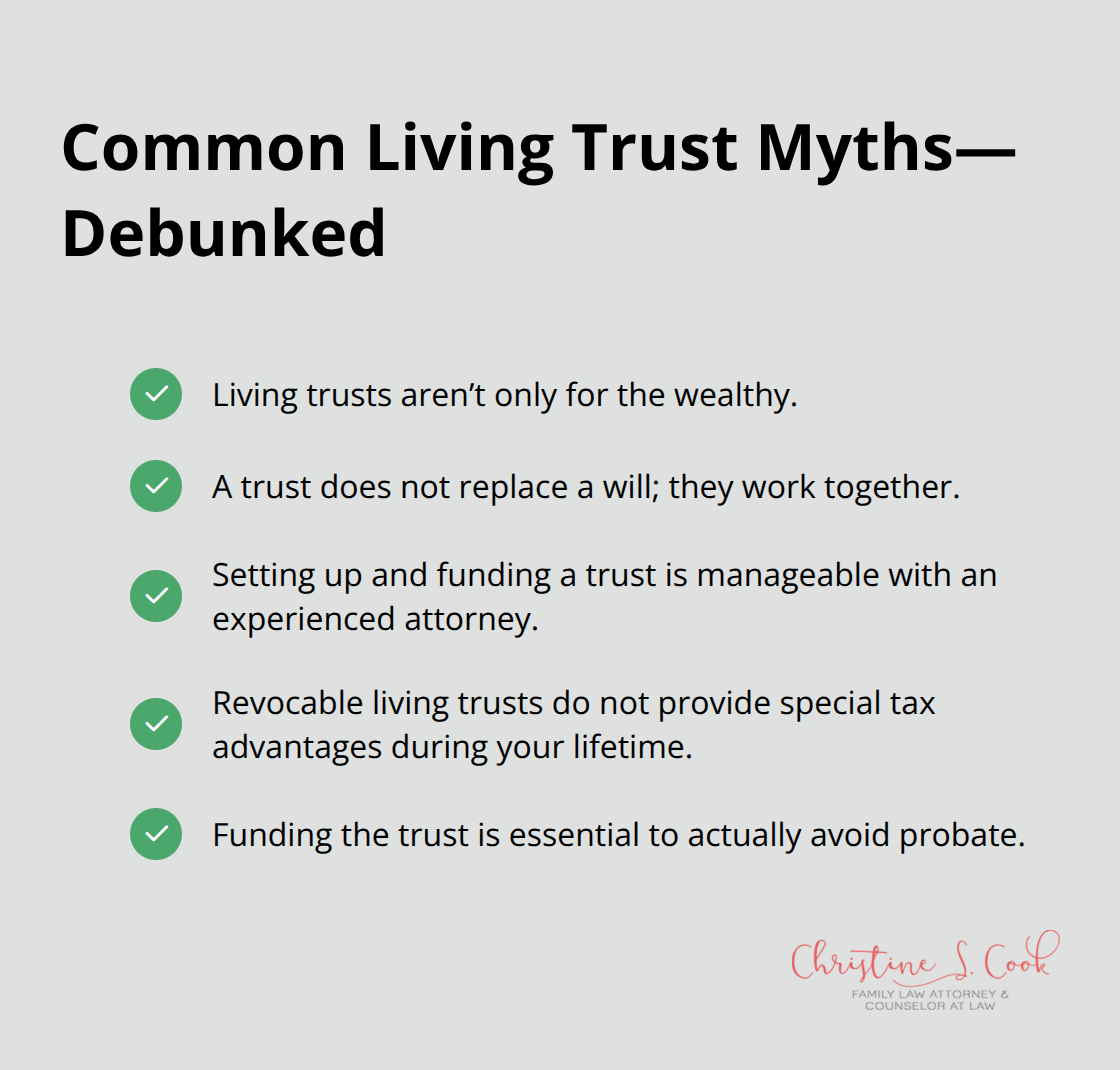
Another widespread myth is that a living trust replaces your will completely, but that’s not accurate. A living trust and a will serve different purposes and work together as complementary documents. Your living trust holds assets you fund into it during your lifetime, while a pour-over will catches any assets you forgot to retitle or acquire after creating the trust. Without that backup will, unfunded assets still go through probate. Additionally, a will is the only document that allows you to designate a guardian for minor children, which is a critical protection that a living trust cannot provide. Florida law requires a will to appoint guardians if your children are under 18, making it an essential part of your overall estate plan regardless of whether you have a trust.
The expense and complexity of establishing a living trust rank among the biggest reasons families delay estate planning, yet both concerns are overstated. A living trust does cost more upfront than a simple will, typically ranging from $1,000 to $3,000 depending on your asset complexity, but that investment pays for itself through probate avoidance within a few years for most families. The complexity argument also misses the mark. While funding the trust requires retitling assets into the trust’s name, that process is straightforward when you work with an experienced attorney who handles the paperwork. You don’t need to understand trust law to benefit from a living trust. Your attorney manages the technical details, and you maintain full control over your assets and decisions.
Many people assume living trusts offer special tax advantages that wills don’t provide, but revocable living trusts are treated identically to wills for federal income tax purposes during your lifetime. Your income is reported on your personal tax return, not the trust’s return. The real advantage isn’t tax savings but probate avoidance and incapacity planning. Estate tax planning strategies available through wills are equally available through trusts, so tax considerations shouldn’t drive your decision between them. What should drive your decision is whether you want to avoid probate, maintain privacy, and ensure seamless asset management if you become incapacitated. For most Florida families, a living trust delivers genuine practical benefits that justify the upfront investment.
A living trust Florida benefits approach addresses the real concerns families face: avoiding probate delays, protecting privacy, and ensuring someone manages your affairs if you become incapacitated. A properly funded living trust accomplishes what a will alone cannot, delivering substantial financial savings and genuine peace of mind. The control you maintain during your lifetime remains complete, and your successor trustee steps in seamlessly if needed.
Your specific circumstances determine whether a living trust makes sense for your family. Your family structure, asset size and nature, multi-state property ownership, and personal priorities around privacy all factor into this decision (some families benefit most from a trust as their primary tool, while others need a combination of trust and will to address guardianship for minor children). An experienced attorney helps you navigate these considerations and identify which approach actually serves your goals.
Christine Sue Cook, LLC offers free consultations to discuss your situation without financial pressure. We listen to your concerns, explain your options in plain language, and help you understand which strategy works best for your family’s future.