Divorce doesn’t have to mean a courtroom battle. Mediation for divorce offers a path where both spouses work together with a neutral third party to reach agreements outside of court.
At Christine Sue Cook, LLC, we’ve seen firsthand how this approach transforms difficult situations into manageable ones. The process is faster, more affordable, and gives you real control over the outcome.
A mediator isn’t a judge, and that distinction matters more than you’d think. The mediator acts as an independent deal broker who helps both spouses communicate and negotiate, but the mediator never decides outcomes for you. This is fundamentally different from litigation, where a judge imposes decisions.
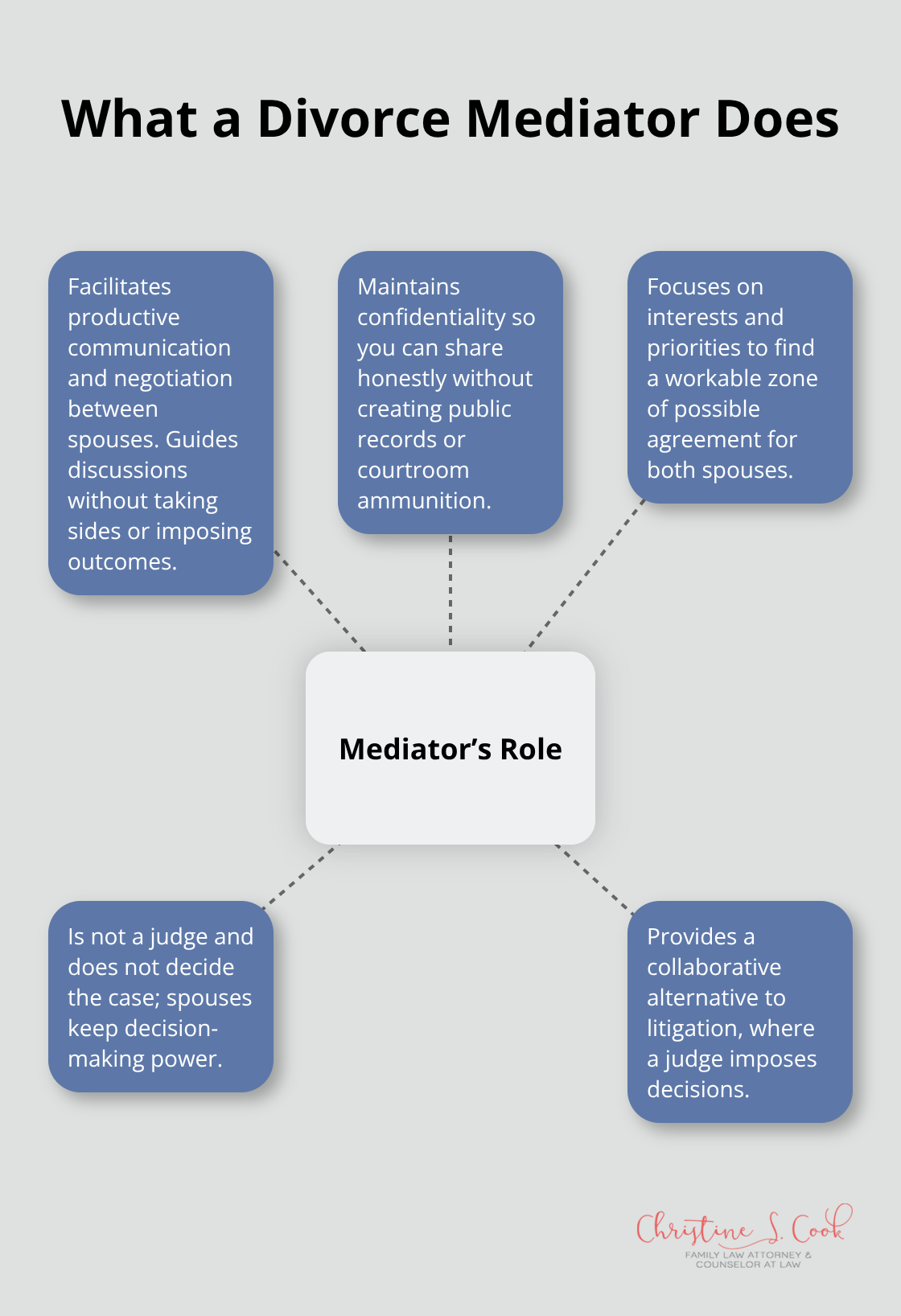
According to Harvard Law Today, identifying and understanding each party’s interests and priorities, then exploring the other side’s interests to reach a zone of possible agreement is the mediator’s core skill. The mediator maintains confidentiality, which means you can share honest information without it becoming public record or ammunition in court later.
Some mediators conduct joint sessions where both spouses sit together, while others employ shuttle diplomacy, moving between separate rooms to facilitate negotiations when direct dialogue becomes too heated or unproductive. The format depends entirely on your situation and relationship dynamics. This flexibility allows the mediator to adapt the process to what actually works for your family rather than forcing a one-size-fits-all approach.
The process itself follows five distinct stages. First comes the introduction, where the mediator explains how mediation works, discusses fees (typically split between spouses), and sets the agenda. Second, you gather information-your mediator will want pay stubs, bank statements, a complete asset and debt list, and your children’s school schedules if custody is involved.

This stage often takes multiple sessions, especially if you’re waiting for property appraisals or expert valuations. Third, you frame your needs and interests by outlining what matters most to you and why. Fourth comes the actual negotiation where you brainstorm options and evaluate solutions together. Fifth, once terms are agreed, the settlement agreement gets drafted and reviewed by both sides, sometimes with attorney input.
Mediation typically wraps up in about three to four months, while litigation commonly extends nine to eighteen months. The cost difference is stark: mediation runs roughly two to four thousand dollars per person, while attorney-led litigation typically costs ten to thirty thousand dollars per person due to hourly billing and discovery expenses. These numbers show why mediation appeals to couples who want to preserve both their finances and their sanity.
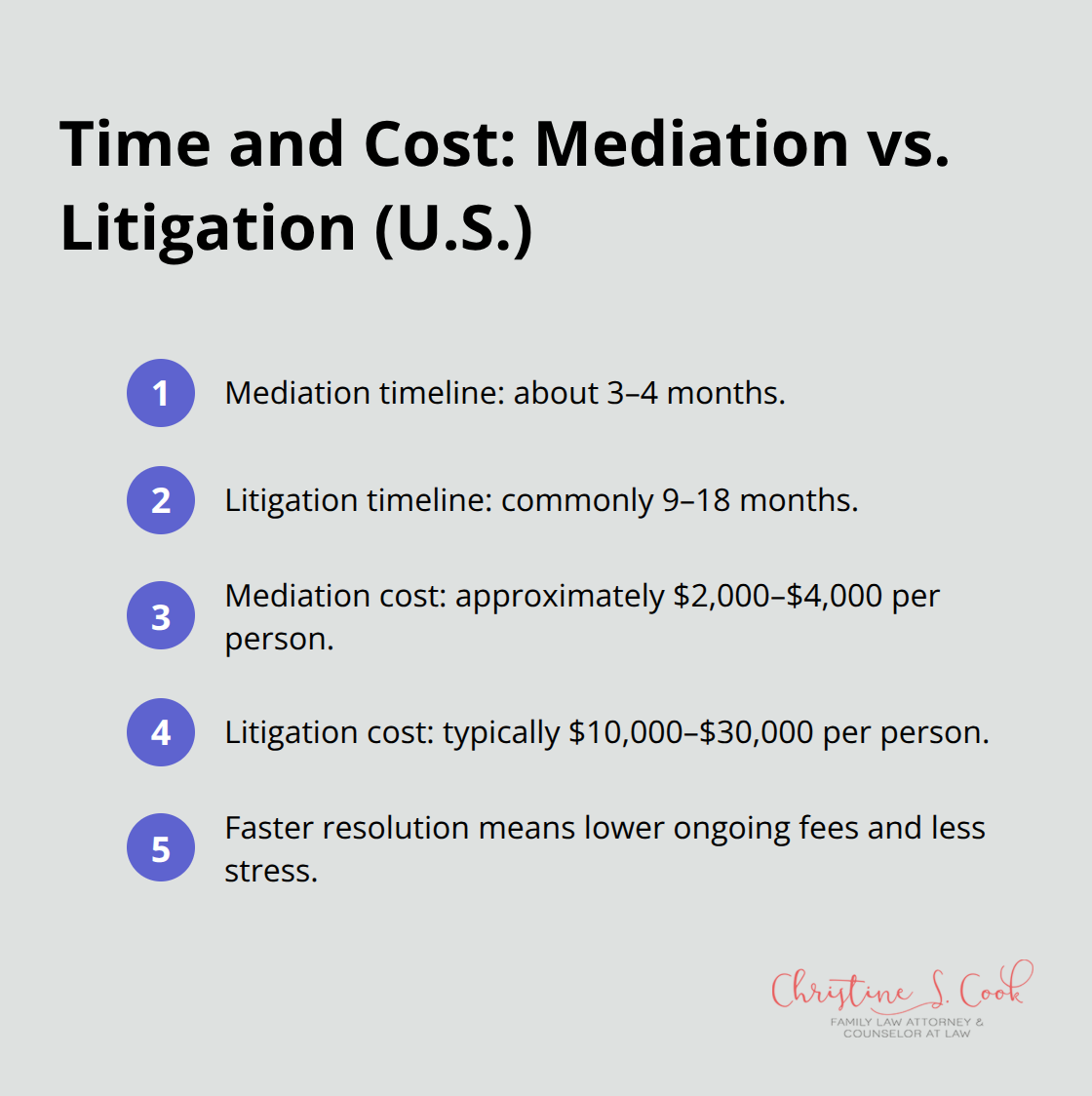
Mediation strips away the financial drain of litigation. When you go to court, you pay for depositions, expert witnesses, discovery disputes, and trial preparation-each billable hour compounds the damage to your bank account. Harvard Law Today reports that litigation typically costs ten to thirty thousand dollars per person, while mediation runs two to four thousand dollars per person. That’s a difference of up to twenty-six thousand dollars per spouse. The reason is structural: litigation operates on hourly billing, meaning your attorney’s meter runs during every email exchange, every motion filed, and every court appearance. Mediation uses flat fees split between both spouses, which eliminates the financial incentive to drag things out.
You control the pace and the number of sessions, not a court calendar or opposing counsel’s strategy. If your case involves straightforward asset division and clear parenting preferences, you could complete mediation in three to four sessions spread over two months. Litigation, by contrast, commonly stretches nine to eighteen months because courts prioritize criminal cases and move civil divorces slowly through the system. The speed advantage matters beyond just saving time. A faster resolution means you stop paying professional fees sooner and move forward with your life.
A faster resolution also means less time for conflict to intensify and more opportunity to preserve relationships that matter, especially if children are involved. You set the mediation schedule around your work and family commitments rather than waiting for court dates months away. Colorado’s ninety-one-day cooling-off period is often the actual bottleneck, not the mediation itself. Once you reach a settlement in mediation, you file your Separation Agreement and Parenting Plan with the court, and judges typically approve uncontested divorces quickly because there’s no dispute left to resolve.
You retain control over every outcome: the parenting schedule, asset splits, spousal support amounts, and how those arrangements phase in over time. A judge imposes solutions based on state guidelines and legal precedent, not your family’s actual needs. Mediation lets you craft arrangements that work for your situation-keeping the family home until children finish school, structuring a business buyout over time, or designing holiday rotations that fit your extended family’s reality. These customized solutions emerge from your priorities, not from a courtroom formula. The next section explores the specific issues that mediation resolves most effectively and how tailored agreements protect what matters most to your family.
Mediation handles the three issues that consume most divorce negotiations: custody arrangements, asset division, and support payments. These aren’t theoretical problems-they’re the concrete decisions that shape your post-divorce life. The strength of mediation lies in its ability to produce tailored solutions rather than forcing you into a judge’s standard template. When you work through these issues in mediation, you’re not constrained by what a court typically orders. Instead, you design arrangements that reflect your family’s actual circumstances.
Custody disputes often become the most contentious divorce issue, yet mediation excels at resolving them because mediators explore what both parents actually need. Custody arrangements and parenting plans in mediation help parents create customized solutions that serve the best interests of their children. This outcome reflects a fundamental truth: mediation produces parenting plans based on what works for your family, not what a judge believes is standard. You might arrange a schedule where your child spends weekdays with one parent and weekends with the other, or you might design a week-on-week-off rotation. Holiday arrangements matter too-many mediated agreements specify exactly which parent has Thanksgiving in odd years, Christmas Eve in even years, and summer vacation weeks split according to school calendars. A mediator helps you think through logistics that courts rarely consider: transportation between homes, work schedules, school start times, and whether your child thrives with frequent transitions or longer blocks with each parent. These details prevent future conflicts because the agreement anticipates real-world problems rather than imposing a generic schedule.
Asset division and creative settlement options in mediation help reduce conflict between spouses and promote a smoother transition. A judge follows statutory guidelines-typically dividing marital property roughly fifty-fifty in equitable distribution states-but a mediator helps you negotiate something different if both parties prefer it. You might keep the family home while your spouse receives other assets of equivalent value, or you might agree that one spouse purchases the other’s business interest over five years rather than forcing an immediate sale. Mediation allows phased settlements: your spouse might receive the investment accounts now while you retain the house until your youngest child graduates, then the house sells and proceeds split. These creative arrangements emerge from understanding what each spouse actually values. Some people prioritize keeping a home; others care more about liquidity or minimizing tax consequences. A mediator helps articulate these priorities and finds solutions that satisfy both parties better than a court order could. Property appraisals and valuations still matter-you need accurate figures for your home, business, retirement accounts, and vehicles-but the mediator ensures both sides have access to the same information rather than fighting over valuations in depositions and expert testimony.
Spousal support and child support calculations in mediation start with state guidelines but don’t stop there. Most states publish child support formulas based on both parents’ incomes and custody arrangements, yet mediation allows flexibility within and sometimes beyond those guidelines. If one spouse has significantly higher earning potential but chooses lower-income work, mediation lets you address that reality directly rather than litigating the issue. You might agree to support amounts that reflect current income while building in adjustment mechanisms if circumstances change. These agreements work because both parties helped design them. A mediator explains what courts typically order in your state, then helps you negotiate something you both accept. This transparency prevents the resentment that often follows court-imposed support orders. If income is irregular-from self-employment, bonuses, or seasonal work-mediation allows you to structure support around actual earning patterns rather than forcing predictions into a standard formula. You can also address what happens if either spouse’s income changes significantly: does support adjust automatically, or do you require renegotiation? These provisions prevent future disputes and make the agreement genuinely workable over time.
Mediation for divorce puts you in control of decisions that shape your life for years to come. You avoid the financial drain of litigation (which costs ten to thirty thousand dollars per person) and instead invest two to four thousand dollars per person in a process that produces faster resolutions and outcomes tailored to your family’s actual needs. Your parenting plans reflect what your children actually need, your asset division respects what matters most to each spouse, and your support agreements account for real income patterns rather than rigid calculations.
That said, mediation isn’t appropriate in every situation. If domestic violence, coercive control, or undisclosed assets exist, mediation creates unsafe conditions for honest negotiation. These cases require litigation or lawyer-assisted mediation with proper safeguards, and one spouse’s refusal to negotiate in good faith makes the power imbalance too severe for mediation to work effectively.
For couples willing to work toward resolution, mediation offers a path forward that preserves dignity, protects finances, and maintains relationships that matter. If you’re considering this approach, start by discussing it with your spouse and consulting with a qualified family law attorney who can assess your specific circumstances. Contact us for a free consultation to explore whether mediation fits your situation and how we can support your path forward.