Family law disputes don’t have to destroy relationships. At Christine Sue Cook, LLC, we’ve seen countless families protect their bonds through amicable settlement strategies that keep control in their hands.
When you choose negotiation over court battles, you reduce costs, emotional strain, and uncertainty. This guide shows you how.
Ninety-eight percent of divorce cases settle before trial, yet most people still approach family law disputes as if courtroom battles are inevitable. This assumption costs families tens of thousands of dollars and years of emotional damage. When you settle amicably, you control the outcome instead of handing that power to a judge who knows nothing about your family’s unique circumstances. Courts make binary decisions based on legal standards; you make decisions based on what actually works for your children, your finances, and your future. Settlement timelines typically resolve within months, while trials often extend beyond a year due to court scheduling backlogs. This speed matters because every month in limbo costs money in legal fees and keeps your family in conflict.
Mediation and collaborative approaches cost significantly less than litigation because you avoid discovery battles, depositions, and trial preparation. A contested trial requires your attorney to spend hundreds of hours building a case, whereas settlement negotiations happen in focused sessions where both sides work toward agreement rather than victory. Trials drain your retirement accounts, home equity, and investment portfolios through direct costs and the opportunity cost of delayed financial decisions. You also avoid the hidden expenses of prolonged conflict: therapy for children, medical costs from stress-related illness, and lost productivity at work. Settlement lets you preserve assets for your children’s education, your retirement, and your post-divorce stability instead of feeding them to the legal system.
Children benefit measurably when parents cooperate during separation. Amicable processes let you create a joint parenting plan that prioritizes your kids’ wellbeing rather than fighting over custody as a power play. This approach doesn’t require you to remain friends with your ex, but it does mean your children aren’t caught between parents locked in ongoing conflict. You’ll interact with your ex for years through school events, medical decisions, and parenting logistics. Choosing collaboration now prevents the constant tension that damages children’s emotional development and your own mental health. Settlement also protects your ability to adjust arrangements later-when life changes, cooperative parents can modify agreements informally, while litigated orders require expensive court modifications.
Once you reach an amicable agreement, the real work of protecting your relationships begins. The settlement terms you negotiate today shape how smoothly your family transitions forward and whether future disputes stay manageable or escalate into new conflicts. This is where professional guidance becomes essential to translate your agreement into a legally sound document that both parties can actually live with long-term.
Successful negotiation in family law requires three distinct skills that most people never learn: listening to understand rather than to respond, identifying what both parties actually need rather than what they claim they want, and making concessions strategically so they create movement toward agreement instead of signaling weakness. The first mistake people make is treating negotiation as a debate where winning means proving the other party wrong. This approach backfires immediately because the other party becomes defensive, stops sharing information, and digs into extreme positions.
When you shift from adversarial framing to collaborative problem-solving, you uncover options neither side initially considered. This means asking clarifying questions before countering, acknowledging legitimate concerns the other party raises, and actively listening for what sits beneath their stated demands. If your ex demands majority custody, don’t immediately argue why that’s unfair. Instead, ask what specific concerns drive that request. Often the real issue isn’t control but anxiety about missing important moments or financial strain from reduced parenting time. Once you identify the actual concern, you can address it directly through creative solutions like flexible scheduling, shared decision-making on major issues, or adjusted support calculations that neither party would find through positional bargaining.
Finding common ground starts with listing shared interests that exist independent of your conflict. You both want your children to thrive, both need financial stability post-divorce, and both benefit from resolving this quickly rather than litigating for years. These aren’t abstract values; they’re concrete motivations that make agreement possible. When negotiations stall, explicitly reference these shared goals to reframe the conversation away from winning and toward solving.
The most powerful negotiation tactic involves making concessions strategically by labeling them, demanding reciprocal movement, and breaking large concessions into installments. When you offer something, name it explicitly: “I’m willing to accept your proposed custody schedule if you adjust the support calculation to reflect my reduced parenting time.” This prevents your concession from being overlooked or treated as your opening position rather than movement toward agreement.
Don’t concede everything at once because people perceive gains in installments as more valuable than lump sums. Offer one concession, pause, let the other party respond, then offer another. This approach maintains momentum, tests whether the other side reciprocates, and prevents you from bidding against yourself. If the other party makes demands without offering anything in return, stop moving. State clearly: “I’m willing to make concessions when they’re reciprocal, but I won’t continue adjusting my position if you’re not adjusting yours.” This isn’t harsh; it’s honest about how negotiation works. People respect boundaries more than they respect endless flexibility.
Negotiation rarely flows smoothly. The other party may anchor with extreme demands, claim limited authority to move, issue take-it-or-leave-it ultimatums, or use personal attacks to provoke emotional reactions. When hardball tactics surface, name them directly and refuse to engage. If your ex claims they can’t budge on a position, involve their attorney or financial advisor to verify real authority. If they issue ultimatums, counter with proposals that address both sides’ interests rather than accepting false deadlines. When they insult you or your position, set boundaries and take a break if needed to restore composure. These tactics test your tolerance; staying grounded in your own credible assessment of options prevents them from derailing progress toward agreement.
Collaborative divorce operates on a fundamentally different premise than litigation: both parties commit upfront to reaching settlement without court involvement, and if negotiations fail, both attorneys must withdraw. This structural incentive aligns everyone’s interests toward agreement rather than prolonging conflict. In a collaborative process, your attorney, the other party’s attorney, and neutral professionals like financial advisors or child specialists work together in structured sessions to identify interests, share information transparently, and build solutions that address both sides’ concerns.
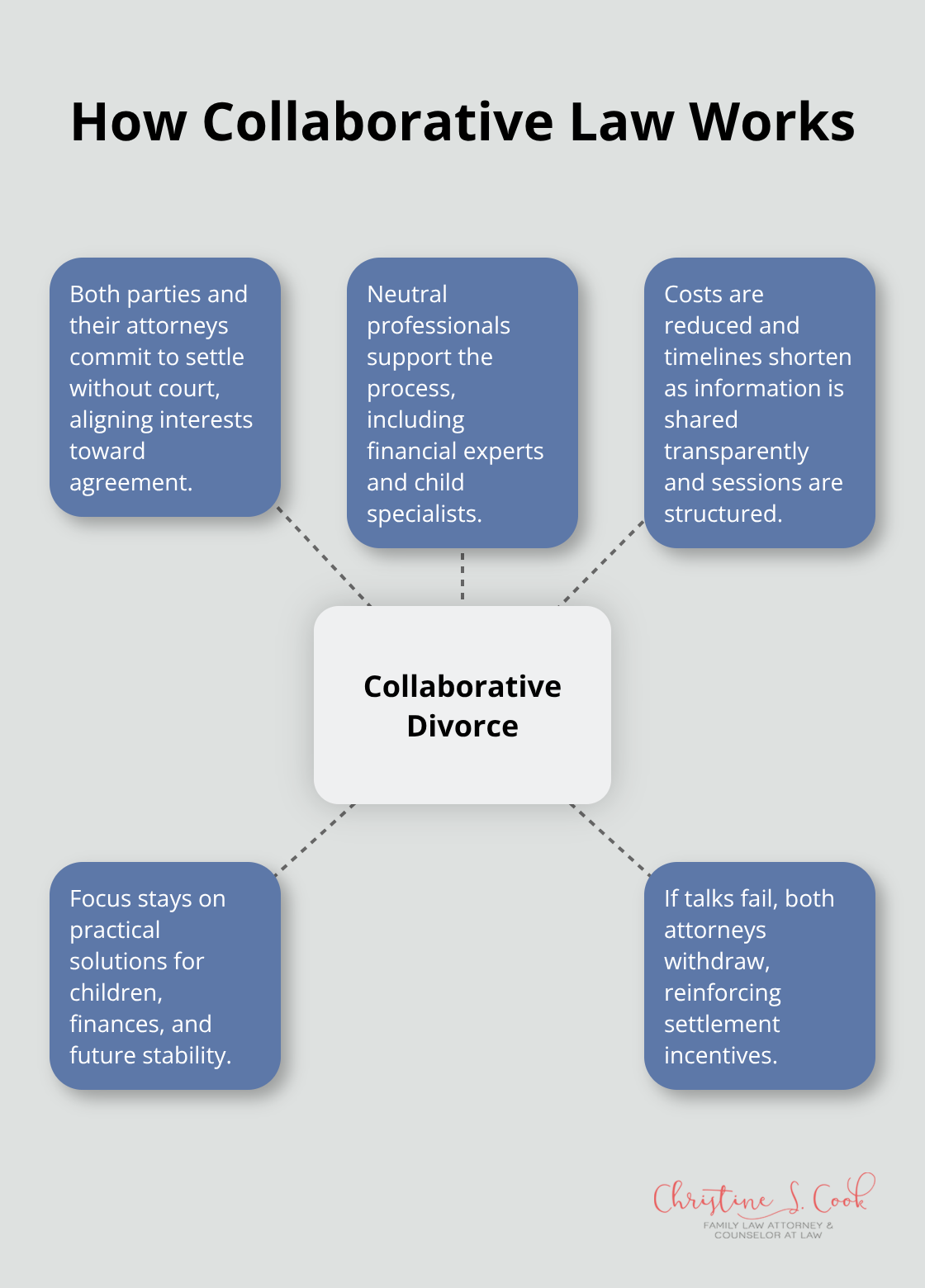
The difference matters financially. Collaborative cases typically cost 40–60% less than litigation because discovery happens cooperatively rather than through expensive formal requests, and settlement arrives in months rather than years of court delays. You avoid the adversarial positioning that turns negotiations into a battle where each party hides information, exaggerates positions, and prepares for trial even when settlement is likely. Instead, you work with professionals trained to find creative solutions that satisfy both parties’ actual needs rather than their opening demands. This approach works especially well when children are involved because it models cooperative problem-solving and keeps parenting arrangements focused on what serves your kids rather than what punishes your ex.
The neutral professionals in collaborative divorce serve specific roles that protect both parties and accelerate agreement. A collaborative financial neutral helps each side understand the full picture of assets, debts, income, and tax implications so neither party can claim surprise or unfairness later. A child specialist meets with parents and children to understand how custody and parenting time arrangements affect your kids’ stability and emotional wellbeing, then recommends schedules that reflect those realities rather than abstract legal standards. These professionals work for the process itself, which means their recommendations carry weight with both parties because they’re seen as neutral rather than biased.
Once you reach agreement through collaborative law, the resulting documents reflect solutions you actually created together rather than orders imposed by a judge. This matters for long-term compliance because people honor agreements they helped shape far more consistently than they honor court orders they fought against. Transparent information-sharing combined with professional guidance keeps negotiations moving toward outcomes both parties can accept. Collaborative law techniques help families achieve sustainable settlements that protect relationships while resolving disputes efficiently.
Amicable settlement strategies work because they align everyone’s interests toward resolution rather than conflict. Ninety-eight percent of divorce cases settle before trial, settlements cost significantly less than litigation, and families who negotiate cooperatively preserve relationships that matter for decades. The financial savings alone justify choosing negotiation over court battles, but the real benefit is control-you shape the outcome instead of accepting whatever a judge decides based on legal standards that don’t account for your family’s unique circumstances.
The tactics covered here (active listening, identifying shared interests, making strategic concessions, and recognizing hardball tactics) work because they’re grounded in how people actually behave during high-stakes negotiations. Labeling your concessions prevents them from being overlooked, breaking large concessions into installments makes them feel more valuable to the other party, and demanding reciprocity keeps negotiations balanced instead of letting you bid against yourself. These aren’t theoretical concepts; they’re practical tools that shift conversations from adversarial positioning toward collaborative problem-solving.
We at Christine Sue Cook, LLC specialize in collaborative law techniques to achieve amicable settlements strategies while maintaining aggressive representation when necessary. Your settlement today determines your family’s stability for years to come, which is why we focus on solutions both parties can actually live with long-term. Contact us to secure your future and your children’s wellbeing without the emotional and financial devastation of prolonged conflict.