What happens if you become unable to manage your finances or healthcare decisions tomorrow? Without a power of attorney in Florida, your family could face months of legal battles and court involvement.
At Christine Sue Cook, LLC, we help clients protect themselves by establishing powers of attorney before incapacity strikes. This document gives you control over who makes decisions on your behalf and prevents costly guardianship proceedings.
A power of attorney is a legal document that authorizes someone you trust to act on your behalf in financial, legal, or healthcare matters. In Florida, you must sign this document, have two witnesses present, and obtain a notary’s seal for it to be valid. The person you appoint-called your agent or attorney-in-fact-can then handle banking transactions, sell real estate, manage investments, access medical records, and make healthcare decisions based on the powers you grant them. Your agent’s authority extends only as far as what you explicitly allow in the document, which means you maintain complete control over their actions. Without a power of attorney in place, your family cannot legally act on your behalf if you become incapacitated, forcing them into a costly guardianship process through the Florida courts.
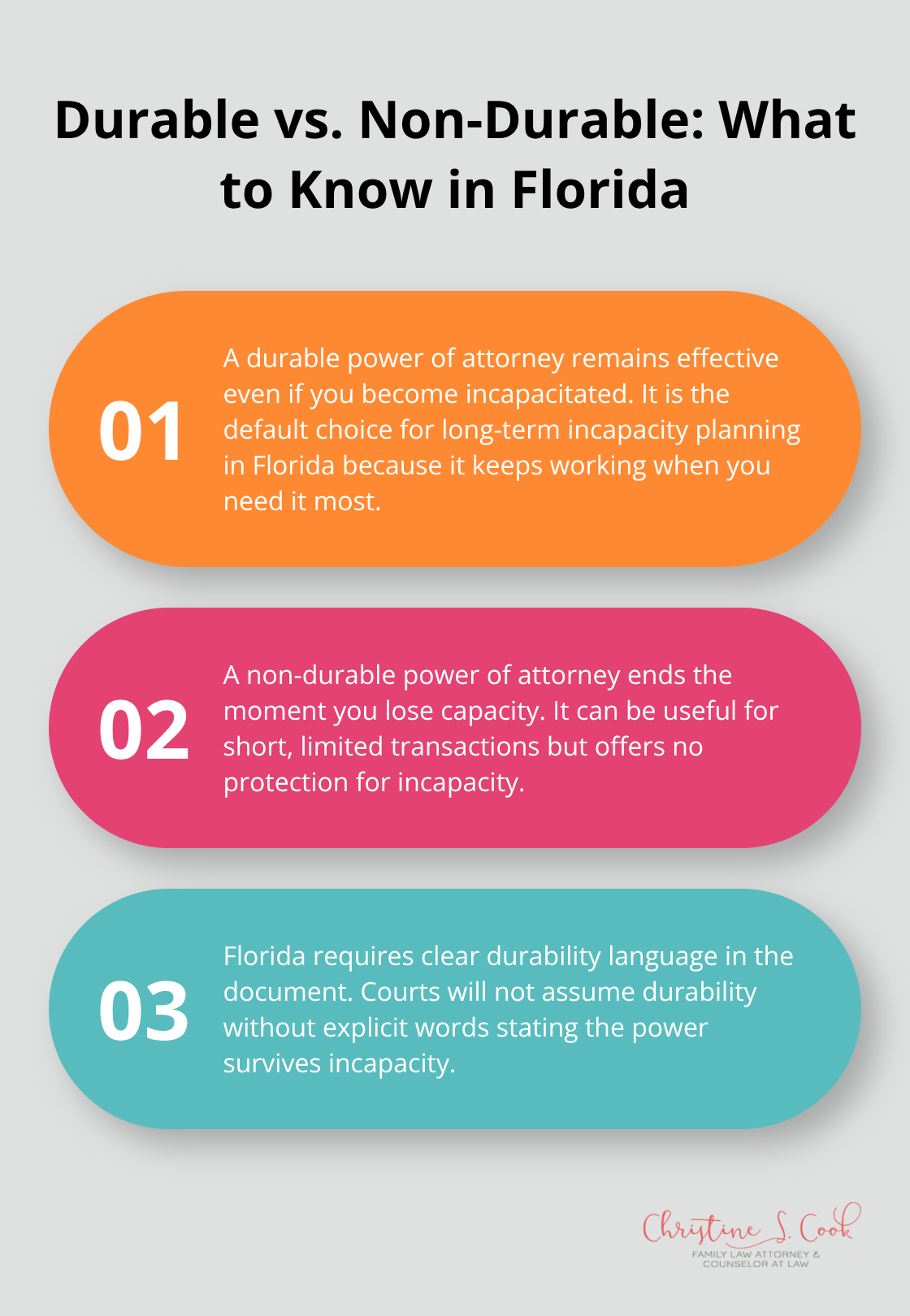
The distinction between durable and non-durable powers of attorney matters significantly and often goes misunderstood. A durable power of attorney remains in effect even if you become mentally or physically incapacitated, which is why it serves as the standard choice for incapacity planning in Florida. A non-durable power of attorney terminates the moment you lose capacity, making it useless for long-term protection. Most people who establish a power of attorney today select the durable version specifically because it continues working when you need it most. The durability clause must appear explicitly in the document; Florida courts will not assume durability without clear language stating that the power survives your incapacity.
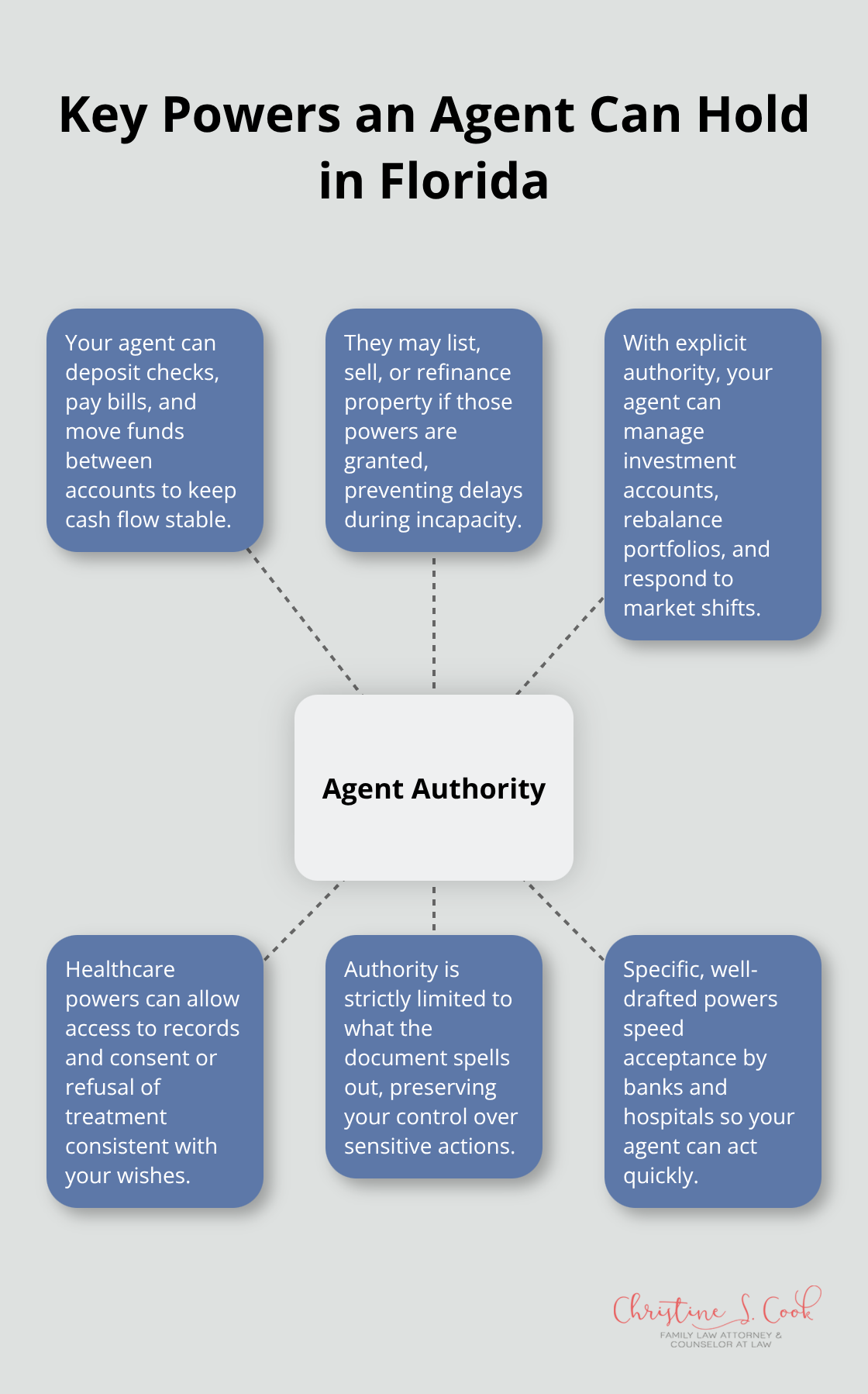
Florida law allows you to grant your agent authority to conduct banking transactions under Florida Statutes 709.2208. You can also authorize your agent to conduct real estate transactions, create or modify trusts, make gifts, and access your safe deposit boxes. Healthcare powers are equally important and allow your agent to consent to medical treatment, refuse life-prolonging measures, and communicate directly with doctors and hospital staff on your behalf. The key is being specific about which powers matter for your situation rather than granting blanket authority. For example, if you only need someone to manage one investment account, you can limit their power to that specific account rather than authorizing them to access all your finances.
Broad powers create unnecessary risk and can lead to disputes among family members about what your agent can actually do. When you clearly define which powers your agent holds (and which ones they don’t), you prevent misunderstandings and potential conflicts later. Your agent should sign documents as “agent for” you to avoid personal liability, and third parties may request an affidavit or opinion of counsel before accepting the document. The more specific your power of attorney, the faster third parties accept it and the sooner your agent can act on your behalf.
You don’t have to appoint the same person for financial decisions and healthcare decisions; separating these roles often works better. Your financial agent should be detail-oriented and capable with finances and government processes, while your healthcare surrogate should remain calm under pressure and understand your medical values and wishes. This separation allows you to match each person’s strengths to the specific role they’ll play. When you establish both a durable power of attorney for finances and a healthcare surrogate designation, you create a comprehensive incapacity plan that covers all critical decisions.
Without a power of attorney, your family faces a legal nightmare if you become incapacitated. Florida’s guardianship process, often called a living probate, involves filing fees that typically range from $250 to $400, with additional legal costs that can accumulate significantly when family disputes arise. The process typically takes three to six months minimum, during which no one can legally manage your finances, pay your bills, or make medical decisions on your behalf. Your bank accounts freeze. Your mortgage payments stop. Medical decisions fall into limbo while your family petitions the court for authority they could have simply granted you beforehand.

A lifetime risk of dementia of 42% after age 55 means many Floridians face incapacity planning needs, yet most wait until crisis strikes before addressing them. A durable power of attorney eliminates this chaos entirely. Once signed and notarized, it gives your chosen agent immediate authority to act on your behalf without court involvement, without delays, and without the emotional drain of public court proceedings.
The financial impact of guardianship extends far beyond legal fees. Your agent cannot access your investment accounts to rebalance your portfolio, meaning your retirement savings may decline during market downturns while your case winds through the court system. Your real estate cannot be sold or refinanced without a judge’s approval, even if you need to access equity for medical care. Your business cannot operate effectively if you’re the owner and become incapacitated. Meanwhile, your family members must take unpaid time off work to attend court hearings, consult with lawyers, and manage your affairs under court supervision indefinitely. A properly drafted power of attorney costs between $300 and $800 from an experienced attorney and takes a few hours to complete. The return on that investment is substantial when you consider avoiding months of court proceedings, thousands in legal fees, and the stress of your family fighting in front of a judge over who controls your assets.
Guardianship proceedings are public record in Florida. Your financial situation, medical conditions, family conflicts, and personal decisions all become part of the court file accessible to anyone. Your agent operates under court supervision, requiring annual accountings and court approval for major decisions like selling property or making gifts. A power of attorney keeps your affairs completely private. Your agent acts without court involvement or public disclosure, making decisions quickly and confidentially based on your explicit instructions. You retain control by specifying exactly which powers your agent holds and can revoke the document anytime you wish while you have capacity. This autonomy matters especially for business owners, real estate investors, and anyone with complex finances who cannot afford delays in decision-making.
The choice between planning now and facing guardianship later is straightforward. A power of attorney gives you control over your future while you still have the capacity to make these decisions. The next step involves selecting the right type of power of attorney for your situation and identifying the person (or people) you trust to act on your behalf.
The right power of attorney type depends entirely on your financial situation and what decisions you actually need someone to handle. A durable power of attorney for finances works best if you own real estate, manage investments, or operate a business because it gives your agent broad authority to handle these complex assets without court delays. A healthcare power of attorney becomes essential if you want someone to make medical decisions and access your medical records when you cannot communicate. Many Floridians need both documents working together, not one or the other.
The mistake most people make is selecting a generic online template that grants vague powers or fails to include the specific authority your situation requires. If you own investment accounts, your agent needs explicit authority to conduct investment transactions to manage those accounts effectively. If you own real estate, the document must specifically authorize real estate transactions. A healthcare power of attorney must clearly state your agent can refuse life-prolonging treatment and communicate with hospital staff on your behalf. Without these specifics, third parties like banks and hospitals will reject the document or delay accepting it, defeating the entire purpose of having a power of attorney.
Your financial agent should be detail-oriented, capable with numbers and government processes, and someone you trust completely with your bank accounts and assets. Your healthcare surrogate should remain calm under medical pressure and genuinely understand your values about end-of-life care and medical treatment. These rarely need to be the same person.
Many families appoint their oldest child as both financial and healthcare agent simply because of birth order, when a younger child might have superior financial skills or medical knowledge. You should also name successor agents in case your primary choice cannot serve when needed. Life changes unexpectedly: your chosen agent might move out of state, become incapacitated themselves, or pass away before you do. Including two or three successor agents in your document prevents your family from facing an invalid power of attorney when they need it most.
Working with an experienced attorney is non-negotiable if you want a document that actually functions when your family needs it. Florida law requires specific language, proper witnessing, and notarization for validity, but more importantly, your attorney should verify the powers granted match your actual situation and include authorization for sophisticated planning strategies like Medicaid-compliant asset management if that applies to you. An attorney familiar with Florida’s requirements ensures your document will be accepted by banks, hospitals, and government agencies without delays or disputes.
A power of attorney in Florida stands as your most effective tool for preventing chaos if incapacity strikes. Without one, your family faces months of court involvement, thousands in legal fees, and the emotional burden of guardianship proceedings while your finances sit frozen and your medical decisions hang in limbo. With one in place, your chosen agent can immediately manage your bank accounts, handle real estate transactions, make healthcare decisions, and protect your assets-all without court supervision or public disclosure of your personal affairs.
The statistics demand attention: a 42% lifetime risk of dementia after age 55 means many Floridians will face incapacity at some point, yet most people wait until crisis strikes before addressing their incapacity planning needs. You cannot sign a power of attorney after you lose capacity, and your family cannot create one for you without going through the guardianship process you were trying to avoid. Planning now costs between $300 and $800 from an experienced attorney and takes a few hours to complete.
Contact Christine Sue Cook, LLC to discuss your incapacity planning needs and secure your financial and healthcare decisions today. We at Christine Sue Cook, LLC offer free consultations to review your situation without financial pressure and specialize in tailoring powers of attorney that actually work when your family needs them. Don’t wait for incapacity to force your hand.