Divorce in Florida forces you to make one critical decision: contested or uncontested. This choice shapes everything from your timeline to your wallet.
At Christine Sue Cook, LLC, we help clients understand how contested vs uncontested divorce in Florida works so you can pick the path that fits your situation.
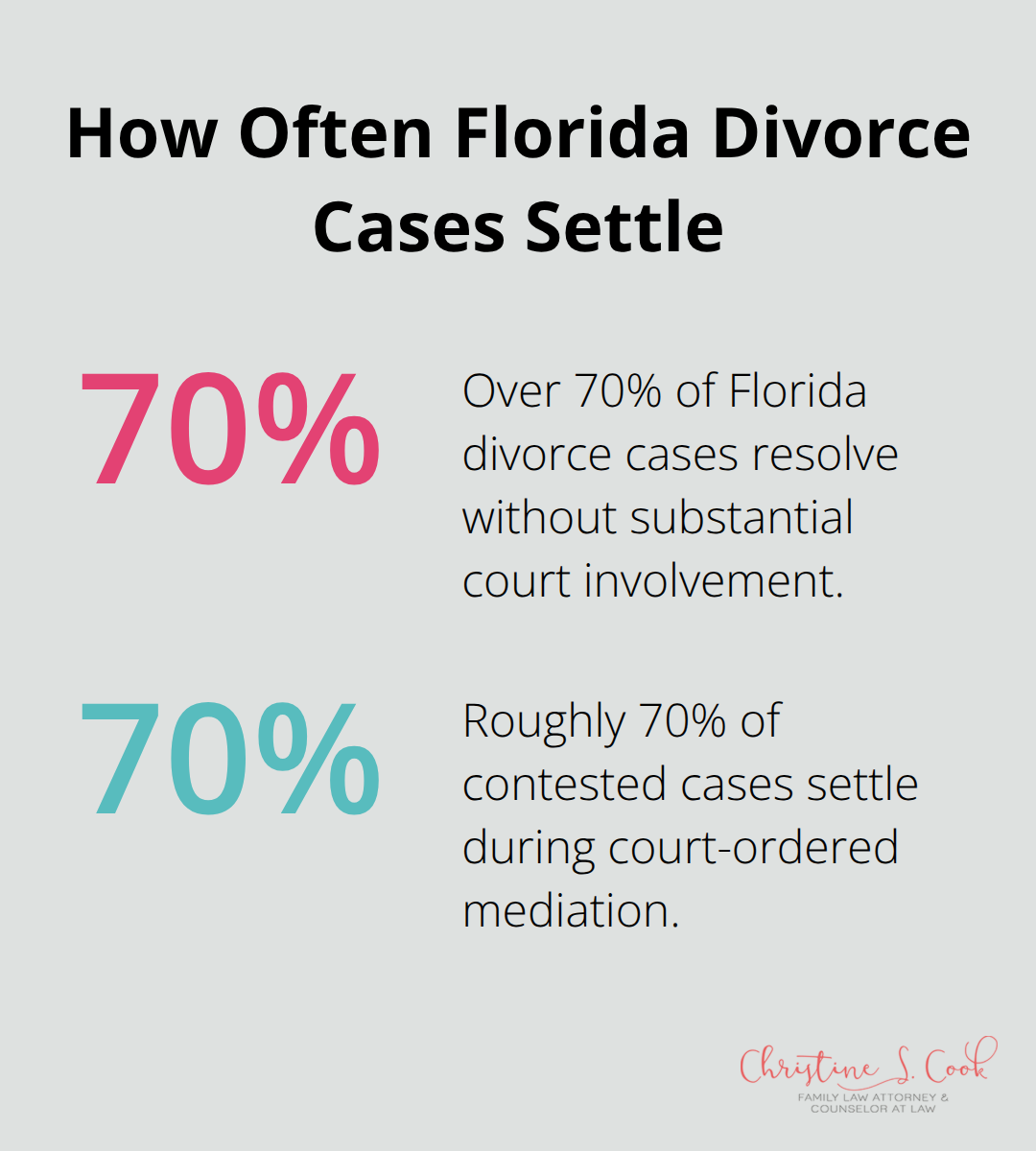
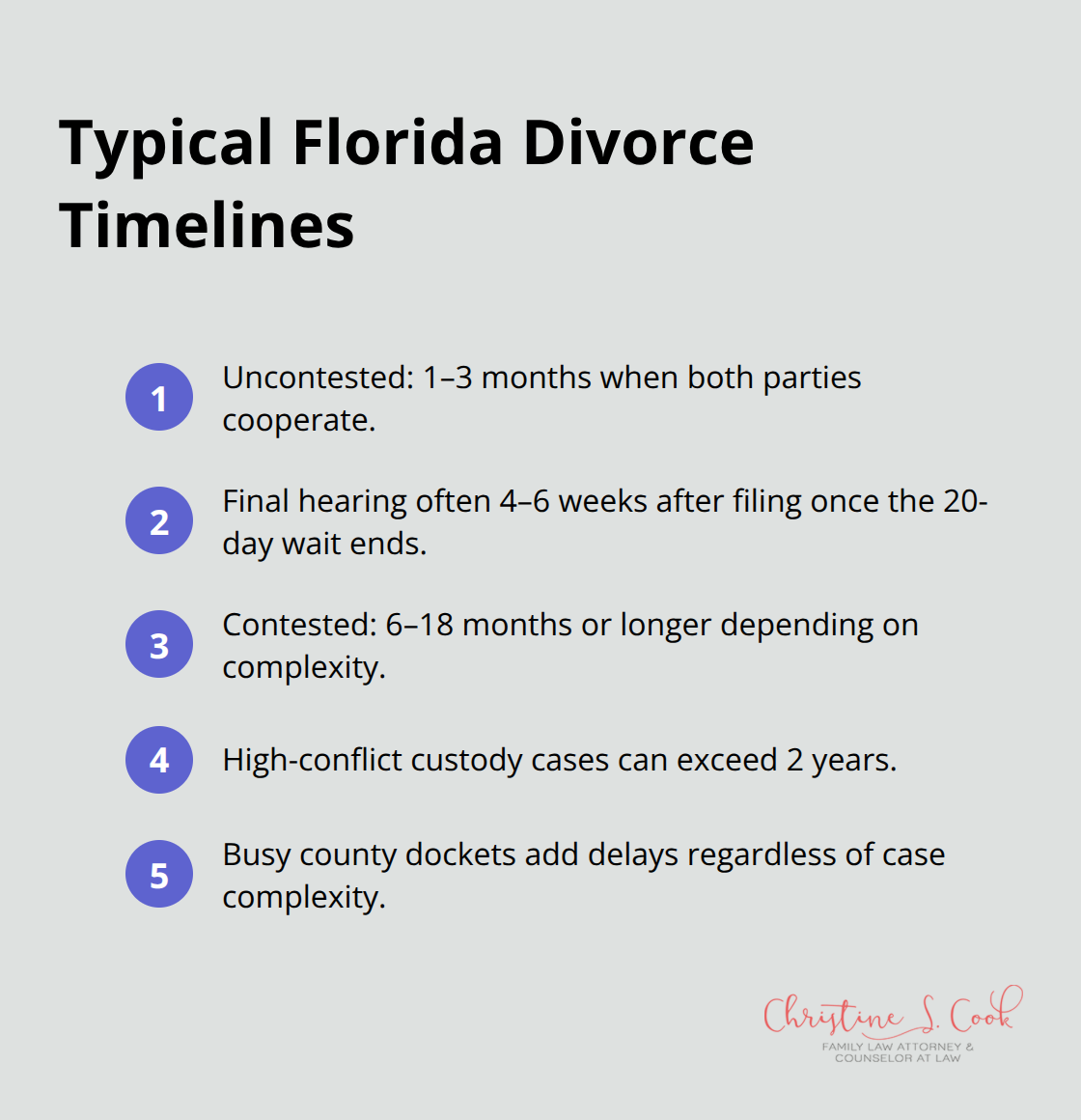
An uncontested divorce means both spouses agree on every major issue before filing: how assets and debts split, who gets primary custody, child support amounts, and alimony terms. You and your spouse negotiate a Marital Settlement Agreement outside court, then submit it for a judge’s approval. The process moves straight to a final hearing, typically four to six weeks after filing once Florida’s mandatory 20-day waiting period passes. A contested divorce is the opposite-at least one spouse disagrees on a material issue, triggering discovery (exchanging financial documents), temporary hearings, mediation, and potentially a trial. Even when labeled contested, most cases settle during mediation; according to Florida Courts data, over 70 percent of divorce cases resolve without substantial court involvement. The real difference is control: uncontested divorces let you shape the outcome, while contested divorces hand that power to a judge who applies Florida’s equitable distribution rules.
Uncontested divorces close in one to three months total, assuming both parties cooperate and financial disclosures are straightforward. Contested divorces stretch six to eighteen months or longer, with high-conflict cases sometimes exceeding two years. The court docket matters too-busy counties add delays regardless of case complexity.
If custody disputes exist or assets are tangled (business interests, multiple properties, retirement accounts requiring a QDRO), you should expect the longer timeline.
Uncontested divorces typically run $1,500 to $5,000 because your attorney handles paperwork, negotiation, and one hearing. Contested divorces commonly cost $10,000 to $50,000 or more once you factor in discovery, expert witnesses, multiple hearings, and trial preparation. Each deposition, interrogatory, and motion practice hearing adds attorney hours and fees. A single trial can push costs beyond $100,000 for complex asset cases.
Florida frequently requires mediation before a contested case proceeds to trial, and this step often converts a contested path into settlement. When both spouses sit with a neutral mediator, they often find middle ground on custody schedules, asset splits, or support amounts they wouldn’t have reached alone. This is why even contested cases often settle partway through-the reality of litigation costs and unpredictability pushes parties toward compromise. Understanding which path fits your situation requires honest assessment of your spouse’s willingness to cooperate and the complexity of your financial and family circumstances.
An uncontested divorce delivers what most people want: speed and affordability. The numbers speak clearly. You’ll spend $1,500 to $5,000 total, compared to $10,000 to $50,000 or higher for contested cases. That’s a difference of roughly $8,500 to $95,000 depending on complexity. Your attorney handles the Marital Settlement Agreement, coordinates financial disclosures with your spouse’s lawyer, and appears at a single final hearing. No depositions. No expert witnesses. No discovery disputes that drag on for months. The timeline compresses to four to six weeks after Florida’s waiting period ends, meaning you move forward with your life faster while your bank account stays healthier. This matters especially when children are involved-they benefit from parents who aren’t hemorrhaging money on legal fees and court battles that could fund their education or activities instead.
Uncontested divorce succeeds when both spouses communicate honestly and prioritize resolution over winning. If you and your ex can agree on how to split retirement accounts, divide the house, and structure a parenting schedule without constant conflict, this path fits. Couples with straightforward finances (one home, modest retirement savings, clear income) move through uncontested divorce smoothly. Parents who genuinely want to co-parent cooperatively and can negotiate a workable time-sharing schedule find that uncontested divorce preserves the relationship enough to function as parents afterward. If you have no minor children and your assets are separate or easily divisible, uncontested divorce becomes nearly frictionless.
Uncontested divorce fails the moment one spouse refuses to disclose assets or changes their mind midway through. If your spouse claims the business is worthless when you know it generates six figures annually, or suddenly demands primary custody after agreeing to shared time-sharing, you cannot force agreement through paperwork. Hidden assets-offshore accounts, undisclosed property, retirement funds buried in corporate structures-blow up uncontested agreements fast. Spouses with significant income differences sometimes use uncontested negotiations as cover to hide unfavorable financial positions, then dispute the agreement later. If your ex is hostile, controlling, or has a history of breaking agreements, uncontested divorce becomes a gamble you’ll lose. Full financial transparency is non-negotiable; without it, you’re signing away rights blindly. Courts expect both parties to exchange complete financial affidavits under oath, and failure to disclose can render the entire agreement unenforceable or subject to modification years later.
Hidden assets represent the biggest threat to uncontested divorce success. Your spouse may conceal income through cash businesses, delay bonuses until after the divorce, or transfer funds to relatives before settlement. Forensic accountants can uncover these schemes, but only if you suspect something is wrong. If you discover hidden assets after signing an agreement, you face costly litigation to modify or void the settlement. This is why full transparency matters from day one. Ask your spouse’s attorney directly for complete financial disclosures and verify income through tax returns, bank statements, and employment records. When assets are complex or your spouse’s financial history raises red flags, contested divorce protects you better than uncontested paths that rely on good faith.
Contested divorce isn’t a choice you make willingly-it’s a necessity when your spouse refuses agreement on material issues. Court intervention becomes unavoidable when one party disputes custody arrangements, contests the valuation of a family business worth $500,000, or claims they deserve 60 percent of marital assets instead of the 50-50 split you proposed. If your spouse hides income, transfers assets before settlement, or demands primary custody despite a decade of you being the primary caregiver, negotiation fails and litigation begins. The contested path protects you when cooperation collapses because it forces financial transparency through discovery-your spouse must produce tax returns, bank statements, business records, and employment documents under oath. A judge then applies Florida’s equitable distribution rules to divide assets fairly based on concrete evidence rather than whatever your spouse claims verbally. This is why contested divorce, despite its higher costs and longer timeline, becomes the only rational choice when dishonesty or fundamental disagreement exists.
The financial reality of contested divorce demands honest assessment before you commit. Expect $10,000 to $50,000 in attorney fees for standard contested cases, but high-complexity situations with business valuations, forensic accounting, and expert witnesses regularly exceed $100,000. Each deposition costs $2,000 to $5,000 depending on complexity, and hiring a forensic accountant to trace hidden assets runs $5,000 to $15,000 or more. The timeline stretches six to eighteen months for standard contested divorces, with high-conflict custody battles sometimes exceeding two years. However, this extended timeline serves a purpose-it allows thorough discovery to surface hidden assets, establish accurate income figures for child support calculations, and build a factual record that protects your interests if trial becomes necessary.
Florida courts frequently require mediation before trial, and roughly 70 percent of contested cases settle during this process rather than proceeding to judgment, which means you avoid the most expensive phase if middle ground emerges. When your spouse controls a business generating $300,000 annually but claims $80,000 in income to reduce child support obligations, the contested process’s discovery mechanisms catch this deception. When you own rental properties your spouse conveniently forgot to mention, contested litigation forces full disclosure. The cost-benefit analysis shifts dramatically when hidden assets or income exist-spending $30,000 on forensic accounting and litigation to recover $200,000 in concealed marital property makes financial sense, while pursuing uncontested divorce in the same situation leaves you $200,000 worse off.
Contested divorce protects your interests when financial or family circumstances are tangled. Retirement accounts with QDROs, investment portfolios spread across multiple brokerages, commercial real estate, and family businesses all require careful valuation and allocation. If you co-own a medical practice worth $2 million, your spouse’s casual claim that it’s worth $600,000 demands expert rebuttal-contested discovery compels your spouse to produce business records, tax returns, and profit-and-loss statements that establish true value.
Custody disputes involving relocation, allegations of parental unfitness, or competing visions for a child’s upbringing also require contested procedures because judges must evaluate evidence and apply Florida’s best-interests standard across approximately 20 statutory factors. If your spouse threatens to relocate with your children to another state, you need court intervention to prevent removal or establish modified custody terms. Similarly, if substance abuse, domestic violence, or neglect concerns exist, contested litigation creates a record that protects your child’s safety through court-ordered conditions and supervised time-sharing.
The contested path gives you tools that uncontested negotiation cannot match when your spouse controls information or acts deceptively. Depositions allow you to question your spouse under oath about asset transfers, hidden accounts, or income sources. Interrogatories (written questions requiring sworn answers) and requests for production force your spouse to document claims with evidence. These mechanisms work because they carry legal penalties for dishonesty-your spouse faces perjury charges if they lie under oath about finances or family matters.

Uncontested divorce relies on voluntary disclosure and good faith, which collapses the moment your spouse decides to conceal assets or misrepresent facts.
Choosing between contested vs uncontested divorce in Florida comes down to one honest question: can you and your spouse agree on the major issues, or will disagreement force a judge to decide? If you both communicate openly, share financial information transparently, and prioritize moving forward over winning, uncontested divorce saves you thousands of dollars and months of stress. The $1,500 to $5,000 price tag and four to six week timeline make sense when cooperation is genuine.
Your situation determines which path protects you best. Straightforward finances, cooperative co-parenting goals, and honest communication point toward uncontested resolution, while complex assets, hidden income, business interests, or custody disputes demand contested procedures that force transparency through discovery and give you court protection when negotiation fails. The contested process costs more and takes longer, but spending $30,000 to recover $200,000 in concealed marital property makes financial sense, and spending $50,000 to establish accurate child support based on true income rather than false claims protects your children’s future.
Before you decide, consult with an experienced family law attorney who can evaluate your specific circumstances. We at Christine Sue Cook, LLC offer free consultations to discuss your situation without financial pressure and help you move forward with confidence in your choice.