When it comes to wills versus trusts in Florida, many families feel uncertain about which option fits their situation. The choice between these two tools shapes how your assets transfer, who controls them, and whether your family avoids probate court.
At Christine Sue Cook, LLC, we help families understand that this isn’t a one-size-fits-all decision. Your answer depends on your specific circumstances, your assets, and what matters most to your family’s future.
A will is a legal document that tells the court exactly what you want to happen to your assets after you die. In Florida, your will must be in writing, signed by you, and witnessed by at least two people to be legally valid. You name an executor-the person who carries out your instructions-and the court oversees the entire process through probate. Probate validates your will, identifies your assets, pays any debts and taxes, and then distributes what remains to your beneficiaries. This process is public, which means anyone can inspect the probate file at the county court.
The timeline varies significantly: Florida probate can take anywhere from a few months to about two years, depending on estate size, complexity, and whether disputes arise. Probate costs typically include court fees, attorney fees, executor fees, and asset appraisal costs. The executor’s compensation is determined by factors like estate value and the complexity of tasks involved. A will alone does not avoid probate-it actually requires probate to become enforceable.
A trust operates completely outside the probate system. You create a trust during your lifetime, transfer your assets into it, and name a trustee to manage those assets according to your instructions. A revocable living trust allows you to modify or revoke it anytime while you’re alive, giving you complete flexibility. When you die, your successor trustee simply distributes assets directly to your beneficiaries without court involvement or public disclosure.
This privacy advantage matters significantly: trust terms and distributions never appear in public records, unlike wills in probate. Revocable trusts in Florida typically cost between $200 and $1,500 to establish, depending on complexity, though funding the trust with real estate deeds and stock titles may add additional costs. The real advantage emerges after death-your family avoids months or years of probate delays and the associated stress.
A trust also handles incapacity planning effectively. If you become unable to manage your affairs, your successor trustee steps in immediately without court intervention or guardianship proceedings. This continuity protects both your interests and your family’s stability during a vulnerable time. Your assets remain under management, bills get paid, and your family avoids the expense and complexity of court-supervised guardianship.
Now that you understand how these two tools function differently, the real question becomes which one (or which combination) actually fits your life and your family’s needs.
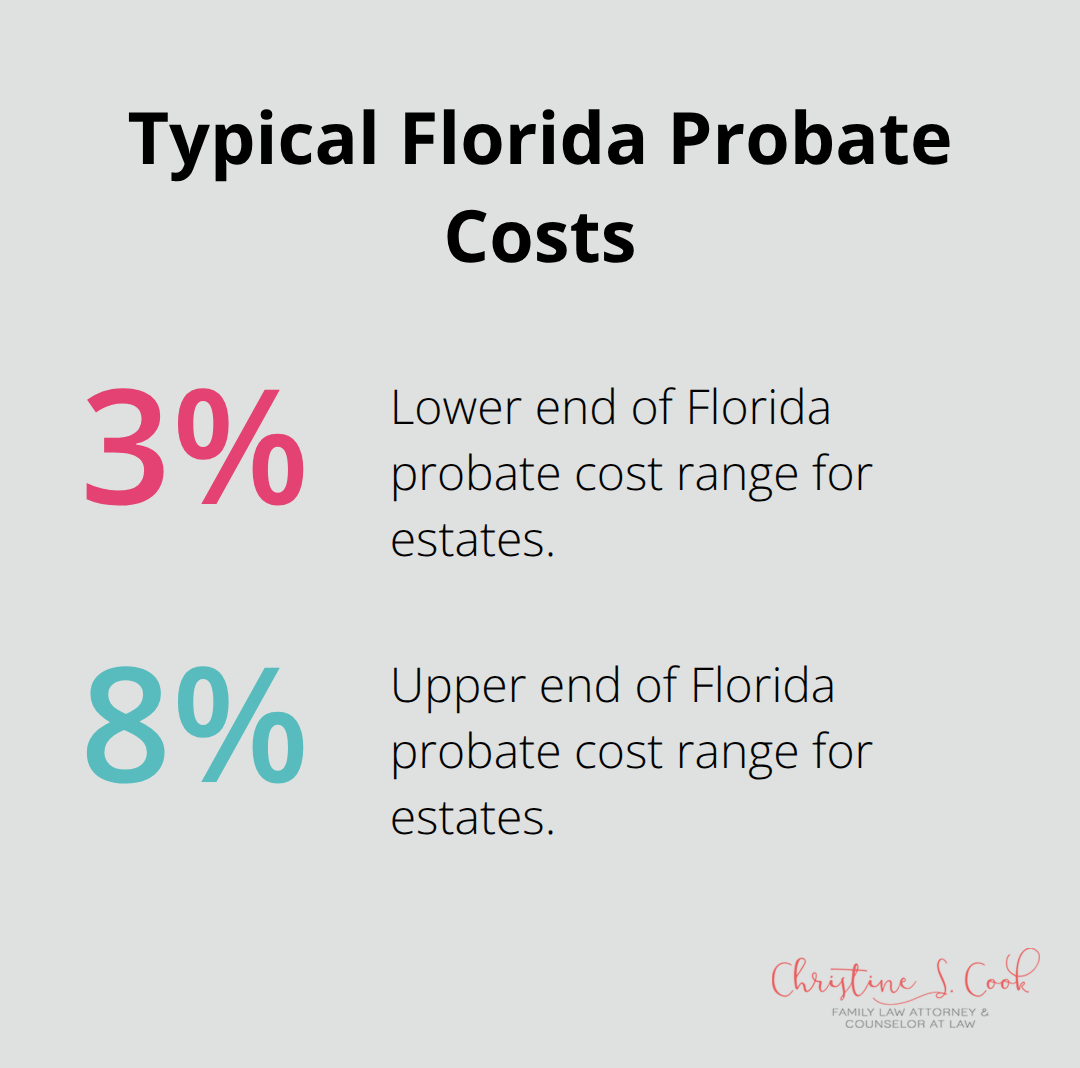
A will works perfectly if your estate is straightforward and your family situation is uncomplicated. You own a modest home, some savings, and personal items you want specific people to inherit. Your children are grown, your marriage is stable, and you don’t anticipate disputes among your beneficiaries. In these cases, probate isn’t the burden people fear. Florida probate for simpler estates often takes just a few months, not years. You’ll pay court fees, attorney fees, and executor compensation, but Florida probate costs for estates typically range from 3% to 8% of the estate’s value. That’s manageable for many families, especially when weighed against the upfront cost of creating a trust.
A will handles something trusts cannot: designating a guardianship for minor children in Florida. If you have young kids, a will becomes essential regardless of whether you also establish a trust. This protection alone makes a will invaluable for parents with dependent children.
Wills suit situations where you want simplicity and lower initial investment. Creating a basic will in Florida costs far less than establishing a trust, and you maintain complete control to change it anytime. You don’t need to retitle property or transfer assets into a trust during your lifetime. The probate process, while public, actually provides a structured framework that protects your beneficiaries. The court ensures debts are paid, taxes are filed correctly, and assets reach the right people.
For single people without complex assets, or couples with modest estates and clear-cut wishes, a will delivers exactly what you need without unnecessary expense or administrative burden. Your executor carries out your instructions, the court validates the process, and your family receives their inheritance according to your wishes. This straightforward approach works well when your situation matches these characteristics.
Now that you understand when a will makes sense, the question shifts: what if your situation is more complex, your assets are substantial, or you want to avoid probate entirely?
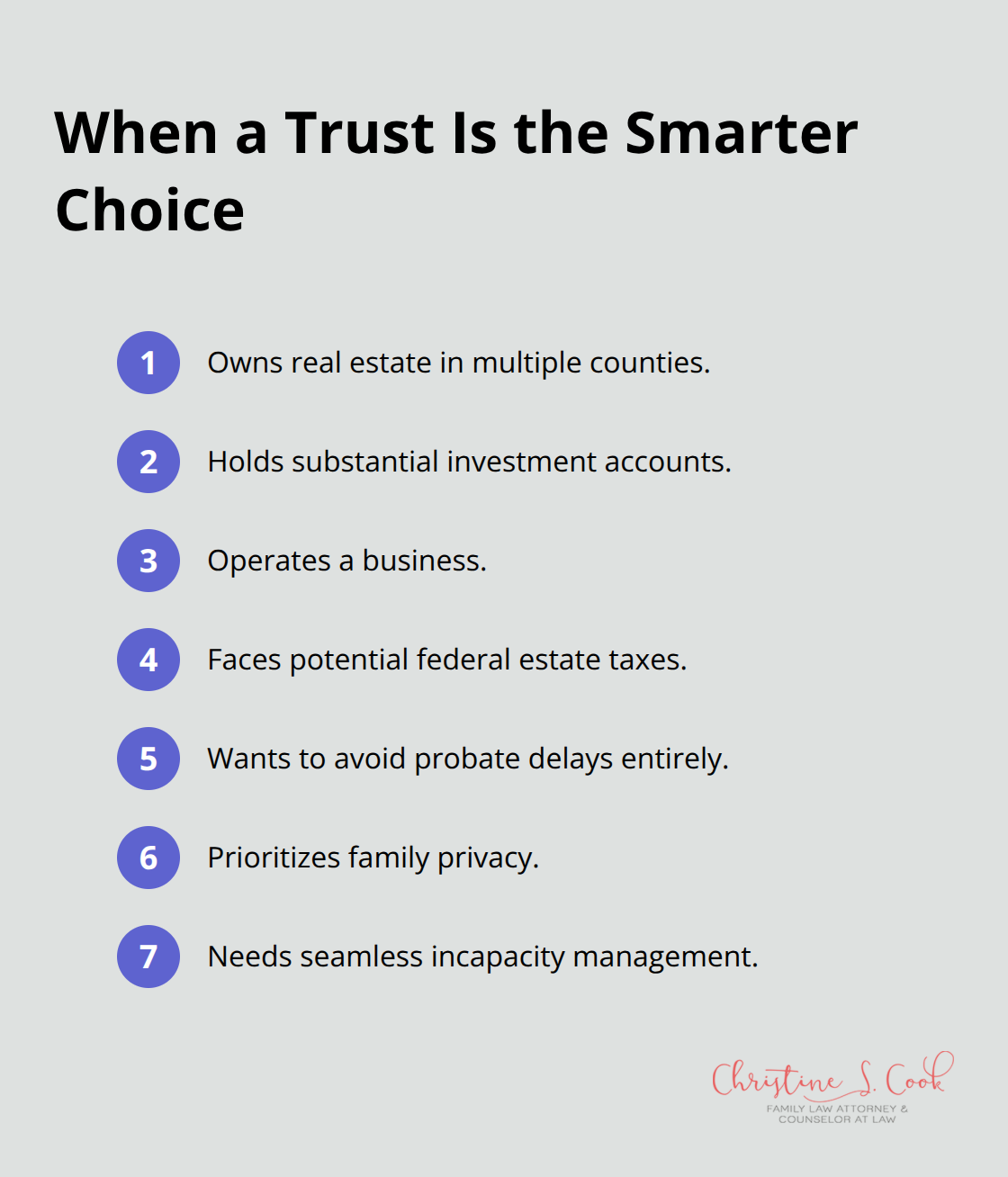
A trust becomes essential when your situation grows beyond what a simple will can handle. If you own real estate in multiple counties, have substantial investment accounts, operate a business, or anticipate your estate might face federal estate taxes, a trust provides protections a will simply cannot match. Federal estate taxes apply to Florida estates exceeding $13.61 million in 2024, though this threshold decreases to $7 million in 2026 unless Congress acts.
A revocable living trust allows you to structure your assets strategically during your lifetime, positioning yourself to minimize tax exposure before death. More importantly, a trust keeps your family out of probate entirely. Instead of spending months or years in court while creditors file claims against your estate, a successor trustee distributes assets directly to your beneficiaries within weeks. Your family avoids the emotional drain of public proceedings and the financial hit of probate costs, which typically consume 3% to 8% of your estate’s value. Privacy matters too. Probate files are public record, meaning anyone can inspect what you owned and who inherited it. A trust operates in complete confidentiality. Your beneficiaries, asset amounts, and distribution instructions remain private forever. This protection proves invaluable for families with blended relationships, significant wealth, or anyone who values discretion.
A trust’s real power emerges when you face incapacity. If you become unable to manage your affairs through illness or cognitive decline, your successor trustee steps in immediately without any court involvement. No guardianship proceedings. No judicial oversight. No public filing of your medical condition. Your successor trustee simply continues managing your assets, paying your bills, and handling your financial affairs as you instructed.
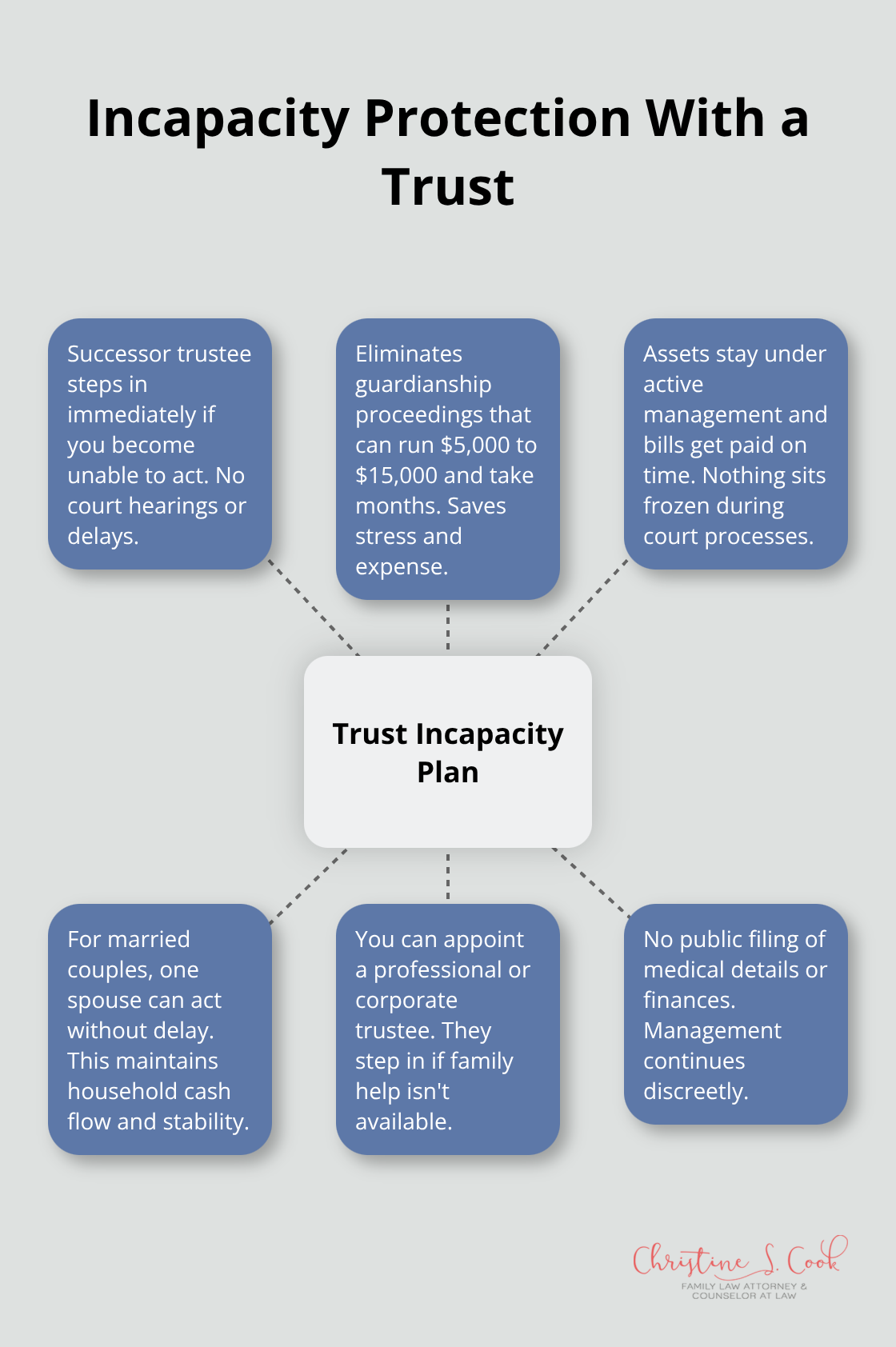
This seamless transition protects both your interests and your family’s stability during a vulnerable period. Your assets remain under active management rather than sitting frozen while your family navigates court procedures. For married couples, this matters enormously. One spouse steps in without delay, maintaining financial continuity when the other spouse cannot act. For single people or those without a reliable family member, you can designate a professional trustee or corporate trustee to assume this role. The cost difference is significant: guardianship proceedings in Florida can run $5,000 to $15,000 and take months to complete, whereas a trust handles incapacity planning at no additional cost beyond the initial trust setup.
A trust gives you control that survives your death. You can write detailed instructions about how and when beneficiaries receive their inheritance. Rather than a one-time distribution, you might specify that your adult child receives income annually but the principal remains protected from creditors and divorce claims. You can create separate trusts for each child with different distribution schedules based on their maturity and circumstances. You can protect a beneficiary with special needs by ensuring their inheritance doesn’t disqualify them from SSI or Medicaid benefits, which have asset thresholds of $2,000 for individuals in 2025. You can even provide for grandchildren or great-grandchildren, creating a multi-generational plan that reflects your values long after you’re gone. This flexibility means your trust adapts to your family’s actual needs rather than forcing everyone into the rigid framework probate provides. You also retain the ability to modify your revocable trust anytime during your lifetime. Your circumstances change, your family dynamics shift, your priorities evolve. A revocable trust changes with you, whereas a will requires formal amendment or revocation each time you want to adjust your wishes.
The decision between wills versus trusts in Florida isn’t about picking one tool and forgetting the other. Most families benefit from using both strategically-a will handles guardianship designations for minor children, which a trust cannot do, while a trust manages your assets during incapacity and avoids probate after death. Together, they create a comprehensive plan that protects your family in every scenario.
For straightforward estates with modest assets and simple family structures, a basic will often suffices and costs less upfront. For larger estates, multiple properties, business interests, or situations where probate delays would burden your family, a revocable living trust becomes the smarter investment because the upfront cost pays for itself through probate avoidance and the peace of mind that comes from knowing your successor trustee can step in immediately if you become incapacitated. Many families use both-a revocable living trust holds the bulk of your assets and avoids probate, while a pour-over will catches any assets you forgot to transfer into the trust and designates guardians for minor children.
The real mistake isn’t choosing a will or a trust-it’s choosing nothing at all. Without either document, Florida law decides who inherits your assets and who manages your affairs if you become unable to act, and that outcome rarely matches what families actually want. Contact us to discuss your specific situation and understand which approach fits your family’s needs and your financial circumstances.