Divorce doesn’t have to mean courtroom battles and years of conflict. A collaborative agreement lets you and your spouse work together with trained professionals to reach solutions that actually work for your family.
At Christine Sue Cook, LLC, we’ve seen firsthand how this approach transforms outcomes. When both parties commit to cooperation instead of confrontation, everyone-especially children-benefits.
Collaborative divorce is a settlement process where both spouses and their attorneys agree upfront to negotiate outside the courtroom. Unlike traditional litigation, where a judge makes final decisions, collaborative divorce puts control directly in your hands. The process relies on open communication, full financial disclosure, and a team of trained professionals who work together to solve problems rather than escalate conflict. When both parties commit to this framework, outcomes shift dramatically. Collaborative cases resolve faster and cost significantly less than contested litigation, with many couples reporting reduced stress and better post-divorce relationships, especially when children are involved.
In traditional litigation, your attorney advocates aggressively on your behalf, often positioning your spouse as an adversary. Court battles involve discovery phases that drag on for months, depositions that cost thousands of dollars, and trial dates that get postponed repeatedly. A judge ultimately decides property division, custody, and support based on state law and whatever argument wins in the courtroom. The entire process is public, with court records accessible to anyone. Collaborative divorce eliminates these inefficiencies. Both attorneys sign a participation agreement stating they will not represent either party if the process breaks down and settlement negotiations fail. This commitment fundamentally changes the dynamic. Instead of building a case to win, both lawyers focus on helping their clients reach fair agreements. Negotiation sessions happen in structured settings where both spouses, their attorneys, and relevant specialists sit together to discuss issues systematically.
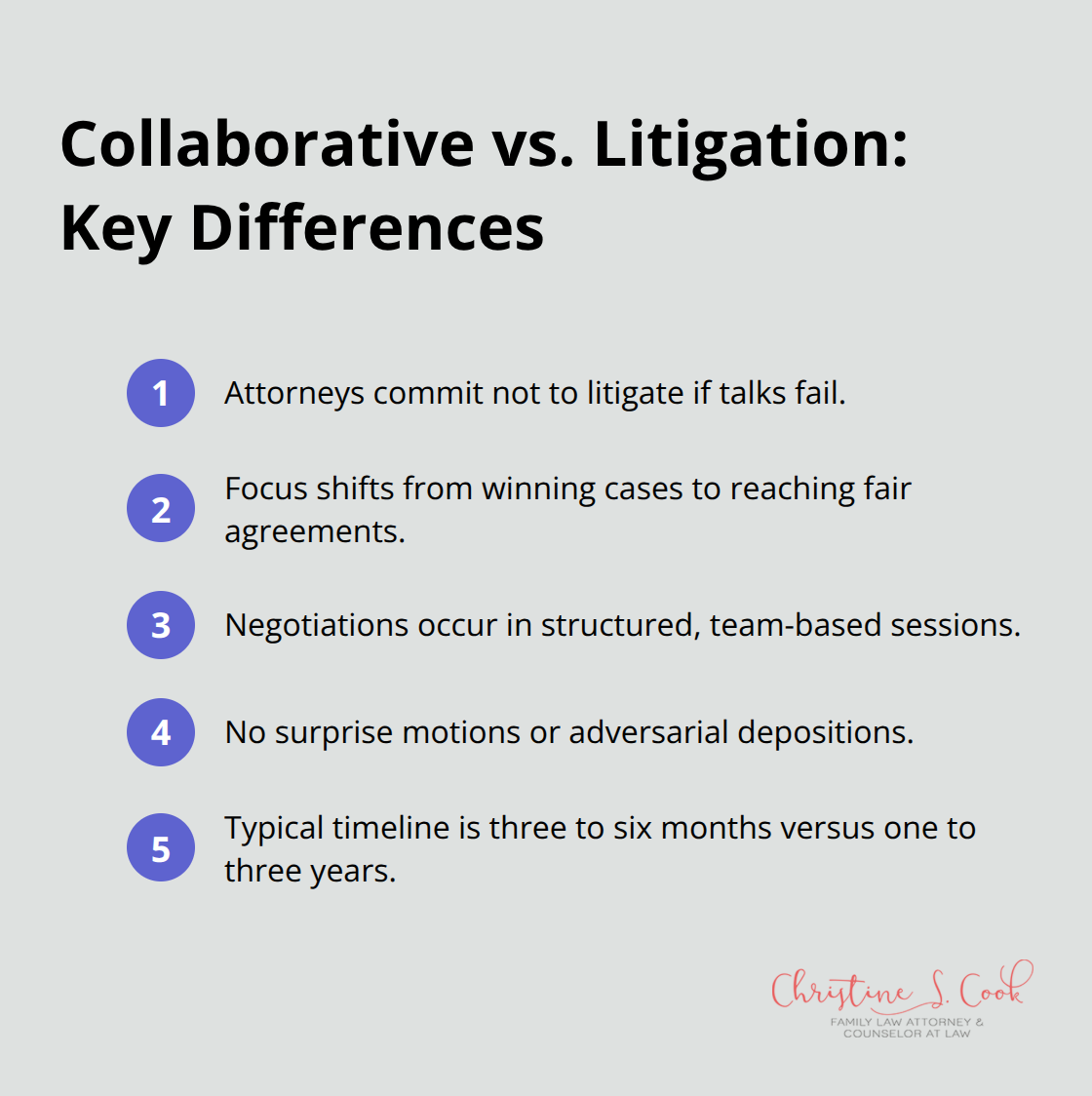
There are no surprise motions, no adversarial depositions, and no judge imposing a decision neither party wanted. The process typically takes three to six months rather than the one to three years common in litigation.
Collaborative cases succeed because they assemble professionals with specific expertise. Your collaborative team includes two specially trained attorneys, but also extends to child specialists, financial planners, therapists, and coaches as needed. A child specialist meets with parents separately to understand children’s needs and perspectives, then helps the team craft parenting plans that actually reflect what kids need for stability. Financial planners review tax returns, retirement accounts, and long-term income projections to ensure property division does not create financial disasters years later. Therapists help couples communicate constructively and process emotions outside negotiation sessions, keeping those meetings focused on problem-solving.
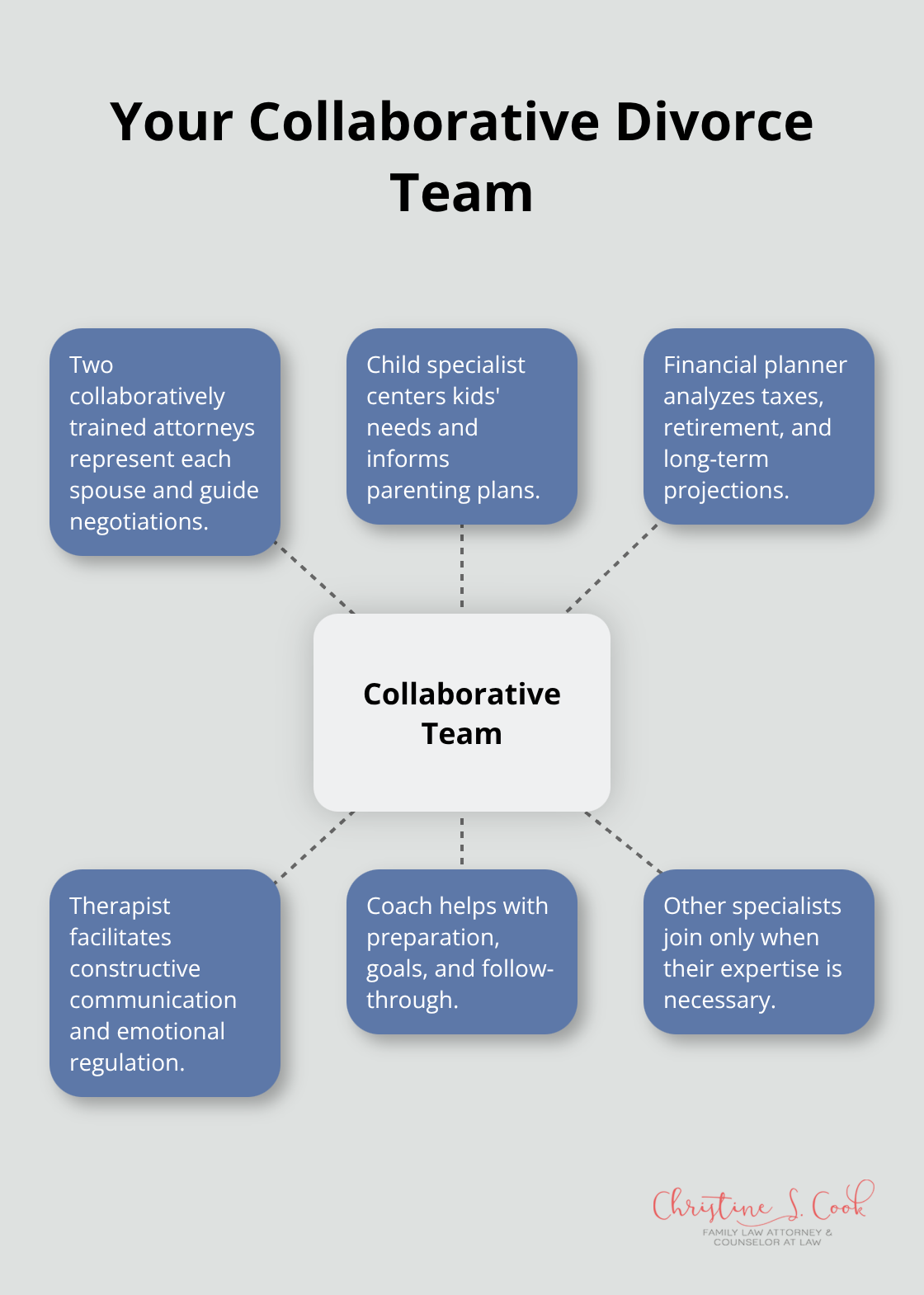
You pay for specialists only when their expertise matters. If your case involves straightforward finances and no custody disputes, you may never need a financial planner. This targeted approach keeps costs manageable compared to litigation, where you pay for extensive attorney time on every single issue.
Couples select collaborative divorce for concrete reasons. The process preserves privacy-your settlement agreement stays confidential, unlike court records that become public documents. You retain control over outcomes rather than accepting a judge’s ruling. Collaborative agreements prioritize co-parenting relationships, a significant advantage when children remain involved with both parents long after the divorce finalizes. The structured team approach prevents oversights that single attorneys might miss. Financial planners catch retirement account issues that lawyers overlook. Child specialists identify parenting arrangements that actually work for your family’s schedule and your children’s emotional needs. Most importantly, this method costs substantially less than litigation. You avoid months of depositions, expert witness fees, and repeated court appearances. Many couples complete collaborative divorces for a fraction of what contested litigation would cost.
The foundation of any successful collaborative agreement rests on the specific elements that protect both parties and create lasting stability. Understanding financial disclosure requirements, property division strategies, and child-centered arrangements transforms how you approach the next phase of your divorce.
Full financial transparency forms the bedrock of any collaborative agreement that lasts. Both spouses must disclose every asset, debt, income source, and financial obligation without exception. This means providing tax returns from the past three years, W-2s, 1099s, bank statements, retirement account statements, and mortgage documents. Hidden assets destroy collaborative agreements faster than anything else. When one spouse discovers undisclosed property or income later, the agreement falls apart and litigation becomes inevitable. Courts in most states require full disclosure under penalty of perjury, and collaborative agreements demand the same standard.
Start with a complete inventory of everything you own together and separately. Include the obvious items like real estate, vehicles, and investment accounts, but also less obvious assets like pensions, stock options, deferred compensation, and life insurance policies with cash values. A financial planner can help identify assets you might overlook. Many people underestimate the value of retirement accounts. A pension that pays $3,000 monthly for life often exceeds the value of a house you could sell for $400,000, yet divorcing spouses frequently trade pensions away without understanding the long-term cost.
Review both spouses’ tax returns carefully with a financial advisor. Tax returns reveal capital gains, business income, depreciation, losses, and other financial details that illuminate what assets actually exist and how they’re being used. This homework prevents one spouse from manipulating the financial picture during negotiations.
Property division in collaborative divorce focuses on creating sustainable arrangements, not winning at the other person’s expense. Rather than splitting every asset 50-50, which often creates problems, collaborative teams structure agreements around what each person actually needs post-divorce. If one spouse needs to stay in the family home for stability with children while the other needs liquid retirement assets for independence, an equalizing payment bridges the gap fairly.
For example, if one spouse keeps a $500,000 house while the other receives $200,000 in retirement accounts, an equalizing payment of $150,000 creates balance without forcing the sale of assets either party wants to keep. This approach protects both parties’ long-term financial security rather than creating artificial equality that fails in practice.
Child custody and support require equally practical thinking. Courts generally prefer arrangements where children maintain meaningful relationships with both parents, but your specific situation might call for different structures. One parent might have primary physical custody while both share legal custody decisions about education and healthcare. Or parents might alternate weeks to create stability without one parent feeling marginalized.
Child support calculations start with state guidelines. You can agree to different amounts, but the court must see the guideline figure in your agreement. Beyond the child support number, address who carries health insurance for the children, how uncovered medical expenses split, and who pays for childcare, school activities, and travel for visitation. These details prevent disputes later when unexpected costs arise.
The specific arrangements you craft during this phase directly shape how your family functions post-divorce. The next chapter walks you through the actual collaborative process-how you assemble your team, structure negotiation sessions, and move from agreement to finalized decree.
The collaborative process starts with a structured initial consultation where you meet with a trained collaborative attorney who will represent you throughout the case. During this first meeting, your attorney explains the participation agreement both lawyers will sign, outlining the commitment to settle without court involvement. This is where you decide whether collaborative divorce truly fits your situation. If either spouse has a history of hiding assets, refuses to disclose finances, or shows signs of domestic violence, collaboration may not work. Your attorney should be direct about this assessment rather than pushing you into a process destined to fail.
Once both parties commit, your team assembles based on the specific issues in your case. If you have minor children, a child specialist joins immediately. If retirement accounts or complex property exist, a financial planner becomes essential. We recommend scheduling your first full team meeting within two weeks of signing participation agreements to maintain momentum. This initial session establishes ground rules for communication, sets meeting frequency typically at two to four week intervals, and identifies the information each person must gather before the next meeting.
You’ll receive a detailed asset inventory form to complete, asking for account numbers, current values, and documentation. Your spouse receives the identical request. This parallel preparation prevents one person from controlling the information flow.
Negotiation sessions follow a structured format designed to keep discussions productive rather than emotional. Both spouses sit at a table with their attorneys present, and specialists participate when their expertise becomes relevant. Rather than arguing positions, the team focuses on interests. Instead of you saying “I want the house and you’re leaving,” the conversation shifts to what each person actually needs post-divorce.
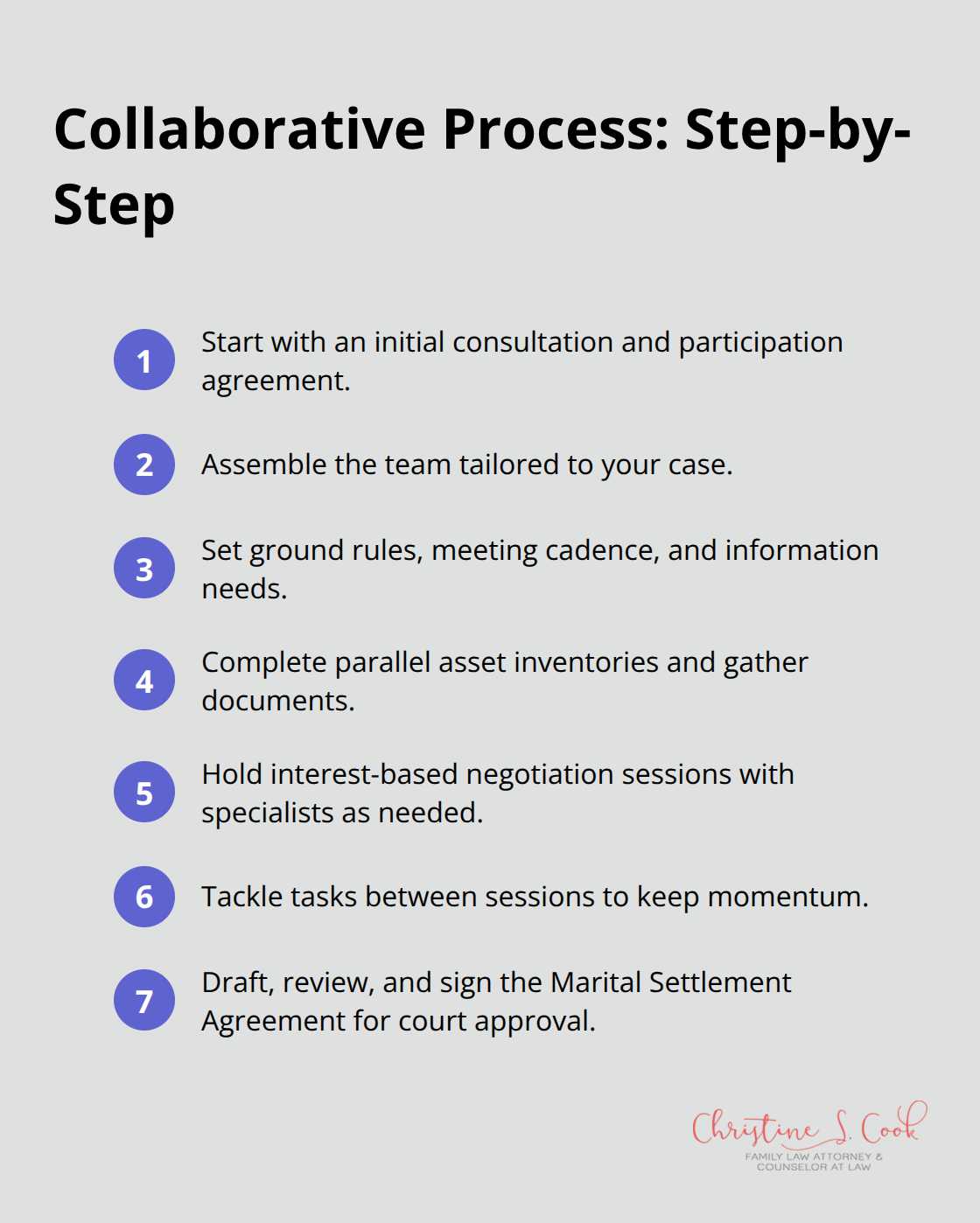
One spouse might prioritize housing stability for children while the other prioritizes retirement security. A financial planner then models scenarios showing how different property divisions achieve both goals. This problem-solving approach typically resolves contentious issues faster than litigation because you’re not fighting over winners and losers. Most collaborative cases require five to eight negotiation sessions spanning three to six months.
Between sessions, your attorney handles specific tasks like obtaining pension valuations or retrieving missing tax documents, keeping the process moving forward. These intervals allow time for reflection and preparation without prolonging the overall timeline unnecessarily.
Once you’ve reached agreement on all major issues, attorneys draft the Marital Settlement Agreement translating your decisions into legal language. You review this document carefully with your attorney before both parties sign. The agreement then goes to a judge for final approval, which is largely a formality in most cases since you’ve already resolved every issue collaboratively.
The judge reviews the agreement for legal sufficiency and confirms it complies with state law, but rarely objects when both parties consent to the terms. This final step transforms your collaborative work into a binding legal document that guides your family’s arrangements moving forward.
Collaborative divorce fundamentally transforms what becomes possible when both spouses commit to working together instead of fighting in court. You shape outcomes that reflect your family’s real needs rather than accepting decisions a judge imposes on you. The collaborative agreement you craft protects your children’s relationships with both parents, preserves your privacy, and typically costs a fraction of what litigation demands.
Starting this journey begins with a conversation with an attorney trained in collaborative law. You’ll discuss whether collaboration fits your situation, what your team might look like, and what to expect during negotiations. Be honest about your circumstances-if you have concerns about hidden assets or safety issues, your attorney will help you determine whether collaboration serves you or if a different path makes more sense.
At Christine Sue Cook, LLC in Pensacola, we understand that divorce reshapes your family’s future. Contact us for a free consultation to discuss whether collaborative divorce aligns with your goals and circumstances.