Probate can drain your family’s resources and expose your private finances to public scrutiny. The good news is that Florida probate avoidance tips exist, and many are simpler than you’d think.
At Christine Sue Cook, LLC, we help families protect their assets and keep their affairs private. With the right planning tools in place, you can spare your loved ones months of waiting and thousands in unnecessary costs.
Probate in Florida drains your family’s resources and exposes your private finances to public scrutiny. Court fees, attorney expenses, and the time your family spends managing the process add up to real money that could otherwise go to your loved ones.
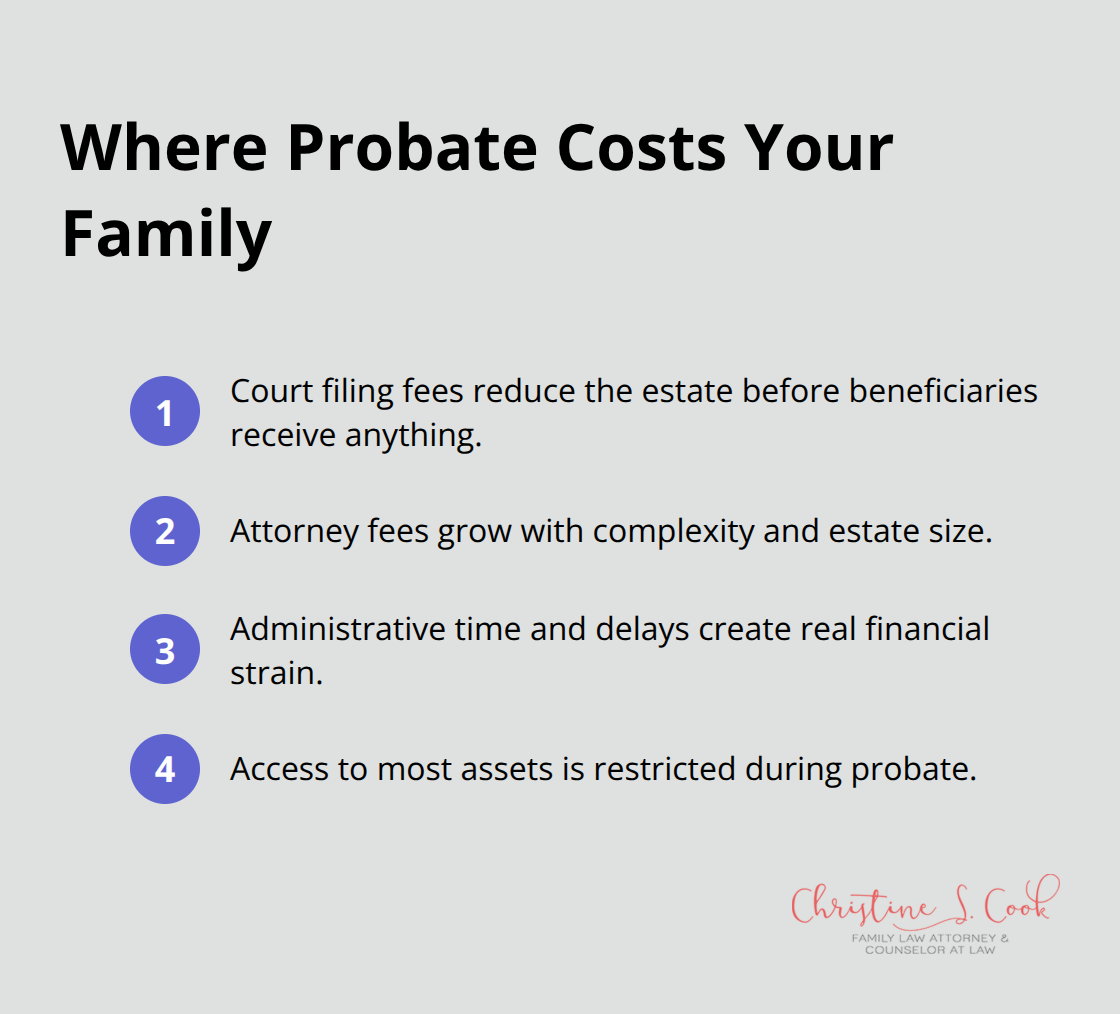
Probate can take anywhere from a few months to two or more years, depending on the estate size and whether creditors file claims. During that entire time, your family cannot access most assets, and they’re paying for the privilege.
Court filing fees alone run several hundred dollars, and if your estate is moderately sized or complex, attorney fees can easily reach thousands. These costs come directly out of your estate, meaning your beneficiaries receive less. The larger your estate, the more expensive probate becomes. This reality makes advance planning not just smart but essential for protecting what you’ve worked to build.
Your family cannot access most assets while probate proceeds through the court system. Creditors file claims, the court supervises the process, and months pass before your loved ones see any money. This delay creates real hardship for families who need funds to pay bills, cover medical expenses, or handle immediate needs. The longer probate takes, the more stress your family experiences.
Most people don’t realize that probate records in Florida are public. Anyone can walk into the county courthouse and see exactly what you owned, how much it was worth, and who you left it to. This public exposure creates real problems. Identity thieves use probate records to target families. Distant relatives suddenly appear asking for money. Scammers know your address, your assets, and your family members’ names (and they use this information to exploit vulnerable people). You lose all control over who knows your financial information the moment your will enters probate court.
This privacy vulnerability affects real families every year. If privacy matters to you and your family, probate avoidance should become part of your planning strategy. Fortunately, Florida offers multiple tools that keep your assets private while you’re alive and transfer them smoothly after you’re gone.
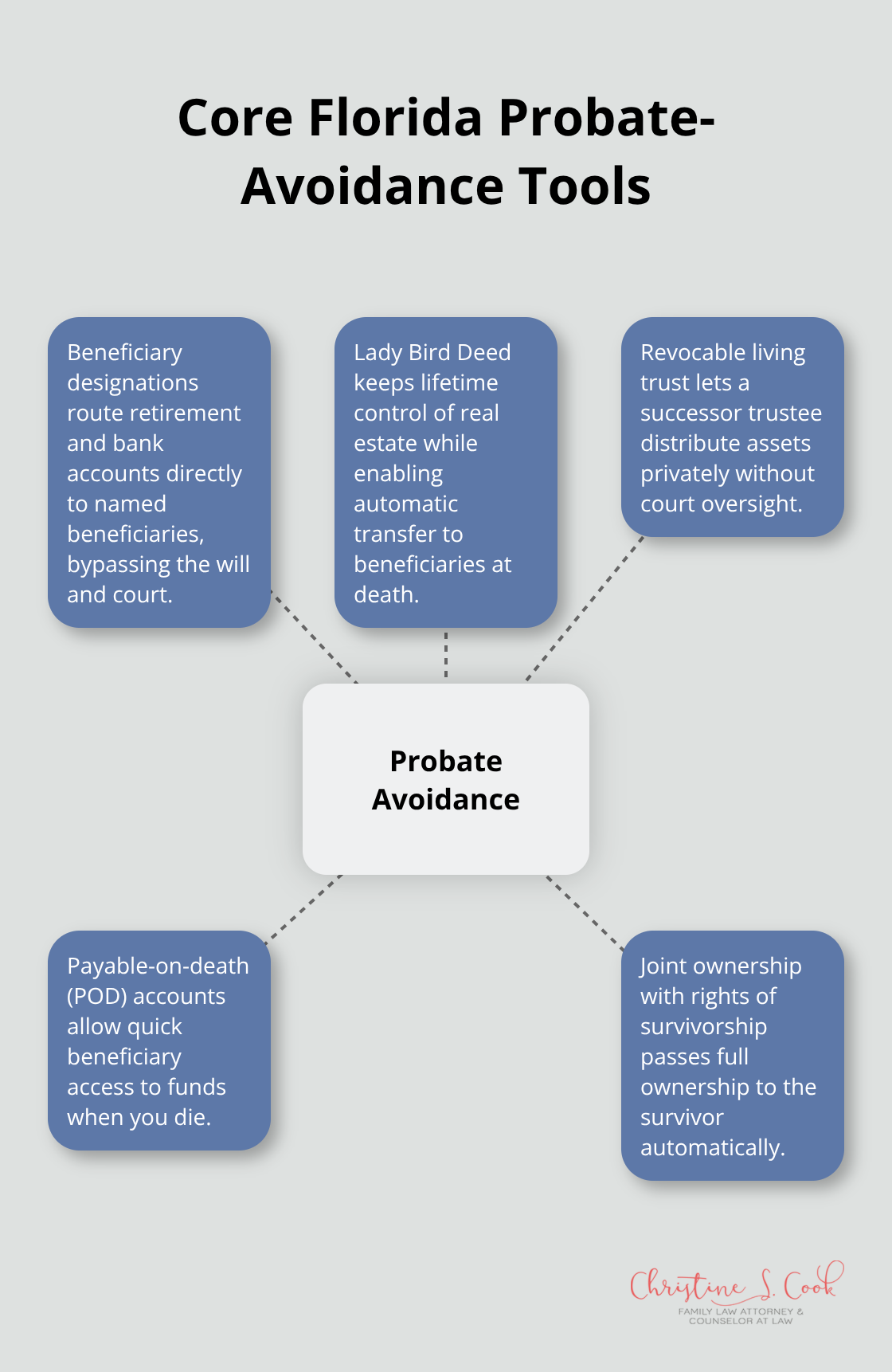
Beneficiary designations on retirement accounts and bank accounts move money directly to your named beneficiary without touching probate court. An IRA or 401(k) passes to whoever you name as beneficiary, completely outside your will and the probate process. The same applies to payable-on-death bank accounts-you keep full control during your lifetime, but when you die, the funds go straight to your designated beneficiary. This method requires almost no setup beyond a conversation with your financial institution and completing a form. Your beneficiary can access these funds within weeks instead of waiting months or years for probate to conclude. Federal law already recognizes beneficiary designations, so Florida probate law cannot touch retirement accounts.
Real estate presents a different challenge because Florida does not recognize transfer-on-death deeds the way about 30 other states do. However, Florida offers the enhanced life estate deed-commonly called a Lady Bird Deed-which accomplishes the same goal. A Lady Bird Deed lets you keep complete control of your property during your lifetime, including the right to sell, mortgage, or lease it. You can change beneficiaries whenever you want by recording a new deed. When you die, the property transfers automatically to your named beneficiaries without probate. The cost to prepare a Lady Bird Deed typically runs between $400 and $1,000, plus recording fees under $50. This makes it far cheaper than a living trust for a single property.
A living trust transfers ownership of virtually any asset into the trust itself, so when you die, your successor trustee distributes assets according to your instructions without court involvement. The trade-off is higher upfront cost and the requirement to retitle your assets into the trust name during your lifetime. Many Florida families use a combination: a living trust for their primary residence and investment accounts, a Lady Bird Deed for a second property, and beneficiary designations on retirement accounts and bank accounts. This layered approach keeps assets private, avoids probate, and costs far less than probate would drain from your estate.
The key to success with any strategy is actually completing the paperwork and funding the accounts correctly. Many families establish these tools but fail to transfer ownership, leaving assets vulnerable to probate anyway. Your financial institutions need accurate forms on file. Your trust documents need assets retitled into the trust name. Your deeds need proper recording at the county level. Each step matters because incomplete planning defeats the entire purpose.
The strategy you choose depends on your asset mix, your family situation, and your privacy goals. Some families need only beneficiary designations and a Lady Bird Deed. Others benefit from a comprehensive living trust that covers everything. The next section walks you through the specific tools and documents that work best for Florida families.
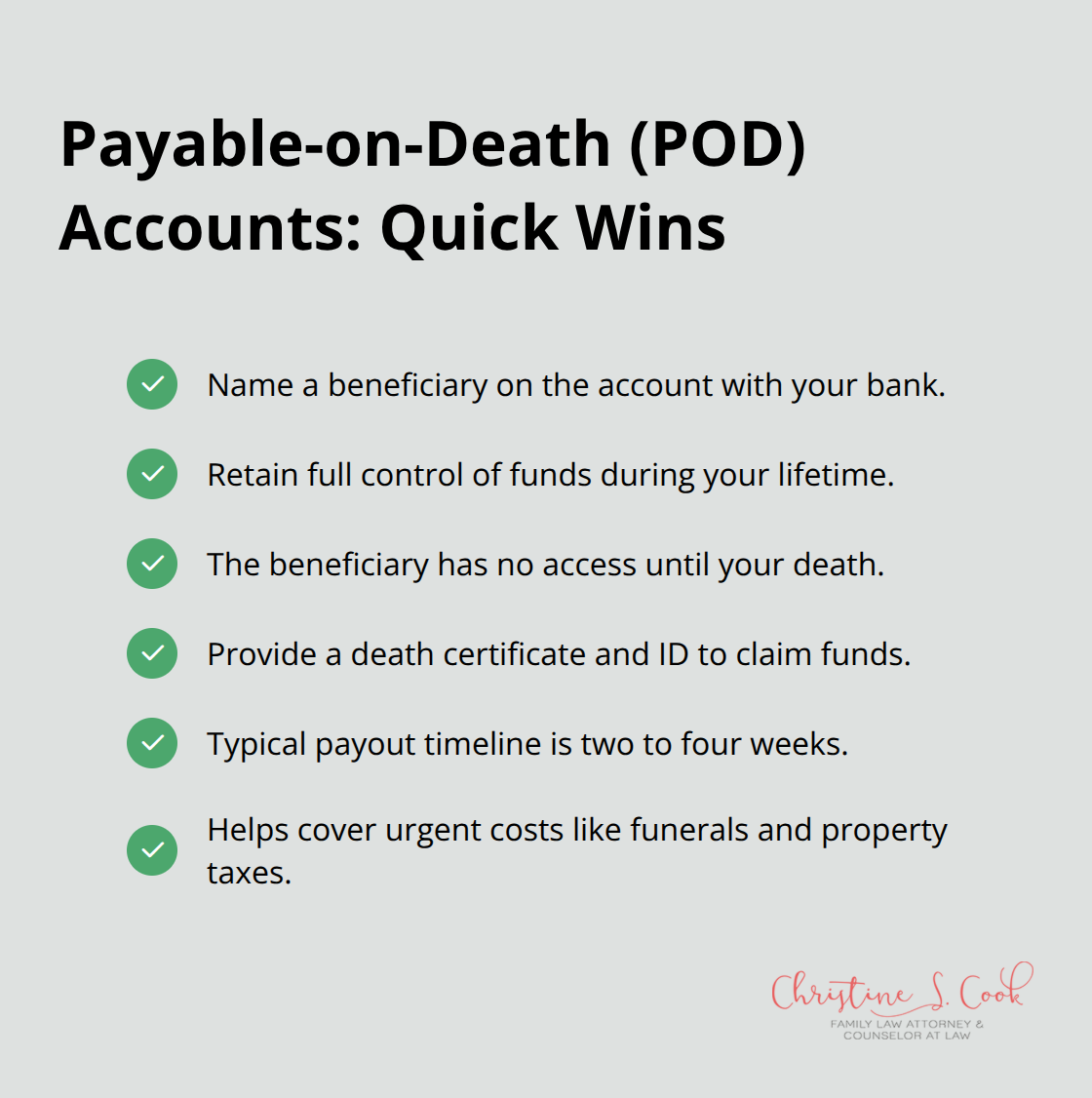
Payable-on-death bank accounts function as workhorses of Florida probate avoidance because they require minimal paperwork and operate exactly when you need them. A payable-on-death bank account lets you name a beneficiary who receives the account balance automatically upon your death, while you retain complete control during your lifetime. Florida Statute § 655.82 governs these accounts, and setup involves nothing more than completing a form at your bank. The beneficiary has no access to funds while you’re alive. Upon your death, the beneficiary provides a death certificate and identification to claim the funds, typically within two to four weeks. This speed matters enormously for families facing immediate expenses like funeral costs or property taxes.
Joint ownership with rights of survivorship works similarly to payable-on-death accounts but applies to real property and titled assets. When you own property jointly with survivorship rights, the surviving owner automatically receives full ownership upon your death without probate involvement. Florida recognizes joint tenancy with right of survivorship under Fla. Stat. § 689.15, and for married couples, tenancy by the entirety provides even stronger protections while keeping creditors at bay during both spouses’ lifetimes. The critical detail is ensuring your deed or title explicitly states the right of survivorship; vague language about joint ownership without survivorship language creates a tenancy in common, which triggers probate when you die. Many families incorrectly assume that simply adding a name to a deed creates survivorship, when in fact the legal language must be precise.
A revocable living trust provides the most comprehensive control because the trustee steps in immediately after your death and distributes assets according to your written instructions without court approval or public disclosure. The successor trustee holds broad duties under Florida law: managing assets, making investment decisions, paying beneficiaries, handling tax filings, and maintaining detailed records. You can name a family member, a trusted friend, or a professional trustee like a bank or trust company. Many families choose a combination, such as a primary successor who is a family member and a successor professional trustee if the primary becomes unable or unwilling to serve. The trustee’s decisions are not subject to court review unless a beneficiary challenges them, which rarely happens when the trust document is clear and the trustee acts in good faith.
Assets must be retitled into the trust name during your lifetime, meaning your deed should read something like Smith Family Trust, your bank accounts should be in the trust’s name, and your investment accounts need formal transfer paperwork completed with your brokerage. Incomplete funding is the single biggest reason trusts fail to avoid probate. A pour-over will captures any remaining assets accidentally left outside the trust and channels them into the trust after your death, but pour-over assets still require a brief probate process. The combination of a properly funded revocable trust, beneficiary designations on retirement accounts, and a Lady Bird Deed for any real estate you want maximum control over creates a comprehensive strategy that handles virtually every asset without probate delays.
Probate avoidance in Florida works because it gives your family what matters most: time, privacy, and money. The strategies we’ve covered-beneficiary designations, Lady Bird Deeds, living trusts, and joint ownership-are not theoretical concepts but practical tools that Florida families use every day to protect their assets and spare their loved ones from months of court delays and thousands in unnecessary costs. The real power comes from combining these tools strategically so that nothing touches probate court, your family’s financial details stay private, and your successor trustee or beneficiaries access funds within weeks instead of waiting years.
Many families hesitate because they think probate avoidance requires expensive, complicated planning, but the truth is simpler. A Lady Bird Deed costs $400 to $1,000, beneficiary designations cost nothing beyond a phone call to your bank, and joint ownership with survivorship requires only precise language on your deed. These Florida probate avoidance tips are affordable and straightforward when you know what to do, and the biggest mistake families make is waiting until probate happens to them.
We at Christine Sue Cook, LLC help Pensacola families build estate plans that match their real lives and tailor strategies to your specific assets, family situation, and privacy goals. If you’re ready to protect your family’s future and keep your affairs private, contact us for a free consultation. Your family’s peace of mind is worth the conversation.