Divorce doesn’t have to be a battle. An amicable divorce meaning a cooperative separation where both parties work together can save you thousands in legal fees and months of court time.
At Christine Sue Cook, LLC, we’ve seen firsthand how couples who choose this path experience less emotional strain and maintain better relationships with their children. This guide walks you through what an amicable divorce looks like and how to make it work for your family.
An amicable divorce is a straightforward agreement between two people to end their marriage without fighting in court. Both spouses decide together how to split assets, handle debts, and arrange custody-or they work with a mediator to reach those decisions. This isn’t about staying friends or pretending the relationship was perfect. It’s about choosing cooperation over confrontation. The National Center for Health Statistics reports that roughly 2.4 divorces occur per 1,000 people in the United States, and most of them could be handled more efficiently outside a courtroom.
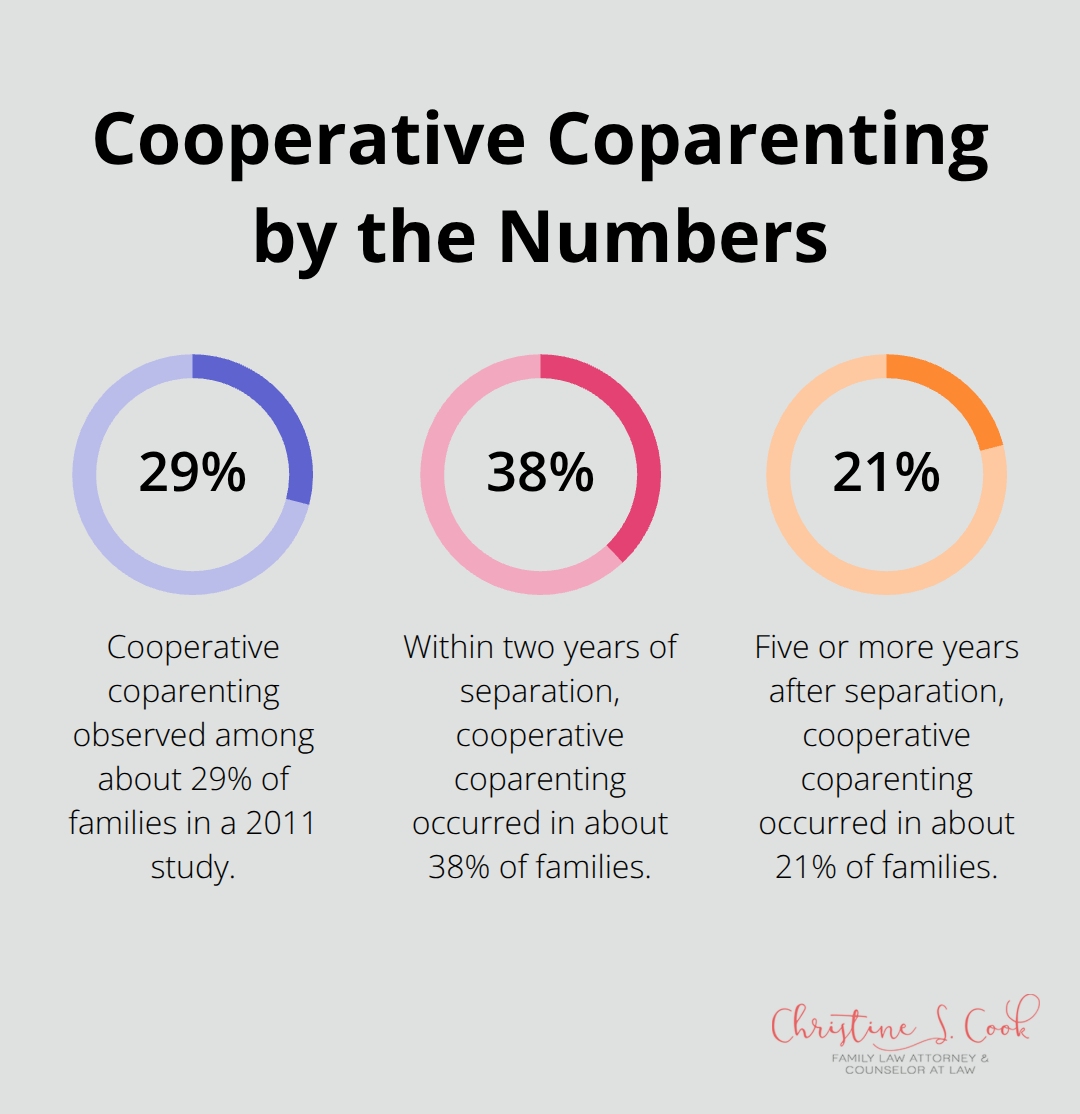
What separates an amicable divorce from a contested one is straightforward: in contested divorces, couples fight over nearly everything and let judges make final decisions. In amicable divorces, the couple controls the outcome. Research from Amato, Kane, and James in 2011 examined three post-divorce parenting patterns and found that cooperative coparenting-the closest thing to an amicable outcome-occurred in about 29 percent of families. These families showed high contact between children and both parents, frequent discussions about parenting, and genuine satisfaction with the other parent. Adolescents in these cooperative arrangements had roughly 0.20 standard deviations fewer behavior problems than kids in parallel parenting or single parenting situations. That’s real data showing real benefits.
Communication is the engine that drives an amicable divorce. Without honest, calm conversation, the process stalls or deteriorates into conflict. Set ground rules before discussions: listen without interrupting, speak calmly, and avoid blame language. Many couples find it easier to communicate in writing first-emails or shared documents-because writing forces clarity and gives both people time to think before responding.
If direct conversation becomes heated, a neutral mediator can facilitate discussions and help both sides understand each other’s actual needs versus positions. Mediation costs typically range from $5,000 to $12,500 depending on case complexity, which is substantially less than contested litigation. The mediator doesn’t decide anything; instead, they help you and your spouse brainstorm solutions and reach your own agreements. This matters because when you control the outcome, you’re far more likely to follow through on agreements after the divorce is final.
Before you sit down to discuss asset division or custody, you need to gather your financial documents. Recent bank statements, retirement account statements, investment portfolios, and tax returns give you and your spouse a clear picture of what you’re actually dividing. Transparency about debts and assets isn’t optional-it’s the foundation of any real agreement. If either person hides money or downplays debt, the entire process collapses.
Consider consulting a financial advisor to understand your post-divorce budget and what a fair settlement looks like for your specific situation. You should know your actual needs versus what you’re willing to negotiate. If you need the house to stay stable for your children, state that clearly. If you can live with a 60/40 asset split instead of 50/50, know that before negotiations start. This prevents you from agreeing to something that damages your financial security later.
An attorney can clarify your rights and help you understand what’s negotiable and what isn’t, preparing you for productive conversations with your spouse. This preparation step separates couples who reach fair agreements from those who later regret their decisions. Christine S. Cook, LLC offers free consultations to discuss your legal needs without financial pressure, helping you understand your position before you sit down with your spouse. With clear legal guidance in place, you move into the next phase of the process-actually working toward resolution-with confidence and realistic expectations about what you can and should accept.
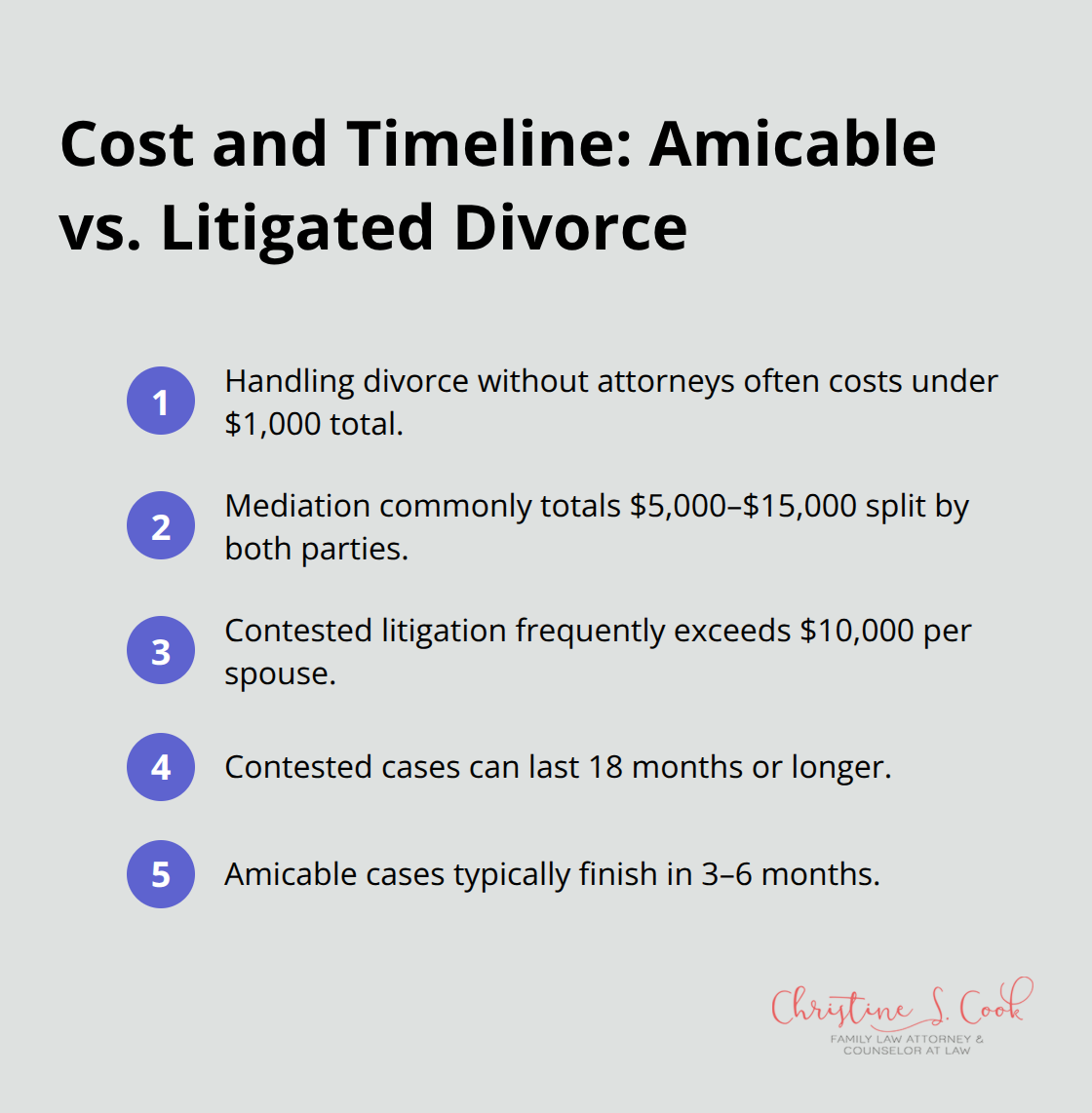
An amicable divorce costs significantly less than litigation because you avoid the courtroom entirely. Couples who handle divorce without attorneys often spend under $1,000 total, while those who fight in court typically spend $10,000 or more per spouse. Mediation sits in the middle at $5,000 to $15,000 depending on complexity, but this investment pays for itself because both parties split the cost and the process wraps up faster. A contested divorce can drag on for 18 months or longer as lawyers file motions, request discovery, and prepare for trial. An amicable divorce typically concludes in three to six months. That speed matters because every month of conflict ties up your money in legal fees and keeps you in limbo.
You cannot rebuild your life or move forward; you remain stuck paying attorneys to argue about who gets what.
The financial savings extend beyond attorney fees. When you control the negotiation process instead of leaving decisions to a judge, you preserve more of your assets because you stop burning money on extended litigation. You also avoid interim court orders that can lock you into unfavorable temporary arrangements while the case drags on. Transparent financial discussions during mediation help both spouses understand the actual value of what you are dividing, which leads to fairer settlements that both people can live with long-term. Research from Amato, Kane, and James found that cooperative coparenting-the outcome of amicable divorces-occurred more frequently within two years of separation (about 38 percent of families) than five or more years after (about 21 percent). This pattern suggests that quick, amicable resolution helps parents move into stable post-divorce routines faster, which directly benefits children’s adjustment.
Children in households marked by ongoing conflict show higher stress levels and more behavior problems than those in amicable separations. When parents handle divorce cooperatively, children witness their parents solving problems together rather than destroying each other in court. That modeling shapes how children handle conflict throughout their lives. An amicable approach also means you maintain more control over what your children hear and how they experience the separation. In contested divorces, children often learn about the ugliest details because they appear in depositions, court filings, and angry conversations. You can shield them from that harm through cooperation.
The path forward depends on understanding your options and taking action. An experienced family law attorney can clarify your rights, help you prepare for productive conversations with your spouse, and guide you through the mediation or settlement process. Christine S. Cook, LLC offers free consultations to discuss your legal needs without financial pressure, helping you understand your position before you sit down with your spouse. With clear legal guidance in place, you move into the next phase with confidence and realistic expectations about what you can and should accept.
Cooperation over court is the first decision; executing it properly is what actually saves you money and reduces stress. The method you select to reach your agreement shapes everything that follows, from how quickly the process ends to whether both parties feel heard and respected. Two primary paths exist: collaborative law and mediation. Both keep you out of court, but they work differently and suit different situations.
Collaborative law brings two attorneys into the room alongside you and your spouse, with each lawyer committed contractually to settlement before litigation. This approach costs more upfront-typically $3,000 to $8,000 per spouse-but provides balanced legal advocacy for both sides. Mediation takes a different route: a neutral third party facilitates your negotiations without representing either person, and mediators typically charge $150 to $300 per hour with total cases ranging from $5,000 to $15,000. The choice depends on your specific situation. If you and your spouse can communicate reasonably well but need help organizing financial information and options, mediation works. If communication has already broken down or one person has significantly more financial knowledge than the other, collaborative law’s dual-attorney structure prevents one side from gaining unfair advantage. Neither approach guarantees perfection, but both dramatically outperform litigation in cost and speed.
The practical reality of reaching a genuine agreement requires you to handle three concrete areas correctly: financial transparency, custody planning, and documentation. Start with complete financial disclosure before any mediation session or collaborative meeting. Both spouses need recent bank statements, investment account statements, retirement account statements, property deeds, mortgage documents, and tax returns from the past two years.
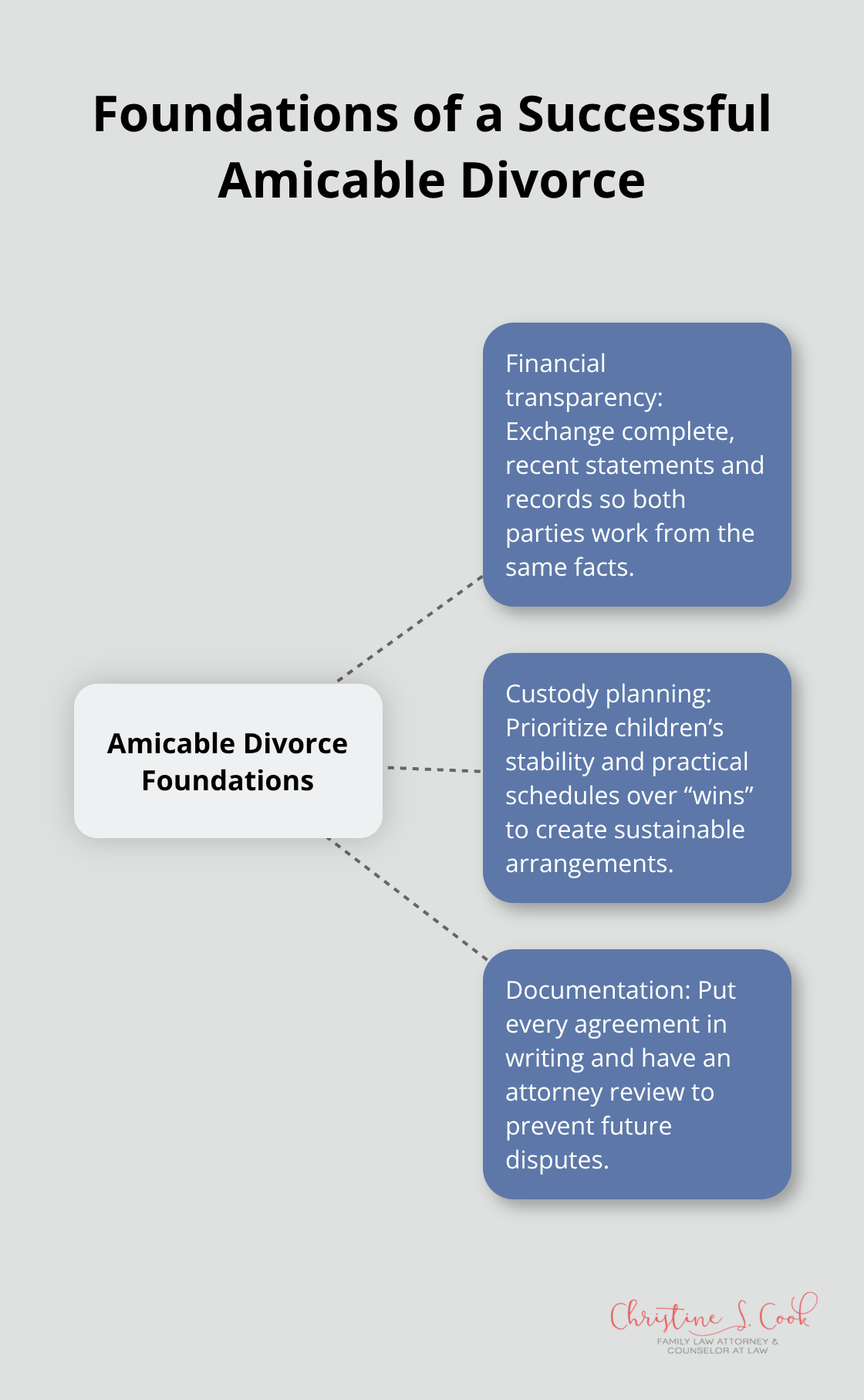
Hidden assets destroy amicable processes faster than anything else-mediators and collaborative attorneys immediately recognize when information is incomplete, and that discovery triggers the entire process into adversarial territory. Once financial information sits on the table, you move forward with confidence that both parties operate from the same facts.
Focus custody discussions on what actually works for your family’s schedule and your children’s stability, not on winning or losing parenting time. When you prioritize your children’s actual needs over symbolic victories, you create arrangements that both parents can sustain long-term. This practical focus prevents the resentment that often emerges when one parent feels forced into an unfavorable schedule. The longer negotiations drag, the more conflict hardens into positions that become difficult to move.
Document everything in writing before you finalize anything with a court. Written agreements prevent misunderstandings later and give both spouses clarity about what they actually agreed to. Have an attorney review the proposed agreement-this costs far less than litigating later because someone misunderstood a verbal arrangement. The review process catches ambiguous language, identifies missing provisions, and ensures the agreement reflects your actual intentions. Christine S. Cook, LLC can review your settlement agreement and handle the final filing, ensuring the court paperwork reflects what you and your spouse actually decided together.
An amicable divorce meaning a cooperative separation where both spouses work together offers clear advantages over litigation: lower costs, faster resolution, reduced emotional strain, and better outcomes for children. Couples who choose cooperation save thousands in legal fees, avoid months of court delays, and maintain the ability to control their own futures rather than leaving decisions to a judge. The research confirms that families with cooperative coparenting arrangements report higher satisfaction, children show fewer behavior problems, and both parents stay more involved in their children’s lives long-term.
Starting an amicable divorce requires three concrete actions: gather your financial documents and commit to transparency with your spouse about assets and debts, decide whether mediation or collaborative law fits your situation better, and consult with an attorney who prioritizes settlement and can review any agreements before you file with the court. This preparation prevents costly mistakes and ensures you understand your rights before negotiations begin. Professional guidance makes the difference between an agreement you regret and one that actually works for your family’s future.
Christine S. Cook, LLC, based in Pensacola, Florida, specializes in family law and offers free consultations to discuss your legal needs without financial pressure. Attorney Christine S. Cook uses collaborative law techniques to achieve amicable settlements and provides the guidance you need to navigate this process confidently. Whether you need help preparing for mediation, reviewing a settlement agreement, or understanding your legal position, contact us today to take the first step toward a resolution that protects your family.