
Make a Payment
850-572-3443
Divorce doesn’t have to be contentious. An amicable divorce agreement protects everyone involved-especially children-while reducing legal costs and emotional strain.
We at Christine Sue Cook, LLC know that most people want to move through divorce with dignity and fairness. This guide walks you through the key components, communication strategies, and legal options that make peaceful settlements possible.
A divorce agreement is far more than a simple document stating you’re no longer married. It’s a binding contract that addresses every financial and family matter arising from your separation. Without clarity on each component, disputes arise years after the divorce is finalized, costly modifications to court orders follow, and ongoing conflict undermines the amicable settlement you worked to achieve.
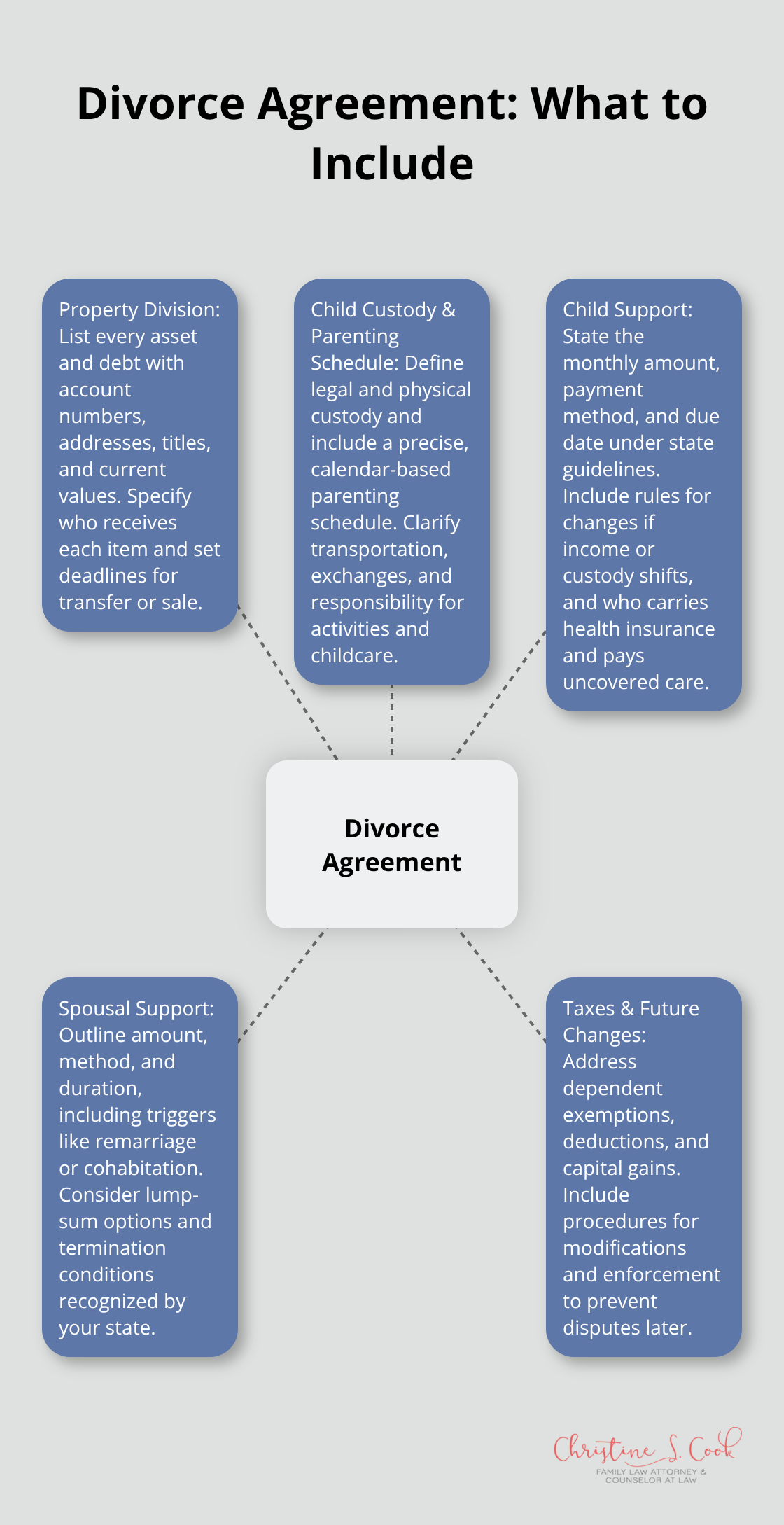
The agreement must cover property division, child arrangements, and financial support with precision and specificity to prevent misinterpretation.
Property division requires you to itemize every asset and debt, not summarize them broadly. List bank accounts with account numbers and balances, real estate with property addresses and current valuations, vehicles with titles and ownership details, retirement accounts including 401(k)s and IRAs with account numbers, and personal property of significant value. For each item, specify who receives it and set a deadline for transfer or sale. Debts demand equal attention: mortgage balances, credit card accounts, car loans, and personal loans all must be assigned to one spouse with a clear statement of who pays and when. If property sells after the divorce, clarify who handles the sale, pays realtor commissions, covers repairs needed for sale, and receives proceeds. Failing to address these details creates enforcement problems when one spouse doesn’t follow through.
Many couples with similar incomes split assets 50/50 and divide debts equally, though uneven income situations often require adjustments. Specify tax implications too: decide which spouse claims dependent exemptions, who benefits from mortgage interest deductions, and how you’ll handle capital gains taxes from asset sales.
Child custody involves two separate decisions: legal custody, which covers decision-making authority for education, healthcare, and discipline, and physical custody, which determines where the child lives and spends time. Joint legal custody is common in modern divorces, allowing both parents input on major decisions. Physical custody arrangements vary widely: joint physical custody means the child spends significant time in both homes, while sole physical custody places the child primarily with one parent.
Your agreement must include a detailed parenting schedule specifying exact days and times each parent has the child, including school days, weekends, holidays, and vacation periods. Use dates tied to school years or recurring events so the schedule remains relevant as your child grows. Address practical logistics: who handles transportation between homes, how you’ll exchange the child, and who pays for activities and childcare. Child support calculations typically follow state guidelines based on both parents’ incomes, the custody arrangement, and number of children. The agreement should state the monthly support amount, payment method, and due date. Include provisions for how support changes if either parent’s income changes significantly or if custody arrangements shift. Specify who carries health insurance for the child and who pays uncovered medical expenses.
Spousal support, also called alimony, compensates a lower-earning spouse for income disparity and is separate from child support. If you agree to spousal support, spousal support agreements specify the exact monthly amount, payment method, and duration. Some agreements set a fixed end date, while others tie support to events like the recipient’s remarriage or completion of education. Try a one-time lump-sum payment if it makes sense for your situation, which eliminates ongoing payment obligations and future disputes. Address how spousal support ends if the recipient cohabitates with a new partner, as many states recognize this as a reason to terminate support.
Beyond regular support, allocate responsibility for future expenses: court filing fees, mediation costs, attorney fees, and any costs related to enforcing the agreement. Insurance matters require attention too: decide whether either spouse remains on the other’s health insurance, life insurance policies, or other coverage. If one spouse’s retirement benefits will be divided, the agreement must specify how much transfers and include language that complies with your state’s requirements for dividing retirement accounts.
Clarity on these financial details prevents misunderstandings and makes the agreement enforceable if disputes arise later. However, translating these components into legally sound language requires expertise. The next section covers how you and your spouse can communicate effectively throughout this process, setting the foundation for agreements that both parties understand and can sustain.
Most couples considering divorce fail at the initial conversation. One spouse raises the topic, emotions spike, and the discussion derails into blame and defensiveness before any actual negotiation happens. The difference between a conversation that leads to an amicable agreement and one that triggers years of litigation often comes down to how you frame the discussion and what ground rules you establish before addressing specifics. You need a strategy that acknowledges the difficulty of the moment while keeping both parties focused on solving problems rather than winning arguments.
Start by selecting the right time and place for this conversation. Avoid discussing divorce during a meal, when either of you is exhausted or stressed, or in front of children. Schedule a dedicated conversation when you can both sit down without distractions. One spouse should initiate by stating the goal clearly: you want to discuss how to separate fairly and with minimal conflict, not to rehash relationship failures. This framing signals that the conversation is solution-focused, not accusatory.
Set explicit ground rules before you get into details. Both of you agree to speak without interrupting, to avoid name-calling or bringing up past grievances unrelated to the separation, and to take breaks if emotions become too intense. Many couples benefit from writing down what they want to say beforehand so they stay on track.
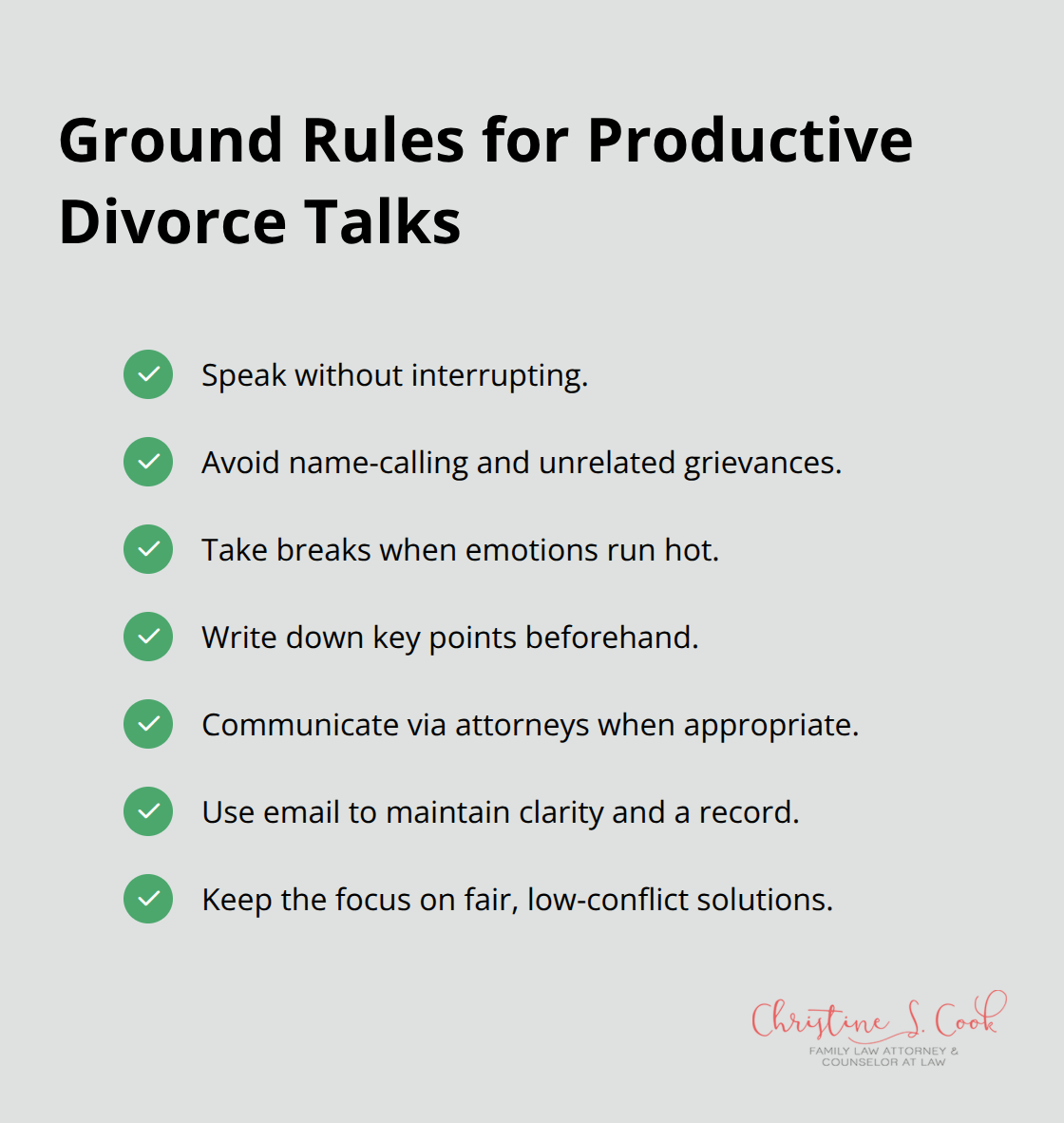
If one or both of you have an attorney, direct all communication through them using email or formal letters rather than in-person arguments. Written communication keeps discussions aligned with amicable goals and creates a record that prevents misunderstandings later.
Identifying your shared priorities makes negotiation far easier than starting from opposing positions. Most couples actually agree on more than they realize: protecting children from conflict, avoiding a courtroom battle, and keeping costs reasonable are nearly universal goals. Write down what each of you wants the outcome to look like. One spouse might prioritize staying in the family home while the other prioritizes a clean break from shared property. Neither position is wrong, but naming them explicitly lets you explore whether you can accommodate both or where compromise makes sense.
Ask direct questions about what matters most: Is maintaining an ongoing relationship important to you? Do you want to co-parent actively? Can you tolerate the other person dating someone new? These conversations are uncomfortable, but avoiding them guarantees conflict later. Property division often feels more negotiable than people expect. If you both understand the total value of marital assets and debts, you can often find divisions that feel fair to both parties without litigation. Transparency is non-negotiable here: share bank statements, property valuations, retirement account statements, and debt balances. Hidden assets or minimized debt figures destroy trust immediately and make amicable settlement impossible.
Emotions will run high during these discussions, and pretending otherwise wastes time. Acknowledge that divorce is painful and that strong feelings are normal. What matters is not whether you feel angry or sad, but whether you act on those feelings in ways that damage the negotiation. If a conversation becomes heated, pause it. Agree to resume at a specific time rather than continuing when emotions are raw. Some couples find it helpful to write responses to each other rather than speaking, especially on emotionally charged topics. This approach gives both people time to think before responding and reduces the likelihood of reactive statements you’ll regret.
A neutral mediator can teach you both communication techniques that keep discussions productive, and many mediators report that couples resolve issues faster and with less acrimony when they have structured guidance. The goal is not to become friends again, but to reach agreements you can both live with and actually follow through on. Once you establish these communication patterns, you’re ready to explore the legal options that support amicable settlements-starting with how collaborative divorce, mediation, and experienced family law representation work together to turn difficult conversations into binding agreements.
Collaborative divorce and mediation offer two distinct legal frameworks for reaching settlement. Your choice depends on your situation, your spouse’s willingness to cooperate, and how complex your finances are. Collaborative divorce brings together both spouses, their attorneys, and neutral specialists like financial advisors or child psychologists in a structured process designed specifically to reach settlement without litigation. Each party commits upfront to full financial transparency and to resolving disputes through negotiation rather than court.
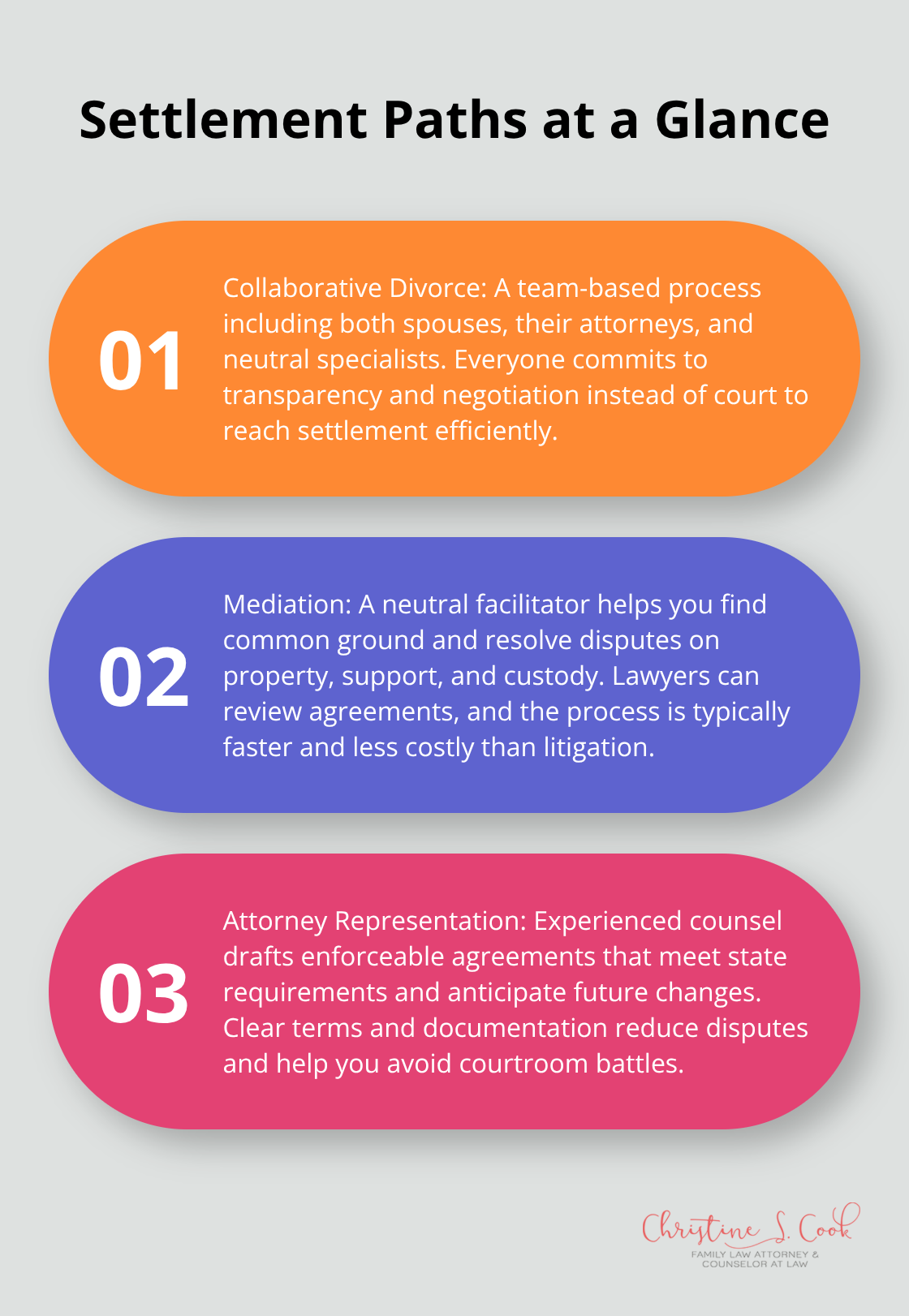
Mediation takes a different approach: a neutral third party facilitates discussions between you and your spouse, helping you identify common ground and work through disagreements on property, support, and custody. Unlike collaborative divorce, mediation doesn’t require attorneys to participate, though many people hire lawyers to review agreements before signing. Mediation typically costs significantly less than litigation and moves faster because sessions occur on your timeline rather than waiting for court dates.
In collaborative divorce, both attorneys must withdraw if either spouse breaks the commitment to negotiate in good faith. This built-in consequence makes collaborative divorce powerful for couples genuinely committed to amicable resolution. The process creates accountability: you cannot threaten litigation as a negotiating tactic without losing your legal team and starting over with new counsel. This structure forces both parties to problem-solve rather than posture, which accelerates settlement and reduces emotional damage.
A mediator guides you through discussions without deciding outcomes or taking sides. The mediator helps you identify what you actually agree on, which often surprises couples locked in conflict. Many mediators teach communication techniques that keep discussions productive, and couples report resolving issues faster and with less acrimony when they have structured guidance. The goal is not to become friends again, but to reach agreements you can both live with and actually follow through on.
An experienced family law attorney matters even in amicable divorces because attorneys draft agreements that withstand scrutiny, comply with state requirements, and actually get enforced if problems arise later. Many people try to minimize legal costs by handling everything themselves or using online templates, but imprecise language in divorce agreements creates expensive disputes years after the divorce is final. Specify exact dates, account numbers, and dollar amounts rather than vague terms. Include detailed parenting schedules tied to school calendars so the plan remains workable as children grow. Address how you’ll handle future changes to income, custody, or circumstances so you don’t need to modify court orders unnecessarily.
An attorney drafts these provisions correctly the first time. If you and your spouse are represented by different attorneys, professional correspondence via email keeps discussions aligned with amicable goals and creates documentation that prevents misunderstandings. Most divorces settle through negotiation rather than trial, and courts actively encourage alternative dispute resolution to clear overcrowded dockets. This means the legal system itself supports your goal of avoiding courtroom battles.
Your attorney’s job is to negotiate aggressively on your behalf while keeping the process civil, protecting your interests while moving toward settlement. The combination of clear communication with your spouse, structured legal processes like mediation or collaborative divorce, and experienced legal representation creates the conditions where amicable agreements become reality rather than wishful thinking. Christine S. Cook, LLC offers compassionate and innovative solutions for divorce, utilizing collaborative law techniques to achieve amicable settlements and providing aggressive court representation when necessary. A consultation with an experienced family law attorney before you choose your path ensures you understand your rights and obligations under Tennessee law and prevents you from agreeing to terms that harm your long-term interests.
An amicable divorce agreement requires more than good intentions between spouses. It demands clear documentation, honest communication, and professional guidance to translate your shared goals into legally binding terms that actually work. Without experienced legal representation, even well-meaning couples end up with vague language that creates disputes years later, forcing expensive modifications to court orders and undermining the peaceful settlement you worked to achieve.
Professional guidance protects you in ways that matter. An attorney ensures your agreement complies with Tennessee law, addresses every financial and custody issue comprehensively, and includes specific dates and dollar amounts rather than vague terms that invite misinterpretation. Your lawyer negotiates aggressively on your behalf while keeping the process civil, balancing your interests against the goal of settlement.
An amicable divorce agreement benefits everyone involved-you and your spouse avoid courtroom battles, reduce legal costs significantly, and maintain the ability to co-parent effectively if children are involved. Contact Christine S. Cook, LLC to discuss your situation and explore whether collaborative law or mediation fits your needs.