
Make a Payment
850-572-3443
Divorce can be a challenging process, and one of the most pressing concerns is often financial stability. At Christine Sue Cook, LLC, we understand the importance of securing your financial future after a marriage ends.
If you’re wondering, “Can I file for spousal support after divorce?” the answer is yes. This guide will walk you through the process, providing you with the knowledge and tools to navigate this complex aspect of divorce proceedings.
Spousal support (also known as alimony) is money one spouse pays the other in a divorce. This support aims to maintain financial stability for the receiving spouse and address economic disparities resulting from the marriage’s end.
Courts consider several key factors when deciding on spousal support:
For instance, a spouse who sacrificed their career to raise children for 15 years might receive substantial support to recognize their non-financial contributions.
Spousal support comes in three main forms:
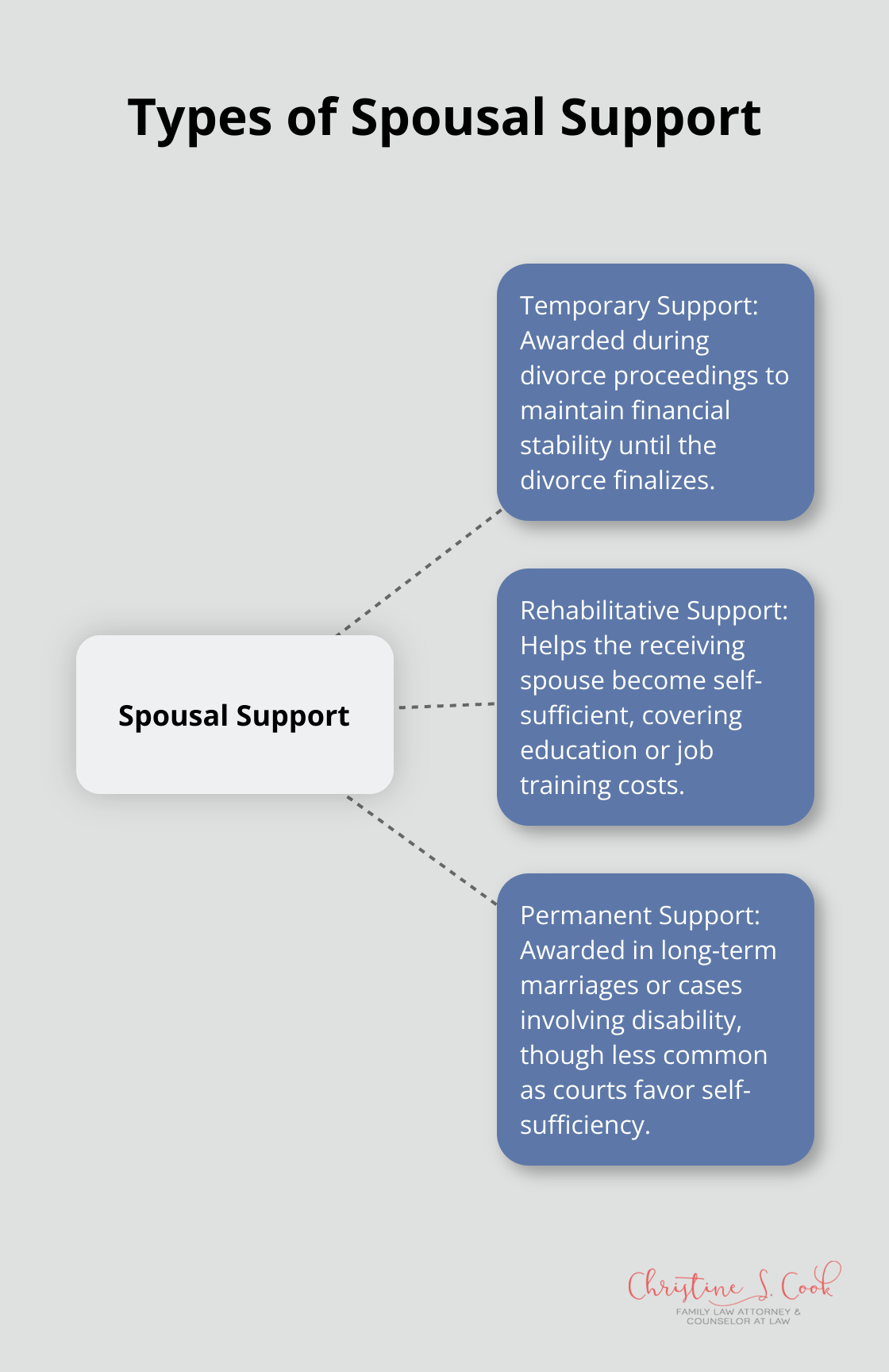
Spousal support significantly affects both parties’ financial situations. The paying spouse may experience reduced disposable income, while the receiving spouse gains crucial financial stability.
In Florida (where Christine Sue Cook, LLC operates), spousal support is not automatically awarded. It requires careful presentation of evidence and skilled negotiation. Attorneys with expertise in family law (such as those at Christine Sue Cook, LLC) can help secure fair spousal support arrangements.
As we move forward, it’s important to understand the steps involved in filing for spousal support. This process requires thorough preparation and strategic planning to ensure the best possible outcome for your financial future.
The first step in filing for spousal support requires you to gather comprehensive financial documentation. This includes:

These documents provide a clear picture of your financial situation and needs. They also demonstrate your ex-spouse’s ability to pay support.
While you can file for spousal support without an attorney, expert legal representation significantly improves your chances of a favorable outcome. A family law attorney can:
Many law firms (including Christine Sue Cook, LLC) offer free consultations to discuss your specific situation and legal options.
After you gather your documentation and consult with an attorney, you must file a petition with the court. This formal document outlines your request for support and the reasons you’re entitled to it.
In Florida, you must file this petition in the county where you or your ex-spouse resides. The filing fee varies by county but typically ranges from $300 to $400. If you can’t afford the fee, you can request a fee waiver from the court.
After filing, you must legally serve the petition to your ex-spouse. This step ensures they receive official notification of your request for spousal support. You can’t serve the papers yourself; instead, use:
Your ex-spouse typically has 20 days to respond to the petition. If they fail to respond, the court may grant your request for spousal support by default.
Filing for spousal support marks the beginning of a potentially complex legal process. You should prepare for negotiations, potential court hearings, and possible challenges from your ex-spouse. The next crucial step involves understanding how to effectively negotiate spousal support to secure the financial stability you need post-divorce.
Mediation provides a less adversarial alternative to court proceedings. A neutral third party helps you and your ex-spouse reach a mutually acceptable agreement. Mediation is the best hope for many clients to maintain some level of control over the settlement. It can lead to creative solutions that a court might not consider.
During mediation, you’ll discuss your financial needs and concerns openly. This can lead to creative solutions that a court might not consider. For example, you might agree to a higher spousal support amount for a shorter duration, or exchange other assets to reduce ongoing payments.
The collaborative law approach involves a team of professionals working together to resolve your divorce issues, including spousal support. This team typically includes attorneys, financial advisors, and mental health professionals.
Collaborative divorce is a form of alternative dispute resolution (ADR) that enables couples to negotiate their divorce settlement outside of court. This approach can be particularly effective when negotiating spousal support, as it allows for a comprehensive review of both parties’ financial situations and future needs.
Several factors can significantly impact your spousal support negotiations:

To negotiate spousal support effectively, you should:
While it’s possible to negotiate spousal support without an attorney, professional legal representation can significantly improve your chances of a favorable outcome. An experienced family law attorney can:
Many law firms (including Christine Sue Cook, LLC) offer free consultations to discuss your specific situation and legal options.
Spousal support after divorce requires careful preparation and strategic negotiation. You can file for spousal support after divorce, but the process demands a thorough understanding of your rights and obligations. Professional legal advice often improves the chances of a favorable outcome in these complex cases.
Amicable resolution through mediation or collaborative law frequently leads to more satisfactory agreements. These approaches allow for tailored solutions that fit unique circumstances and potentially save time, money, and emotional stress. Court battles can be avoided with creative problem-solving and open communication between parties.
Christine Sue Cook, LLC offers expert guidance through every step of the spousal support process. Our experienced team understands Florida family law nuances and protects your interests. We provide compassionate support and innovative legal strategies to help you achieve the best possible outcome in your spousal support case.