At Christine Sue Cook, LLC, we understand the complexities of divorce and family law matters in Florida.
Collaborative law offers a unique approach to resolving disputes without the need for litigation.
This process, gaining popularity in Florida, allows couples to work together with a team of professionals to reach mutually beneficial agreements.
In this post, we’ll explore how to navigate collaborative law in Florida and why it might be the right choice for your family law case.
Collaborative law in Florida represents a non-adversarial approach to resolve family law disputes. The Florida Collaborative Law Process Act became effective as of July 1, 2017. This method allows couples to work with a team of professionals to reach mutually beneficial agreements without court intervention.
The Act provides the legal foundation for this approach, outlining requirements for participation agreements, confidentiality, and the roles of involved professionals. It also specifies procedures for handling collaborative processes during pending divorce or paternity actions.
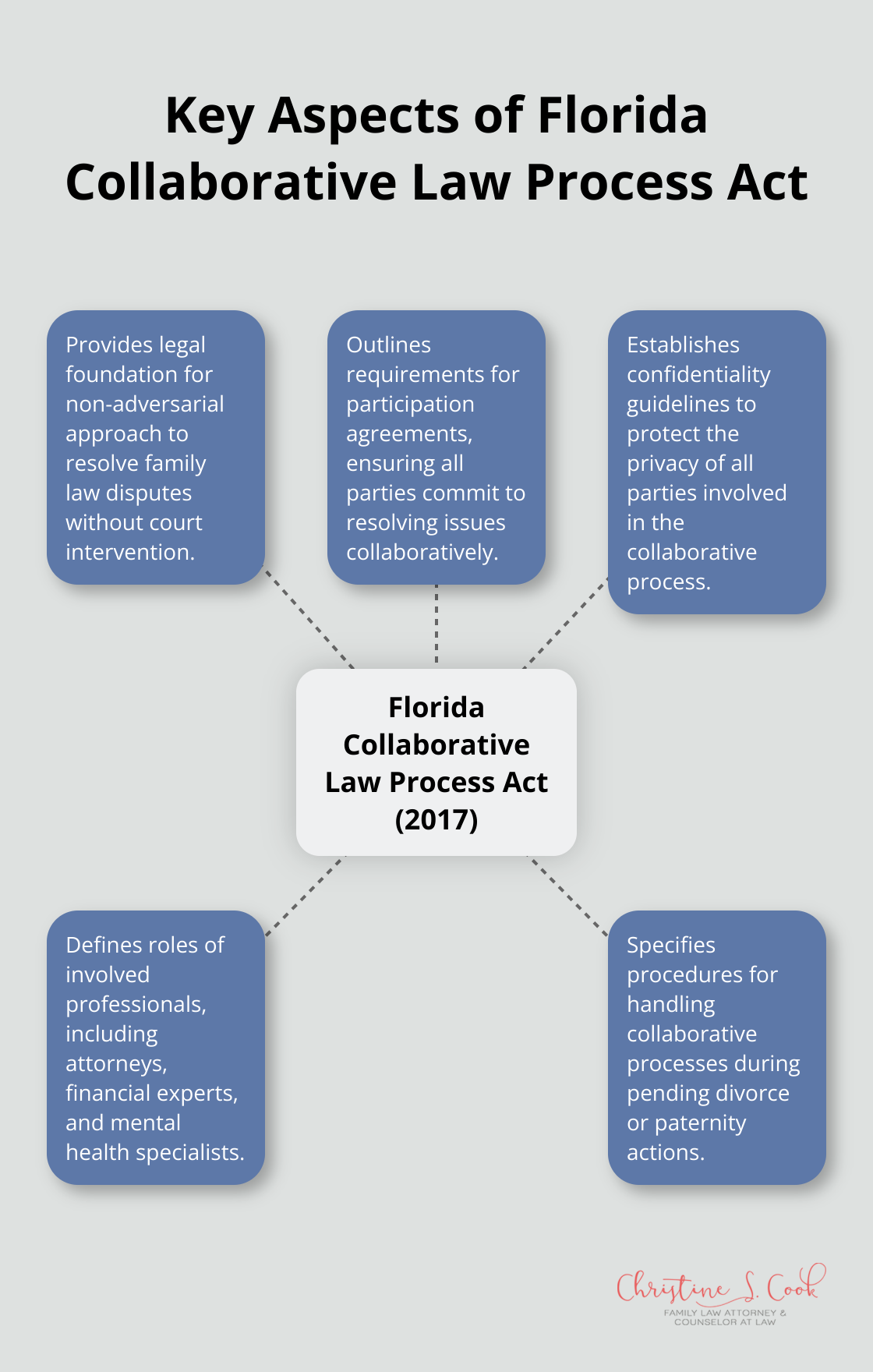
The core of collaborative law focuses on open communication, transparency, and problem-solving. Both parties and their attorneys sign a participation agreement, which commits them to resolve issues without litigation. This agreement also stipulates that if the process fails, the collaborative attorneys must withdraw, thus incentivizing all parties to work towards a resolution.
Collaborative law offers several advantages compared to traditional court battles:
To start the collaborative process, both parties must sign a written participation agreement. This document outlines:
The participation agreement serves as the foundation for the entire collaborative process, ensuring all parties understand their rights and obligations under Florida law.
As we move forward, we’ll explore the key players in the collaborative law process and their specific roles in facilitating successful resolutions.
Collaborative attorneys are essential in the collaborative law process. These legal professionals receive specific training in collaborative techniques, setting them apart from traditional divorce lawyers. In Florida, the Collaborative Law Process Act became law on July 1, 2017, as Section 61.56 Florida Statutes. Attorneys must complete a 14-hour Introductory Collaborative training to practice collaborative law.
These attorneys have a unique responsibility: if the collaborative process fails, they must withdraw from the case. This provision (often referred to as the “disqualification clause”) encourages all parties to work diligently towards a resolution, as starting over with new attorneys can prove costly and time-consuming.
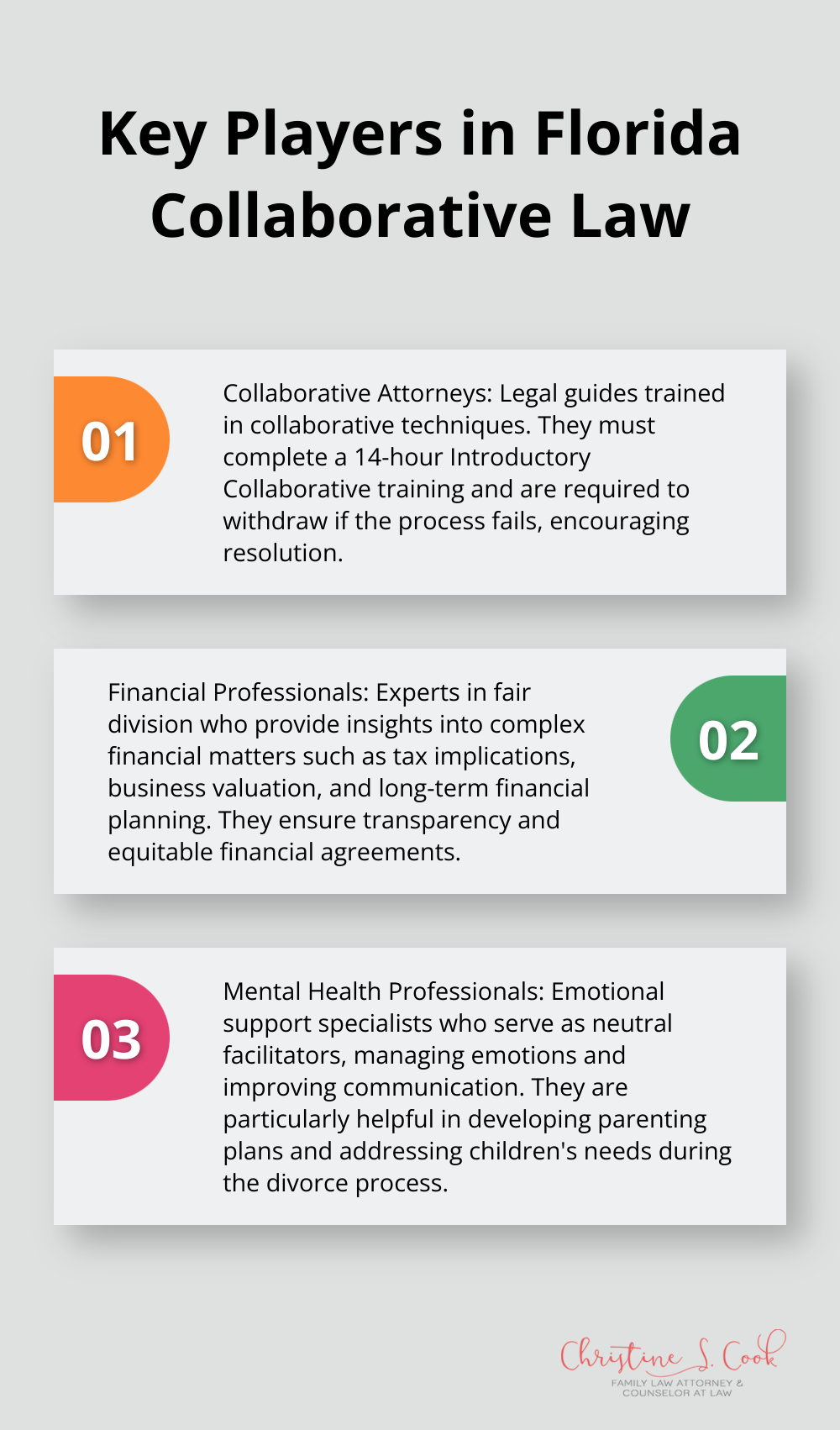
Financial professionals play a vital role in collaborative divorce. They help ensure the financial well-being of a divorcing couple and help craft workable financial agreements that consider everyone’s needs.
These experts provide invaluable insights into complex financial matters such as:
Their neutral stance helps ensure that both parties have a clear understanding of their financial future post-divorce. This transparency often leads to more equitable and sustainable financial agreements.
The emotional toll of divorce can weigh heavily on all parties involved. Mental health professionals, typically licensed therapists or counselors, serve as neutral facilitators to help manage emotions and improve communication between the parties.
These professionals prove particularly helpful when children are involved. They assist in developing parenting plans that prioritize the children’s well-being and help parents navigate co-parenting challenges. Their involvement often leads to more durable agreements and better post-divorce relationships between ex-spouses.
In cases involving children, child specialists may join the collaborative team. These professionals focus solely on the needs and best interests of the children throughout the divorce process. They work to ensure that the children’s voices are heard and their concerns addressed in any agreements reached.
Child specialists can help parents understand the impact of divorce on their children at different developmental stages. They also assist in creating age-appropriate communication strategies to help children cope with the changes in their family structure.
As we move forward, we’ll explore the specific steps involved in the Florida collaborative law process, from the initial consultation to the finalization of agreements.
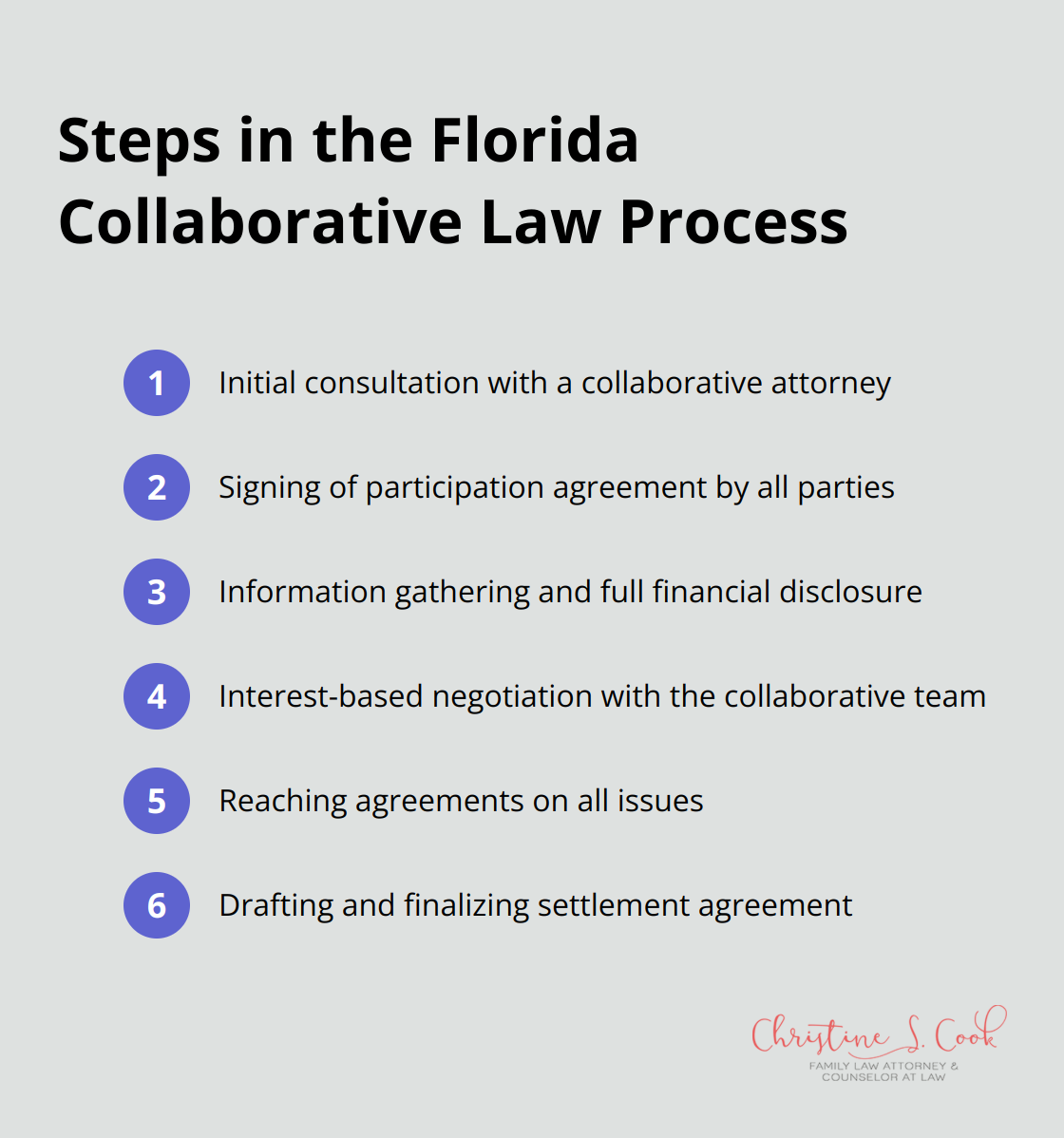
The collaborative law process in Florida starts with an initial consultation. During this meeting, an attorney assesses the case and determines if collaborative law suits the situation. The attorney explains the process, its benefits, and potential challenges. If the client decides to proceed, both spouses retain collaborative attorneys.
Next, all parties sign a participation agreement. This document outlines the ground rules for the process, including the commitment to full disclosure and the agreement not to litigate. If the collaborative process fails, both attorneys must withdraw from the case (this provision incentivizes everyone to work towards a resolution).
After signing the participation agreement, the process moves to the information gathering phase. This step ensures transparency and informed decision-making. Both parties disclose all relevant financial information, including assets, debts, income, and expenses. Financial neutrals often assist in this process, helping to organize and analyze complex financial data.
The collaborative divorce process in Florida allows couples to achieve creative, flexible, private settlement of family law matters without fighting in court.
With all information available, the process progresses to the negotiation phase. Collaborative law uses interest-based negotiation, which focuses on understanding the underlying needs and interests of both parties rather than just their stated positions.
This phase involves a series of meetings with the collaborative team. These meetings typically include both spouses, their attorneys, and any necessary neutral professionals (such as financial experts or child specialists). The team works to create solutions that address everyone’s concerns.
As negotiations advance, the team works to reach agreements on all issues. This might include property division, child custody arrangements, spousal support, and any other relevant matters. The collaborative process allows for flexible and creative solutions that may not be available in traditional court proceedings.
Once the team reaches agreements, they draft them into a formal settlement agreement. Both parties and their attorneys review this document to ensure it accurately reflects the agreed-upon terms. After any necessary revisions, the parties sign the agreement and submit it to the court for approval.
Collaborative law in Florida offers a refreshing approach to resolving family law disputes. This process fosters open communication, transparency, and cooperation, which allows couples to navigate divorce and other family matters with dignity and respect. The benefits include faster resolutions, cost-effectiveness, and the ability to craft personalized solutions that work for everyone involved.
The success of collaborative law depends on the expertise of the professionals involved. Experienced collaborative attorneys, financial experts, and mental health professionals work together to guide you through the process. They protect your interests while maintaining a focus on amicable resolution.
At Christine S. Cook, LLC, we understand the intricacies of collaborative law in Florida. Our team provides compassionate and innovative solutions for your family law needs. We offer free consultations to discuss your legal needs without financial pressure, ensuring you have all the information necessary to make informed decisions about your future.