Divorce settlement negotiations determine whether you control the outcome or leave it to a judge. Most divorces settle because both parties benefit from avoiding trial costs and uncertainty.
At Christine Sue Cook, LLC, we’ve seen firsthand how the right negotiation approach transforms contentious divorces into fair agreements. This guide shows you the strategies that actually work.
Settlement negotiation in divorce is a structured process where both parties work toward an agreement on property division, support obligations, and custody arrangements without a judge deciding the outcome. A U.S. Magistrate Judge who conducted over 100 settlement conferences annually across a 16-year period found that settlement discussions occur in almost every lawsuit, whether parties initiate them or a judge prompts them. This reality reflects a fundamental truth: most divorces settle because both parties gain more control, lower costs, and faster resolution than trial. When you negotiate, you shape the terms yourself rather than accepting whatever a judge imposes after hearing arguments and evidence. The difference matters enormously for your financial future and family stability.
Trial forces a winner-take-all mentality where one party gains and the other loses. Settlement allows both spouses to address underlying interests-not just surface positions-and create outcomes neither would achieve in court. A judge typically divides community property equally under state law, but settlement lets you structure asset division differently if both sides benefit. For example, one spouse might keep the family home and retirement accounts while the other receives a deferred payment plan, which works better for long-term financial planning. Litigation also costs significantly more in attorney fees, court costs, and lost time. Settlement negotiations compress these expenses and let you move forward faster. The emotional toll of trial-months of depositions, discovery, and courtroom appearances-exhausts families already stressed by separation. Settlement avoids this grinding process.
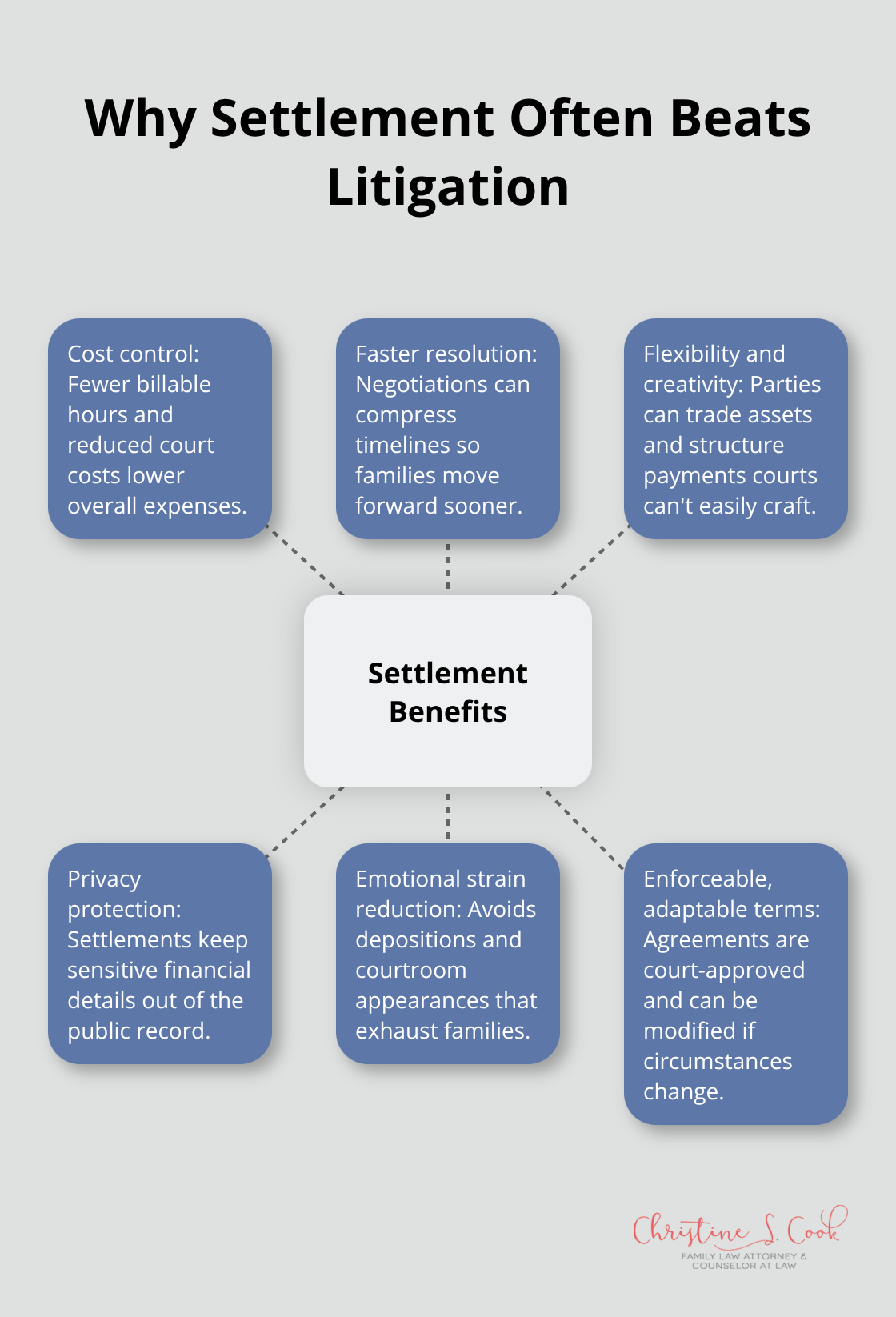
In litigation, a judge decides based on evidence presented and applicable law. You have limited influence over the outcome once trial begins. In negotiation, you control which issues matter most and how much flexibility you show on secondary concerns. Litigation creates a public record; settlement keeps financial details private. Litigation also locks outcomes into rigid court orders that require formal modification if circumstances change, whereas settlement agreements become enforceable once a court approves and includes them in the final decree. The negotiation process demands preparation and strategy, but underprepared lawyers and clients frequently derail talks (making reactive, emotional offers or refusing reasonable compromise). Effective negotiators approach settlement with clear financial priorities, organized documentation, and realistic expectations about what a court would award. This preparation directly shapes whether you reach terms you can live with or accept disappointing outcomes under pressure.
Wide variation exists in lawyer performance during negotiations. Outcomes often reflect preparation and strategy rather than luck or circumstance. Negotiators who invest time upfront to understand their client’s core goals, gather complete financial information, and anticipate the other party’s priorities tend to reach better agreements. Those who treat negotiation as a one-off exchange of offers instead of a structured process frequently miss opportunities to create win-win solutions. Effective negotiators develop a range of acceptable outcomes instead of fixating on a single demand. This flexibility allows you to pivot when talks stall and find creative solutions (such as deferred payments or asset transfers) that break deadlocks. The difference between a negotiator who prepares thoroughly and one who reacts emotionally can mean thousands of dollars and years of conflict.
Your next steps depend on whether you understand your own financial landscape and your spouse’s true priorities. Without this foundation, even skilled negotiation falters.
Start your negotiation by mapping exactly what you need financially and what you can live without. Most divorcing spouses never complete this work upfront, which is why they make reactive offers under pressure and accept terms they regret later. Sit down with your complete financial picture-bank statements, retirement account values, property assessments, debt obligations-and identify your three to five core priorities. These might include keeping the family home, securing adequate child support, or protecting your retirement accounts.
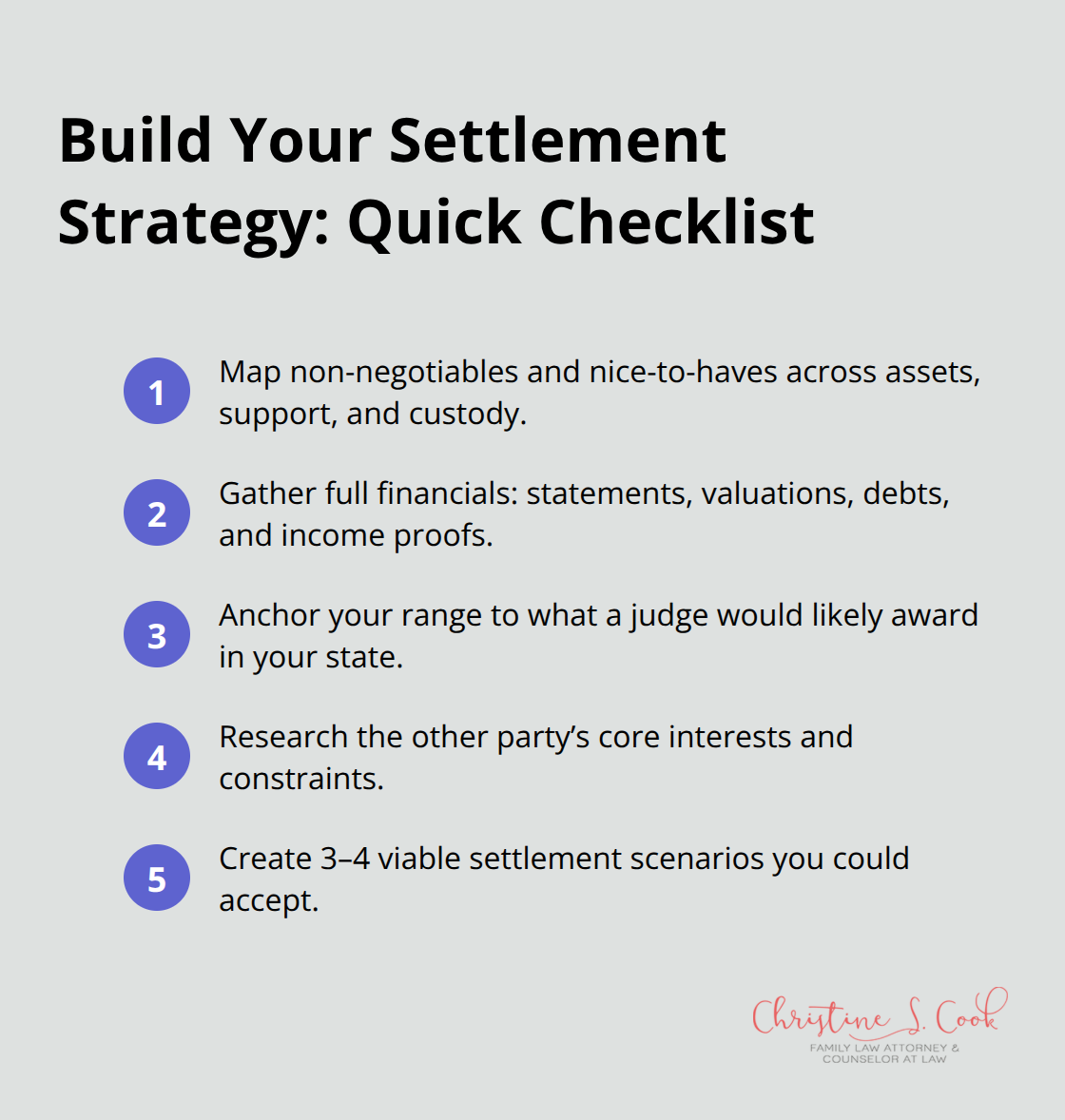
Assign each priority a realistic value based on what a judge would likely award under your state’s property division rules. If you live in a community property state like California, understand that earnings and debts incurred during your marriage are typically split equally, while assets you owned before marriage or inherited remain yours. This legal framework anchors your negotiation range and prevents you from demanding outcomes no court would grant.
Next, research what the other party likely wants. Do they prioritize minimizing spousal support obligations, maintaining custody time with children, or accessing liquid assets for a fresh start? Anticipating their underlying interests-not just their opening demands-lets you craft proposals that address both sides’ real needs. Gather documentation that supports your position: recent paystubs for income claims, appraisals for property values, and account statements showing asset growth during the marriage. Organized, credible financial information forces more serious discussion than vague assertions.
Develop multiple settlement scenarios instead of fixating on one outcome. Perhaps you keep the house but accept a lower retirement asset share, or you trade the investment property for a higher spousal support payment. Having three or four viable paths forward prevents you from becoming trapped in positional bargaining where both sides dig in and talks collapse.
The actual negotiation succeeds when you separate problems from the people involved. If your spouse resists your property division proposal, that resistance usually signals a concern you haven’t addressed, not stubbornness. Ask directly: what matters most about that asset or arrangement? Often you’ll discover they’re worried about cash flow for a mortgage refi, not attached to the property itself. That insight opens doors to creative solutions-perhaps you agree to carry a promissory note or delay the transfer until they refinance.
Concessions work best when they’re strategic concessions, not reactive. Make concessions on lower-priority items to signal good faith, but only if the other party reciprocates on issues that matter to you. If you immediately cave on every request, you signal weakness and invite further demands. Conversely, refusing all compromise signals you’re not serious about settlement, which pushes the case toward trial. The sweet spot is trading: you give ground on the car and furnishings if they move significantly on child support or retirement asset division.
Write down every agreement the moment you reach it, even informal ones. Verbal agreements vanish in memory disputes. Email the other party’s attorney a brief summary: we agree that the 401(k) will be divided via QDRO with you receiving 40 percent, effective within 60 days of the final judgment. This creates a record and prevents backtracking.
If negotiations stall on a major issue, pause rather than accept a bad deal under deadline pressure. Courts understand that some cases need time to settle; a judge won’t penalize you for reasonable deliberation. If direct negotiation isn’t productive, mediation or collaborative divorce processes can refocus discussions and generate options neither side saw alone. The goal isn’t to win every point-it’s to reach an agreement that lets you move forward without the expense and emotional drain of trial. Once you’ve built this foundation and tested your negotiation approach, the next critical step involves understanding how to structure the actual settlement agreement itself.
Emotion hijacks settlement negotiations more often than bad math or hidden assets. When your spouse proposes a property division that feels unfair, your immediate reaction is hurt or anger-and that reaction almost always leads to rejecting reasonable offers or making demands you later regret. A U.S. Magistrate Judge who conducted over 100 settlement conferences annually noted that underprepared lawyers and clients frequently derail negotiations when feelings drive decisions rather than strategy. The fix is mechanical: when you receive a proposal, don’t respond immediately. Tell the other party’s attorney you need 48 hours to review and discuss with your legal team. This pause strips away the emotional charge and lets you evaluate the offer rationally against your documented priorities.
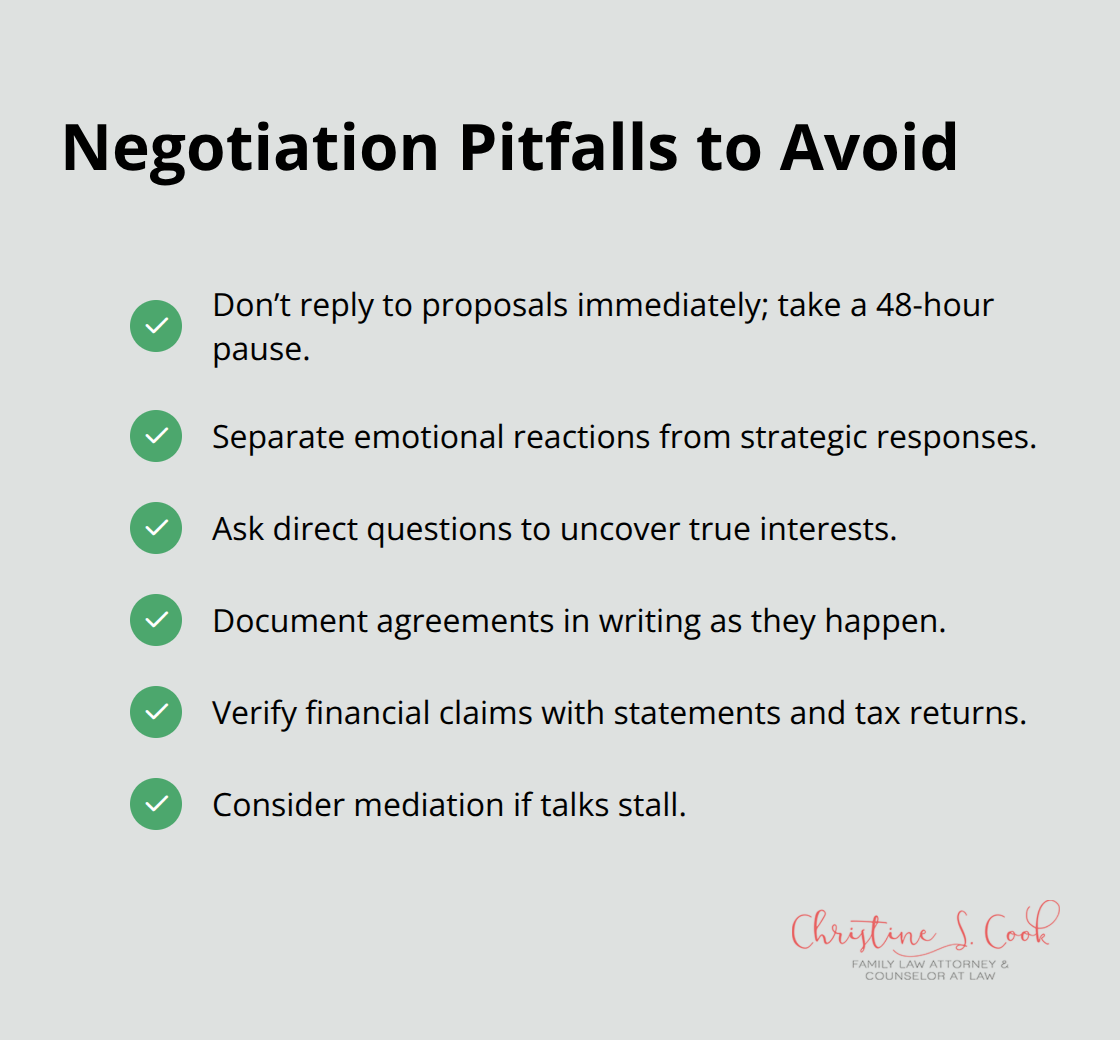
Write down your emotional reaction separately from your strategic response. Often you’ll discover the proposal addresses more of your core needs than your gut feeling suggested. The divorces that settle fastest aren’t the ones where both parties stay calm-they’re the ones where both parties separate their feelings from their decisions and treat the negotiation as a business transaction, because that’s what it is.
Failing to understand your spouse’s actual position costs you thousands in unnecessary concessions. Most divorcing spouses assume they know what the other party wants (money, minimal support, full custody) when they actually have no idea. You hear their opening demand and think that’s their real goal, but opening demands are theater-they’re anchoring positions designed to seem unreasonable so the eventual settlement looks reasonable by comparison.
To navigate this, ask direct questions during negotiation: what specific outcome would solve your cash flow problem? Why does that asset matter to you? What would happen if we structured this differently? Often you’ll find they care deeply about one issue and barely care about another. One spouse might fight fiercely over the investment property because they fear insufficient liquid assets, while they’d gladly concede on furniture and personal items. That insight lets you trade: you keep the investment property, they receive additional retirement assets or a higher spousal support payment. Without this understanding, you make concessions on everything and still can’t reach agreement because you’re not addressing what actually matters.
Full financial disclosure is non-negotiable. If you suspect hidden assets or liabilities, request organized discovery early and consider forensic accounting if disclosures seem incomplete. Hidden assets discovered after settlement can trigger court sanctions and destroy any agreement you’ve reached. The cost of forensic accounting is far cheaper than discovering years later that your spouse concealed income or assets.
Document everything your spouse claims about their financial situation and verify it independently through tax returns, bank statements, and employment records. This verification process also reveals whether they’re underestimating their actual ability to pay child support or spousal support. You protect yourself by treating financial claims as assumptions until you confirm them with hard evidence.
Settlement negotiation in divorce succeeds when you prepare thoroughly, separate emotion from strategy, and understand what both parties actually need. The techniques covered here-mapping your financial priorities, researching the other party’s true interests, making strategic concessions, and pausing when talks stall-directly shape whether you reach a fair agreement or accept disappointing terms under pressure. Effective settlement avoids the months of depositions, court appearances, and attorney fees that trial demands, and it lets you control your financial future and family stability instead of leaving those decisions to a judge.
The long-term benefits of a fair settlement extend far beyond the divorce itself. You preserve privacy around sensitive financial details, avoid a public court record, and maintain the ability to modify terms later if circumstances change significantly. Families with children benefit most because settlement keeps conflict contained and allows both parents to focus on co-parenting rather than courtroom battles.
Moving forward requires experienced legal guidance. At Christine S. Cook, LLC, we help clients navigate settlement negotiations with clear strategy and compassionate support. Contact us for a free consultation to discuss your specific needs without financial pressure.