Separating from your spouse doesn’t always mean divorce is the right choice. Many people choose legal separation instead of divorce for financial, religious, or personal reasons that matter deeply to their situation.
At Christine Sue Cook, LLC, we help clients understand which path makes sense for them. The decision between these two options can significantly affect your benefits, taxes, custody arrangements, and future possibilities.
Legal separation is a formal court process where spouses live apart while remaining legally married. Unlike informal separation, it requires filing a Petition for Legal Separation with the court, which then issues orders addressing custody, support, and asset division-much like divorce-but stops short of ending the marriage itself. The marriage remains in place until you file for and obtain a final Judgment of Dissolution of Marriage.
This distinction matters more than many people realize. According to CDC data, the average marriage that ends in divorce lasts about 8 years, meaning couples often spend years deciding whether to fully dissolve the relationship. A legal separation creates breathing room during this critical decision period. You can live completely separate lives, establish clear financial and parenting arrangements, and test whether the relationship can improve without the permanence of divorce. In some jurisdictions, separation can continue indefinitely, giving you no deadline to finalize anything. The court handles the same issues as divorce: parental responsibilities, parenting time, child support, spousal support, and division of assets and debts. What changes is the outcome-you exit the process still married, not divorced.
The formal legal nature of separation protects both spouses in ways informal separation does not. A separation agreement drafted by an attorney clearly specifies who pays existing debts, how future debts are handled, and how property will be divided. This prevents one spouse from accumulating joint debt without the other’s knowledge or consent.
You retain inheritance rights and can make medical decisions for each other unless you explicitly change these through legal documents. Separated spouses also maintain the ability to file joint tax returns, which the IRS allows for married couples. This flexibility matters significantly for households managing multiple income sources or deductions. Health insurance becomes more manageable too-you typically remain eligible for coverage under your spouse’s employer plan during separation, a benefit that ends immediately after divorce.
If you have children, the court’s custody orders carry full enforcement power, meaning either parent can pursue contempt charges if the other violates the arrangement. An informal separation has no such teeth. This legal structure also positions you well if you eventually decide to divorce. The separation agreement often becomes the foundation for your divorce settlement, reducing negotiation and court time when you finally choose to end the marriage. Roughly 95 percent of divorces settle without trial, and many of those settlements build directly from separation agreements already in place.
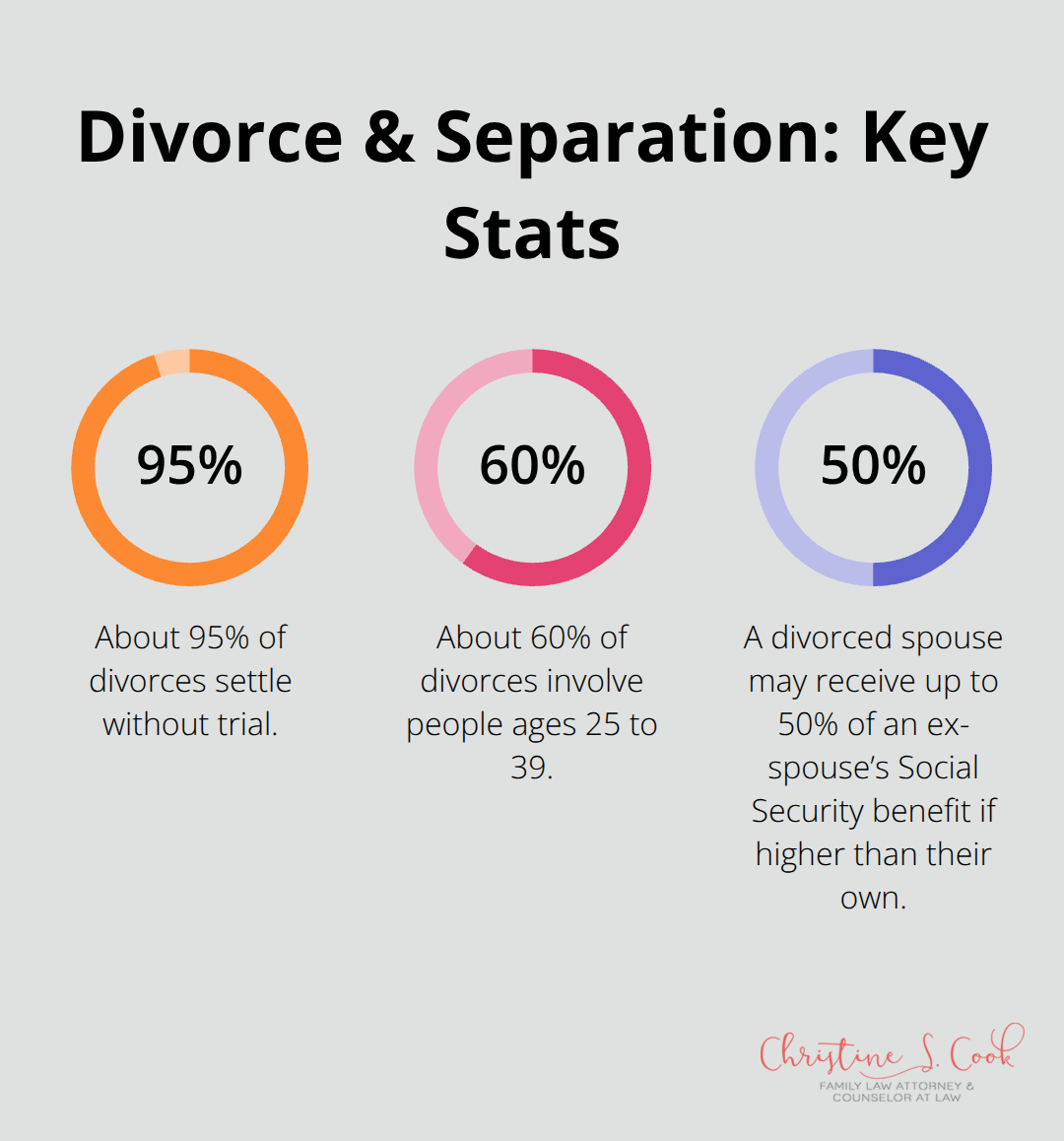
Separation makes strategic sense when you are within striking distance of the 10-year marriage threshold for Social Security benefits. According to the Social Security Administration, you may be eligible for benefits if you’ve been married at least 1 year and are age 62 and older. If you are at year 9 or 10 of your marriage and considering ending it, legal separation lets you delay the final divorce until you cross that threshold. Once the 10-year mark passes, you can proceed to divorce knowing your ex-spouse cannot claim benefits based on your record. A divorced spouse’s benefit is the greater of their own benefit or 50 percent of the ex-spouse’s benefit, so this timing decision affects retirement income significantly.
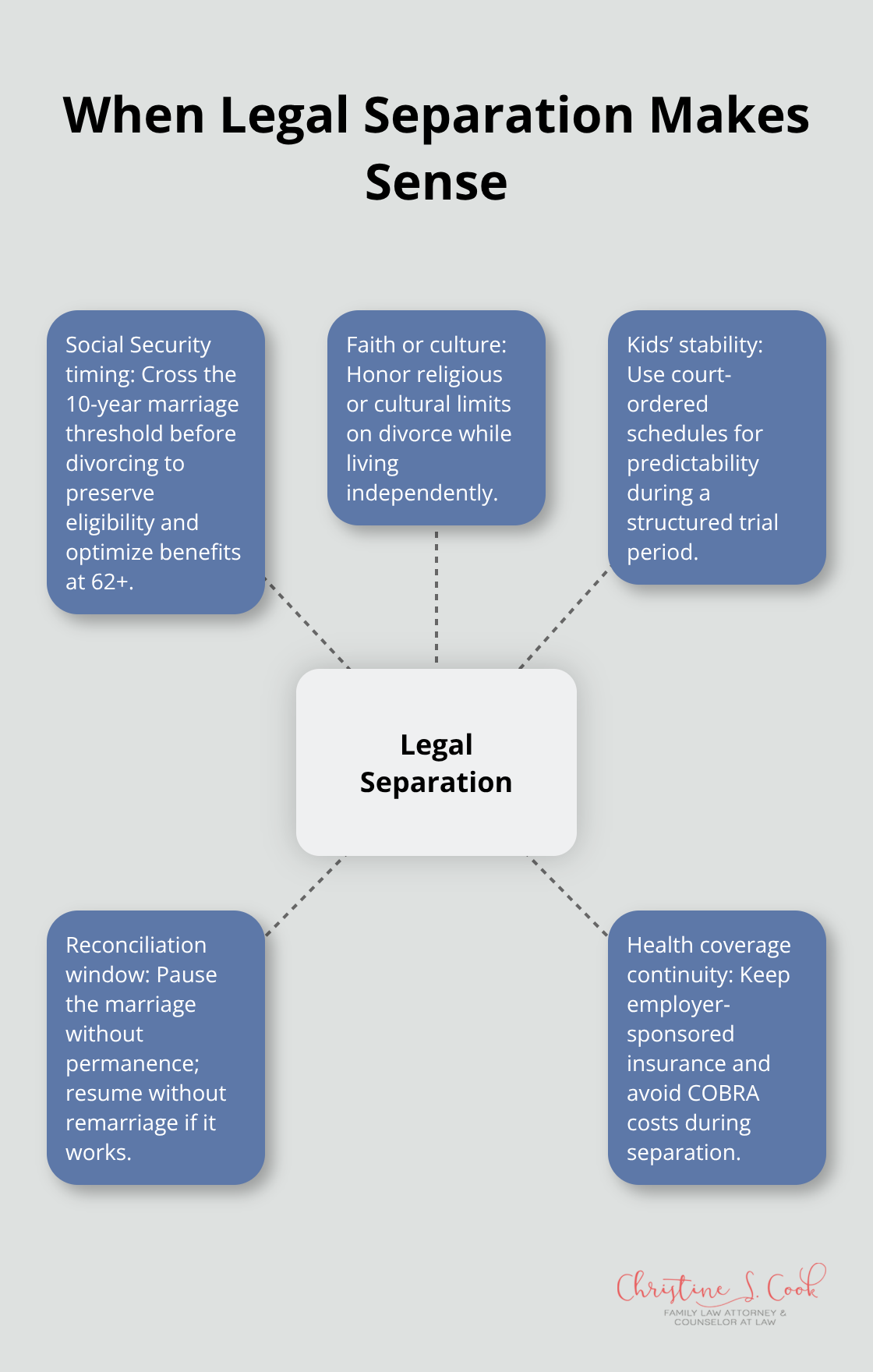
Separation also makes sense when religious or cultural beliefs prohibit divorce but allow separation. You live apart, resolve financial and custody matters, and honor your values simultaneously. For couples with minor children, separation provides a structured trial period that establishes clear parenting schedules and financial obligations while your children remain in a legally stable environment. The average age for a first divorce is around 30, with about 60 percent of divorces involving people aged 25 to 39, a life stage when many parents want stability for their kids.
Separation costs less upfront than divorce in many cases, since you avoid the finality costs and can extend the process over time. If you ultimately reconcile after a legal separation, you resume married life without remarriage paperwork. This option exists only with separation, not divorce. These financial and relational benefits position separation as a practical middle path when your future remains uncertain.
Health insurance coverage stands as one of the most tangible advantages of legal separation. When you divorce, your spouse’s employer health plan terminates your coverage immediately, forcing you to navigate COBRA continuation coverage or purchase individual insurance through Healthcare.gov. COBRA allows you to remain on the plan for up to 36 months, but you pay the full premium plus administrative fees. During legal separation, you typically remain eligible for coverage under your spouse’s employer plan at no additional cost, preserving the same benefits you had while married. This matters enormously if you have chronic health conditions, take expensive medications, or have children with ongoing medical needs. Staying on an existing plan avoids coverage gaps, maintains established doctor relationships, and eliminates the disruption of switching insurers mid-treatment.
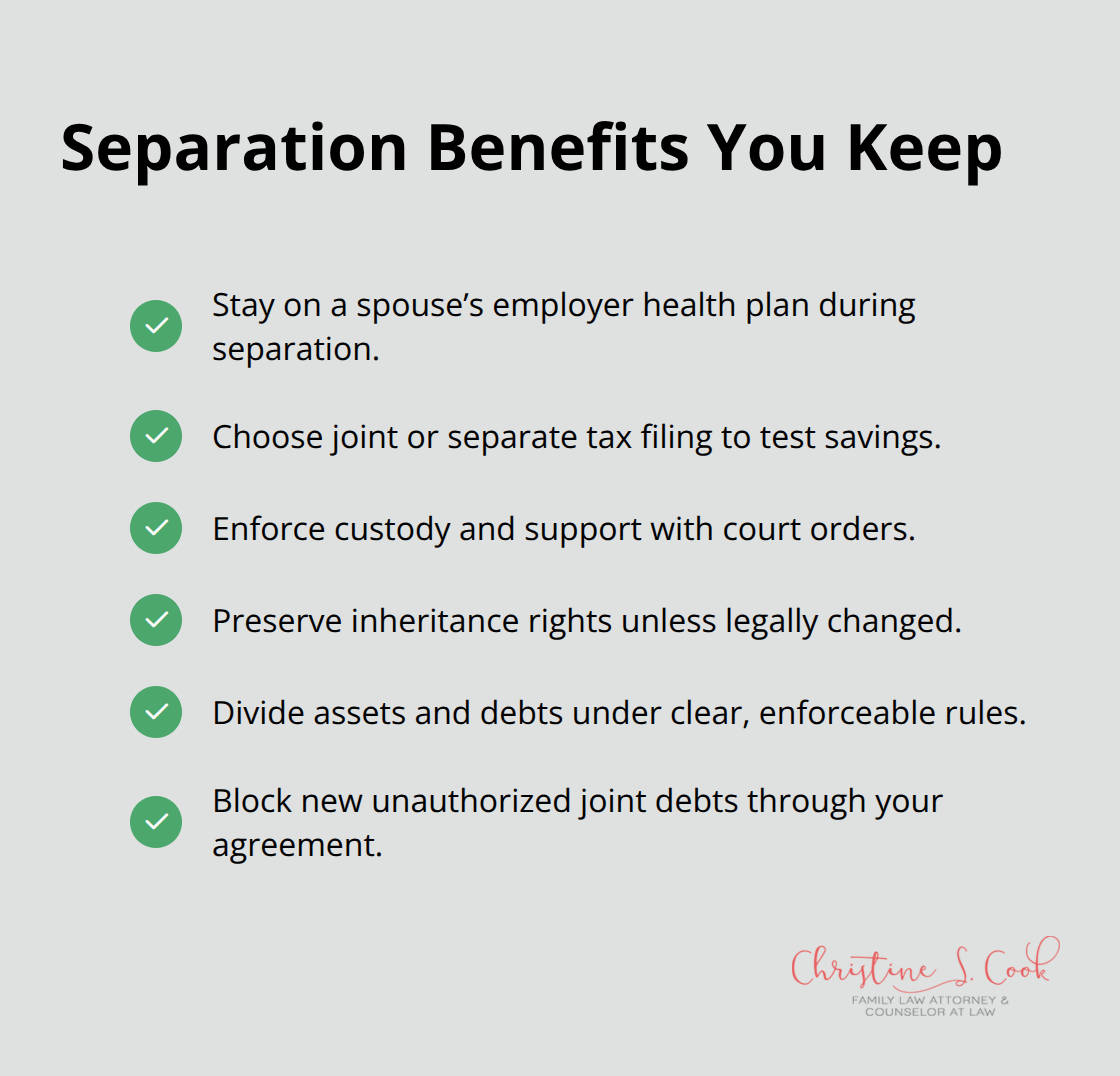
The IRS permits married couples filing separately to claim many of the same deductions and credits available to joint filers, including the standard deduction, child tax credits, and dependent exemptions. If one spouse earns significantly more income, filing separately can reduce the household’s overall tax burden compared to joint filing, especially when one spouse has substantial deductions or charitable contributions. Separation allows you to test different filing strategies before finalizing divorce. Some households benefit from filing jointly during separation years, while others see savings from filing separately. A tax professional can model both approaches using your actual income and deductions to identify which strategy saves the most. Divorced couples lose this flexibility permanently.
Retirement benefits also remain protected during separation. Pensions and 401(k) accounts accumulated during the marriage stay subject to the same division rules as divorce, but separation gives you time to evaluate the actual value of retirement assets before finalizing any split. This prevents rushed decisions about asset division that could cost you thousands in retirement income decades later.
Court-ordered custody and support arrangements during separation carry the same enforcement authority as divorce orders. If your co-parent violates the parenting schedule, fails to pay child support, or breaches other terms, you can file a contempt motion and ask the court to enforce compliance through sanctions, wage garnishments, or modified arrangements. An informal separation agreement lacks this enforcement mechanism entirely. The other parent can simply ignore terms without legal consequence.
During legal separation, the court establishes clear parenting time schedules, decision-making authority for medical and educational choices, and specific support amounts. This structure protects children by removing ambiguity about where they spend time and who makes important decisions. For working parents, formal custody orders also provide documentation that employers recognize when calculating FMLA leave, flexible work arrangements, or childcare benefits. Courts can enforce makeup parenting time if the other parent misses scheduled days, preventing one parent from unilaterally changing arrangements.
A separation agreement drafted by an attorney clearly assigns responsibility for existing debts and establishes rules for future debt incurrence. One spouse cannot accumulate credit card debt, take out loans, or mortgage property without the other’s knowledge or consent if the agreement explicitly prohibits it. This protection prevents one spouse from sabotaging the other’s credit or creating hidden liabilities that surface later.
Property division during separation follows the same valuation methods as divorce, but separation allows you to divide assets gradually if it makes financial sense. Some families benefit from keeping the family home in both names during separation while one spouse buys out the other’s interest over time, rather than forcing an immediate sale. This approach can save significant transaction costs and allow children to remain in their home while parents decide the relationship’s future. Separated spouses retain full inheritance rights unless they execute documents specifically removing those rights, meaning if one spouse dies during separation, the other inherits as a surviving spouse rather than being cut off entirely.
These financial and custody protections create a stable foundation while you navigate your decision. An experienced family law attorney can help you structure a separation agreement that maximizes these benefits and addresses your specific circumstances. Christine S. Cook, LLC offers free consultations to discuss how legal separation might work for your situation and what protections matter most for your family’s future.
For many people, the choice between legal separation and divorce hinges on deeply held beliefs rather than financial optimization. If your faith tradition views divorce as sinful, forbidden, or contrary to your core values, legal separation offers a legitimate path forward that respects those convictions while still allowing you to live independently. Catholic doctrine, certain evangelical Christian teachings, Orthodox Judaism, and Islam all carry varying degrees of restriction on divorce, yet most recognize separation as morally acceptable. Legal separation lets you honor these commitments without pretending the marriage still functions. You establish separate households, handle finances independently, and arrange custody through court orders, all while remaining technically married in the eyes of both law and faith.
This matters practically because it removes the internal conflict many people experience when forced to choose between their beliefs and their wellbeing. A person staying in an unhealthy or unsafe marriage out of religious fear can instead pursue legal separation, which provides court-enforced protections for custody and support without violating their conscience.
The reconciliation window that legal separation provides carries real psychological weight. Some couples genuinely need time and space to determine whether the relationship can improve, and separation creates that opportunity without the permanence of divorce. If you reconcile during separation, you simply resume married life without remarriage paperwork or legal complications. This matters because divorce eliminates that option entirely.
Research on marriage duration shows that the average first marriage ending in divorce lasts about 8 years, suggesting most people benefit from a structured pause to assess whether the relationship has genuine potential. Separation also shields children from the emotional finality of divorce while establishing clear rules about parenting time and financial support.
The emotional toll of prolonged conflict often drives people toward divorce quickly, but a legal separation framework can actually reduce that toll. Separation creates predictable arrangements and clear boundaries without the hostile finality of dissolution. Many parents find this middle ground reduces the psychological weight on their kids during an uncertain period. The court’s custody orders establish who makes medical decisions, where children spend time, and how much support flows between households-removing ambiguity that fuels ongoing conflict.
When both parents know exactly what to expect (parenting schedules, financial obligations, decision-making authority), they can focus on their children’s adjustment rather than fighting over undefined terms. This structured approach often produces better outcomes for children than the uncertainty of informal separation or the acrimony that sometimes accompanies contested divorce. An experienced family law attorney can help you structure a separation agreement that protects your family’s emotional wellbeing while honoring your values and your genuine needs rather than assumptions about what separation means.
Legal separation offers a practical path forward when divorce feels too permanent or misaligned with your values. Throughout this guide, we’ve covered the financial protections-health insurance, tax flexibility, and retirement benefits-that remain available during separation. We’ve also examined why legal separation instead of divorce makes sense for people whose faith traditions or personal circumstances call for a less final approach.
The decision between these two options depends entirely on your situation. If you’re within reach of the 10-year Social Security threshold, separation buys you time to cross that line before finalizing anything. If reconciliation remains possible and you want to preserve that option, separation keeps that door open without remarriage complications.
An experienced family law attorney can help you evaluate whether separation or divorce aligns better with your financial goals, custody needs, and personal values. Contact Christine S. Cook, LLC to discuss your specific circumstances without pressure and map out the approach that works best for you.