
Make a Payment
850-572-3443
At Christine Sue Cook, LLC, we often encounter clients grappling with the decision between mediation and collaborative divorce.
Understanding what is the difference between mediation and collaborative divorce is crucial for couples seeking an amicable separation.
Both methods offer alternatives to traditional litigation, but they have distinct features that may suit different situations.
This blog post will explore these two approaches, helping you make an informed choice for your unique circumstances.
Divorce mediation offers couples a way to negotiate their separation terms with the help of a neutral third party. This process often leads to more amicable and cost-effective resolutions compared to traditional court litigation.
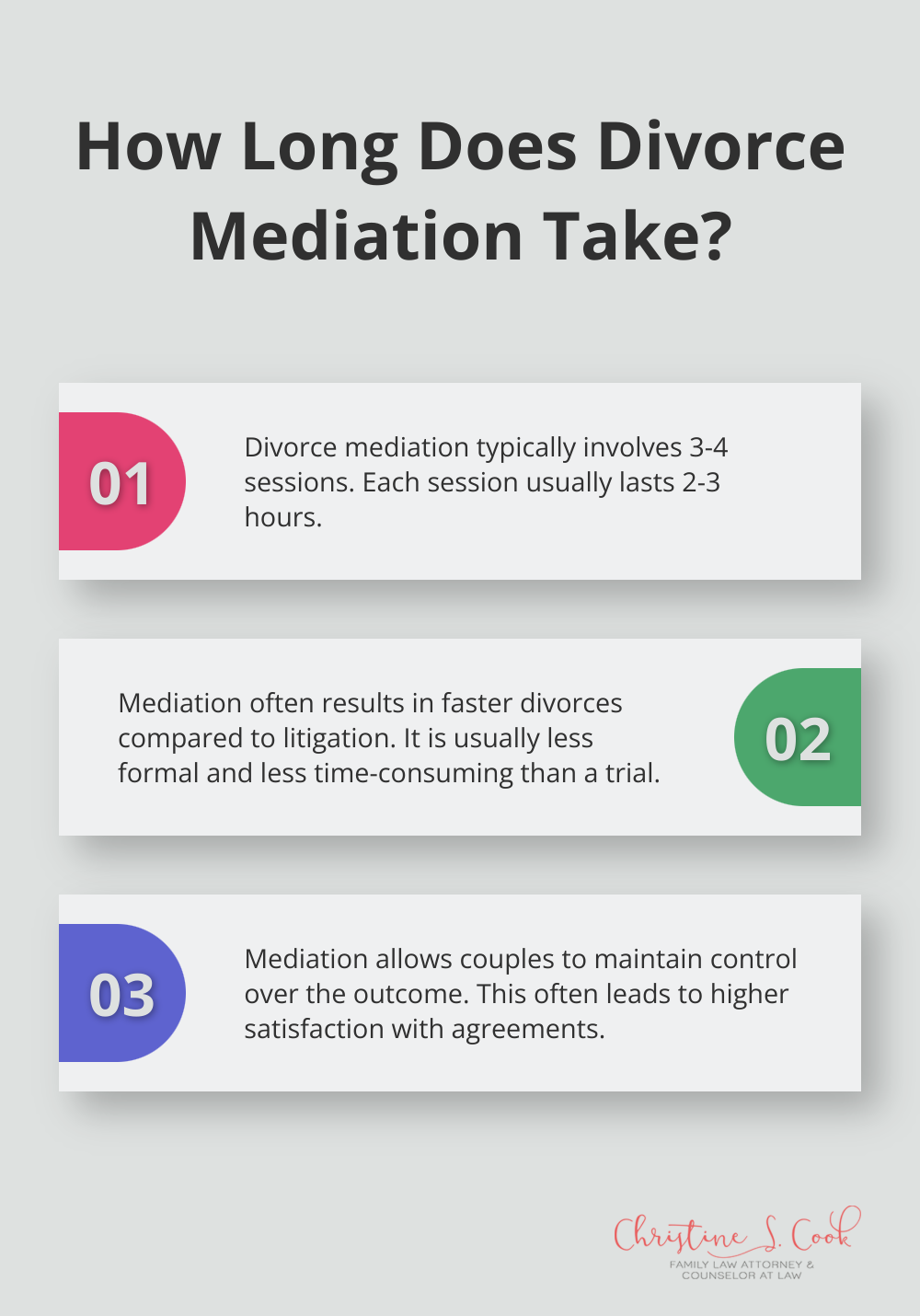
In mediation, both spouses meet with a mediator to discuss and resolve issues such as property division, child custody, and financial support. The mediator doesn’t make decisions but facilitates communication and helps the couple find common ground. This process typically involves 3-4 sessions, each lasting 2-3 hours.
A skilled mediator acts as a neutral facilitator, helping couples communicate effectively and explore potential solutions. They provide information about legal processes (without offering legal advice) and guide discussions, ensuring both parties have equal opportunities to express their needs and concerns.
Mediation often results in faster and less expensive divorces compared to litigation. Alternative dispute resolution is usually less formal, less expensive, and less time-consuming than a trial. Additionally, mediation allows couples to maintain control over the outcome, which often leads to higher satisfaction with agreements.
While mediation has many advantages, it doesn’t suit all situations. Cases involving domestic violence or significant power imbalances may not benefit from mediation. Moreover, if one spouse refuses to compromise or disclose financial information, the process can stall.
Mediation requires both parties to negotiate in good faith. Without this commitment, the process may fail, potentially leading to increased costs and delays if litigation becomes necessary.
Each case requires individual assessment to determine if mediation presents the best approach. Couples should consider their ability to communicate, willingness to compromise, and the complexity of their case when deciding on mediation. For those unsure about their situation, consulting with a family law attorney (such as those at Christine S. Cook, LLC) can provide valuable insights into whether mediation suits their specific circumstances.
As we explore the benefits and potential challenges of mediation, it’s important to consider another alternative dispute resolution method: collaborative divorce. This approach shares some similarities with mediation but offers a distinct process that may better suit certain couples.
Collaborative divorce offers a structured approach to end a marriage that emphasizes cooperation over confrontation. This method often leads to more satisfying outcomes for many couples.
In a collaborative divorce, each spouse hires an attorney trained in collaborative law. These attorneys sign an agreement to resolve all issues without court intervention. If the process fails and litigation becomes necessary, both attorneys must withdraw, and the couple must hire new representation.
Collaborative divorce often involves a team of professionals beyond attorneys:
This team approach ensures experts in their respective fields handle all aspects of the divorce.
Collaborative divorce offers more flexibility, control, and confidentiality while Traditional Litigation puts decisions in the hands of a court:
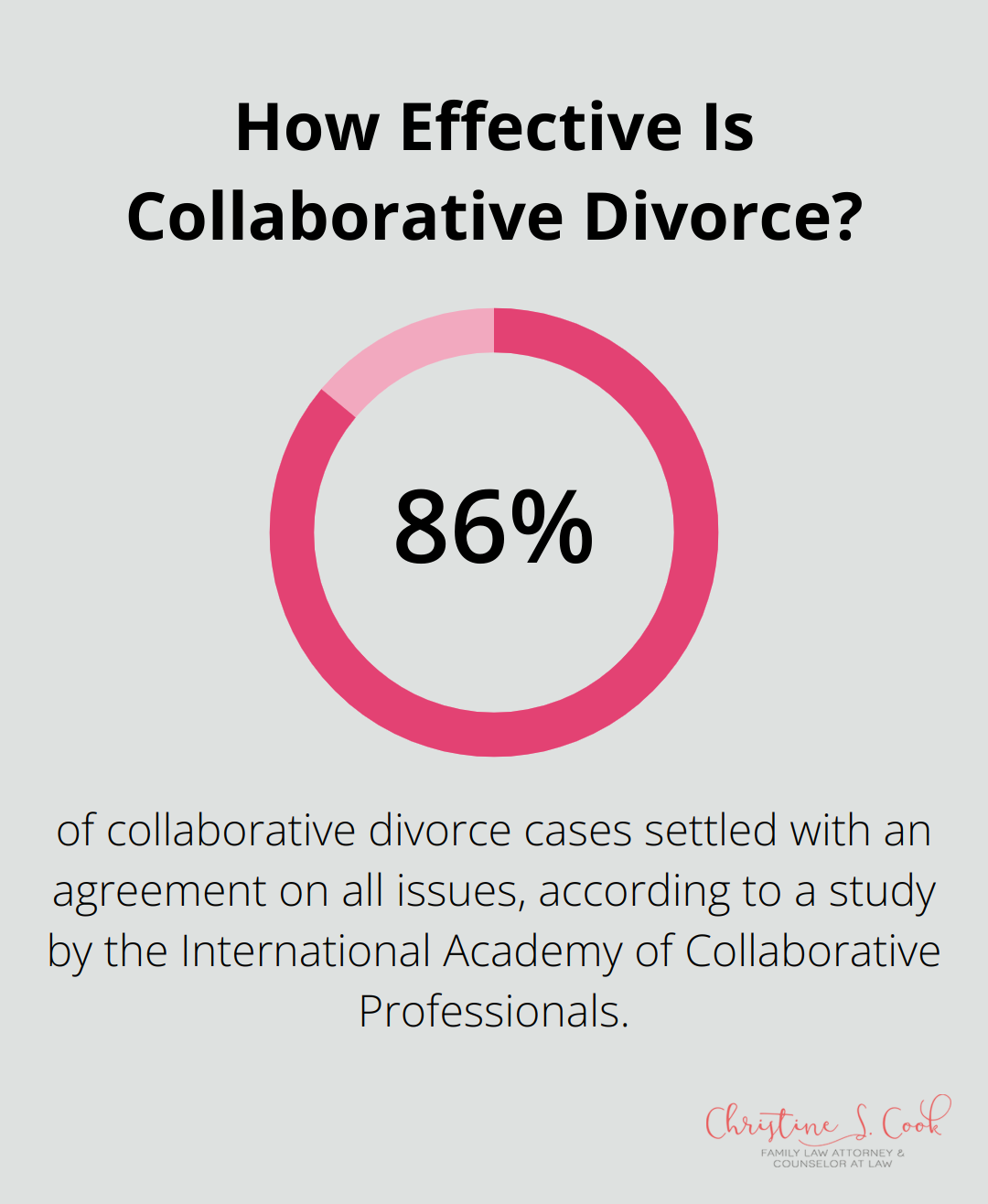
A study by the International Academy of Collaborative Professionals found that 86% of collaborative divorce cases settled with an agreement on all issues.
While collaborative divorce has many advantages, it presents some challenges:
To determine if collaborative divorce fits a couple’s situation, factors such as asset complexity, the presence of children, and the couple’s ability to communicate and compromise must be considered. A thorough evaluation of these elements helps ensure the best approach for each unique case.
As we explore the intricacies of collaborative divorce, it becomes clear that both this method and mediation offer distinct advantages. To help couples make an informed decision, let’s compare these two approaches in more detail.
Mediation typically costs less than collaborative divorce. Mediation often saves you big bucks, slashing costs by 40-60% compared to litigation. Collaborative divorce, while more expensive than mediation, still offers savings over courtroom battles. A 2017 study by the International Academy of Collaborative Professionals found that 58% of collaborative cases cost less than $30,000 (compared to the national average of $15,000 to $30,000 for litigated divorces).
Mediation often resolves faster than collaborative divorce. Mediation can also save costs when compared to litigation – usually between 1/10 to 1/3 of the total price, depending on the case. However, both options generally take less time than litigation, which can extend for years.
Both processes give couples significant control over the outcome. However, mediation may offer slightly more flexibility. In collaborative divorce, attorneys remain present throughout, potentially influencing decisions. Mediation allows couples to negotiate directly, with the mediator facilitating but not directing the conversation.
Collaborative divorce provides comprehensive professional support. Financial advisors, child specialists, and mental health professionals often join the team. This multi-disciplinary approach can benefit complex cases involving significant assets or child custody issues. Mediation, while offering less professional support, allows for consulting experts as needed, providing a more streamlined process for simpler cases.
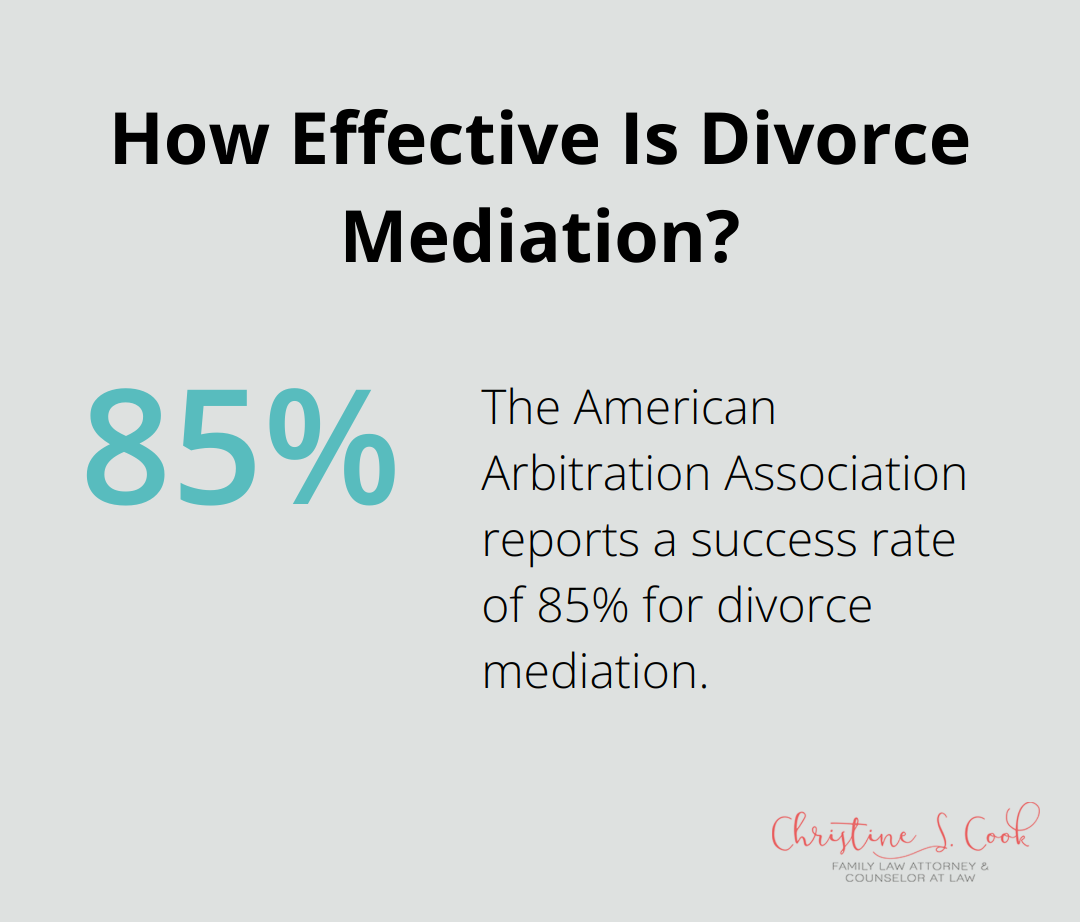
Couples with good communication skills and a willingness to compromise often find success in mediation. The American Arbitration Association reports a success rate of 85% for divorce mediation. Collaborative divorce may suit high-conflict couples or those dealing with complex financial situations better. A 2018 survey by the International Academy of Collaborative Professionals found that 86% of collaborative cases reached full agreement (with another 3% reaching partial agreement).
Mediation and collaborative divorce offer valuable alternatives to traditional litigation. The main difference between mediation and collaborative divorce lies in the level of professional involvement and process structure. Mediation typically involves a single neutral facilitator, while collaborative divorce engages a team of professionals. This distinction often results in mediation being more cost-effective and flexible, whereas collaborative divorce provides comprehensive support for complex cases.

Several factors influence the choice between these options. The complexity of your case, your ability to communicate with your spouse, and your comfort level with direct negotiations all play a role. Financial resources, time constraints, and the need for specialized expertise should also factor into your decision (which varies for each unique situation).
At Christine S. Cook, LLC, we specialize in guiding clients through these challenging decisions. Our experienced team can help you evaluate your situation and determine whether mediation or collaborative divorce aligns better with your needs. For personalized advice on your specific situation, we encourage you to reach out to Christine S. Cook, LLC for a consultation.