Navigating the Pensacola probate process can feel overwhelming when you’re grieving a loved one. The timeline, paperwork, and court procedures create stress at an already difficult time.
At Christine Sue Cook, LLC, we help families understand exactly what to expect. This guide walks you through each stage so you can move forward with confidence.
Probate in Florida is fundamentally a court-supervised transfer of assets to heirs or beneficiaries. According to The Florida Bar, probate becomes necessary when the court must order the transfer of ownership or distribution of assets. This happens when property is titled solely in the decedent’s name without survivorship rights. However, not every asset requires probate. Assets held jointly with rights of survivorship, life insurance policies with named beneficiaries, and retirement accounts with designated beneficiaries bypass probate entirely.
In Pensacola, probate cases are filed in Escambia County Circuit Court. The Escambia County Clerk of Court, located at 190 W Government Street, Pensacola, FL 32502, handles all filings and maintains estate records. Understanding which of your loved one’s assets actually need court involvement saves time and money. Florida law provides two primary paths: formal administration for larger estates versus summary administration for estates under $150,000 with minimal debt. The choice depends entirely on your situation, not on what works for someone else.
Starting probate requires specific documents on file with the Escambia County Clerk of Court. The original will must be deposited within 10 days of death, with no deposit fee but a filing fee applies when opening probate. You’ll also need the death certificate, a petition for administration, and an inventory form listing all known assets. The Clerk’s office provides standard forms, though these general templates may not address your family’s specific circumstances. Many people assume the Clerk’s forms handle every situation, but they don’t always fit complex estates or families with disputes.
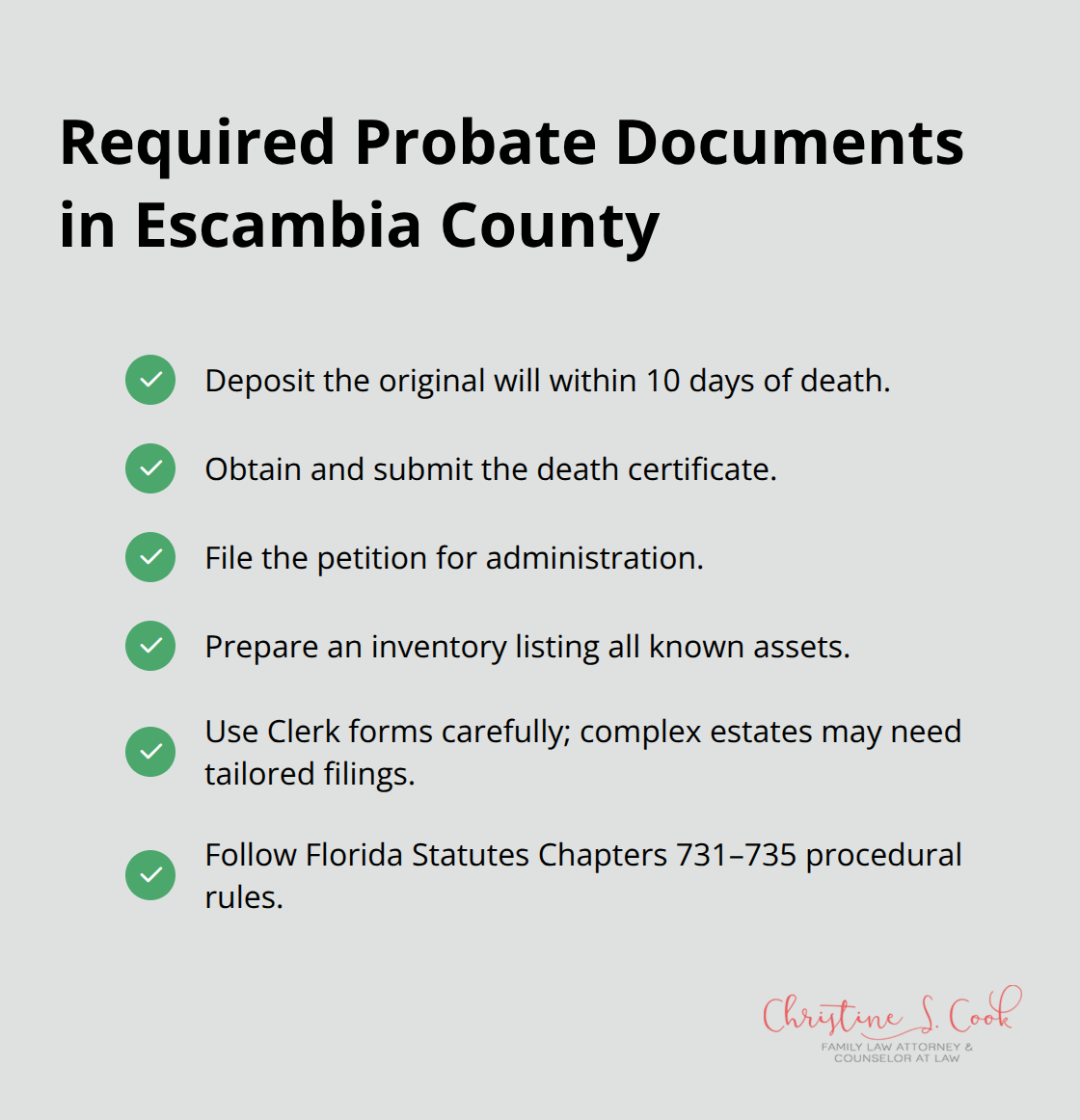
Florida Statutes Chapters 731–735 govern the entire process, and the court follows strict procedural rules.
The personal representative, typically named in the will, must be approved by the judge and has authority to gather assets, pay debts, and manage the estate. If no one is named or willing to serve, any interested party can petition the court for appointment. This person bears legal responsibility for the estate’s administration and can face personal liability if duties are mishandled or taxes go unpaid. Pensacola probate moves through Escambia County’s calendar, which can vary in speed depending on caseload. The court expects the personal representative to act with diligence and transparency throughout the process.
Understanding these foundational elements positions your family to move through the next critical phase: the actual probate timeline and what happens at each stage.
Florida probate timelines depend heavily on which path your estate follows, and the difference between them is substantial. Formal administration for larger estates typically spans 6 to 9 months from the initial filing to final distribution, according to The Florida Bar. Summary administration, available for estates under $75,000 with minimal or no debt, can close in as little as 2 to 3 weeks once the court issues its order.
The original will must reach the Escambia County Clerk of Court within 10 days of death. Missing this window creates complications and signals to the court that you may not be taking the process seriously. Once the petition is filed and the personal representative receives Letters of Administration from the judge, the real timeline begins.
The court requires publication of a Notice to Creditors in a local newspaper, which starts a 90-day window for creditors to file claims against the estate. This three-month period is non-negotiable under Florida law and represents the minimum time any estate must remain open. Many families mistakenly believe probate can close faster if no creditors emerge, but the court will not release assets until this period expires.
During these same 90 days, the personal representative must locate and notify all heirs and beneficiaries, identify and value all estate assets, and handle any immediate obligations like paying funeral expenses or maintaining property.
After the creditor period closes, the estate moves toward distribution, but this phase introduces variability based on complexity. Simple estates with clear asset titles and no disputes typically close within the initial 6 to 9 month window. However, estates with real property requiring appraisal, significant investments needing liquidation, or contested issues can extend 12 months or longer.
The personal representative must file a final accounting showing all income, expenses, and proposed distributions, which the court reviews before releasing assets to beneficiaries. If the estate includes a federal estate tax obligation, additional time is required to file Form 706 and pay taxes before distributions occur.
The personal representative manages all communications with creditors, maintains detailed financial records, and ensures every deadline is met. For complex estates or those with family disagreements, working with an experienced probate attorney prevents costly mistakes and keeps the process moving. Understanding these timelines helps your family prepare for what lies ahead-and knowing where delays commonly occur allows you to sidestep them entirely.
Probate delays rarely happen by accident. The Escambia County Clerk processes filings efficiently, but missed deadlines and incomplete paperwork create bottlenecks that extend timelines by months. Filing errors on the petition for administration or inventory form force the clerk to return documents for correction, adding weeks to the process. Families often miss deadlines because they don’t understand which documents are actually required or confuse general clerk forms with estate-specific needs. The Clerk’s office provides standard templates, but these forms assume straightforward situations and don’t account for complications like multiple properties, business interests, or unclear asset ownership. When you file incomplete paperwork, the court cannot move forward until corrections arrive, and scheduling another hearing slot in Escambia County’s calendar introduces delay. The personal representative bears responsibility for gathering accurate information about all assets, and underestimating what needs inventory creates problems later. If you discover assets after filing the initial inventory, you must file an amended inventory, which restarts portions of the timeline.
Will contests and beneficiary disputes inject unpredictability into any probate. When a family member challenges the will’s validity or disputes the personal representative’s decisions, the court must resolve these conflicts before distributions can occur, sometimes requiring months of litigation. Family conflicts emerge quickly during this process because probate is public record-anyone can see what you owned and who inherited what. Creditor claims also create delays if they arrive near the end of the 90-day period and require investigation or dispute. The personal representative who cannot locate all heirs or beneficiaries cannot proceed with distributions, and tracking down family members across state lines consumes weeks.
Incomplete or missing documentation about asset values forces appraisals that take time to schedule and complete, particularly for real property or valuable personal items. Federal estate tax obligations add complexity when the estate exceeds the exemption threshold, requiring Form 706 filing and additional time for tax payment before assets transfer to beneficiaries. These complications (especially those involving real estate or significant investments) demand careful attention to detail and proper sequencing of steps.
The most common mistake we observe is the personal representative attempting to manage probate alone without legal guidance, resulting in procedural errors that require court intervention to correct. An experienced probate attorney prevents these missteps and keeps the estate moving toward closure on schedule. Christine S. Cook, LLC offers free consultations to discuss your probate situation and help you understand whether professional guidance makes sense for your family’s circumstances.
The Pensacola probate process works smoothly when someone manages it with attention to detail and knowledge of Florida law. The personal representative carries significant responsibility, and mistakes made early create problems that compound throughout estate administration. Filing errors, incomplete asset inventories, and unclear documentation force corrections that push timelines backward, while will contests and creditor disputes introduce unpredictability that affects your family’s timeline.
You don’t need to navigate this alone. At Christine Sue Cook, LLC, we help families move through probate with confidence and clarity. Our free consultations give you a chance to discuss your specific situation without financial pressure, whether your estate qualifies for summary administration or requires formal probate.
Contact us today to discuss your estate or probate situation. The sooner you reach out, the sooner your family can move forward with peace of mind.