Property division during divorce can feel overwhelming without proper organization. A well-structured divorce property division spreadsheet transforms this complex process into manageable steps.
We at Christine Sue Cook, LLC have seen countless couples struggle with asset division because they lack a systematic approach. The right spreadsheet template helps you track every asset, debt, and valuation while maintaining transparency throughout negotiations.
Success in property division starts with thorough preparation, not spreadsheet formulas. Comprehensive information collection serves as your most important first step for avoiding disputes that commonly arise from incomplete asset documentation.
Start with bank statements from the past three years for all accounts (checking, savings, and investment). Include credit union accounts, money market funds, and any foreign bank holdings. Collect documentation for retirement accounts including 401k statements, IRA balances, and pension valuations.
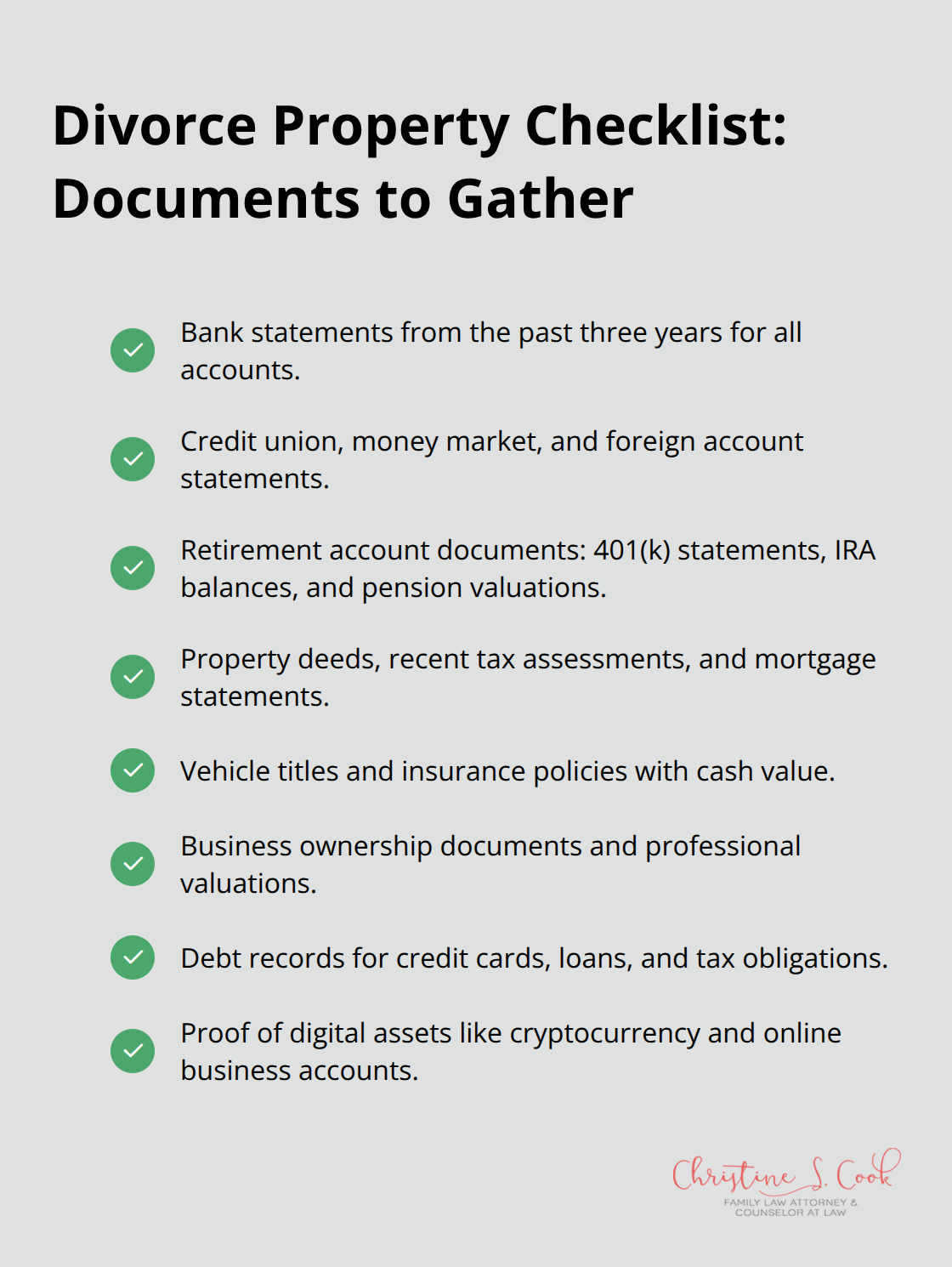
Real estate requires property deeds, recent tax assessments, and mortgage statements. Vehicle titles, insurance policies with cash value, and business ownership documents complete your asset foundation. The IRS requires specific documentation standards for asset transfers during divorce, so maintain original documents rather than copies whenever possible.
Document every debt including credit card statements, personal loans, mortgages, and business liabilities. Include student loans, tax obligations, and any informal debts to family members. Complete disclosure protects you against future legal complications since hidden debts can surface during negotiations.
Professional appraisals prove essential for high-value assets like real estate, businesses, collectibles, and jewelry. Recent appraisals within 90 days of division negotiations provide accurate valuations since property values fluctuate rapidly.
Business valuations require certified professionals who understand income, asset, and market approaches. Digital assets including cryptocurrency holdings, online business accounts, and valuable domain names need specialized documentation. Hidden assets surface in high-net-worth divorces according to forensic accounting studies.
Once you complete this documentation phase, you can move forward with confidence to structure your spreadsheet categories and formulas.
Your spreadsheet foundation determines success in property division negotiations. Create five primary asset categories: real estate, financial accounts, personal property, retirement accounts, and business interests. Each category needs separate worksheet tabs to prevent confusion during complex negotiations.

Financial accounts include checking, savings, investment accounts, and any cryptocurrency holdings. Personal property covers vehicles, jewelry, collectibles, and household items worth more than $500 according to family law standards.
Establish eight essential columns for each asset: description, acquisition date, current market value, debt against asset, net equity, spouse A percentage, spouse B percentage, and transfer method. Current market value requires professional appraisals for accurate valuations of everything that might be divided during a divorce.
Add a notes column for special considerations like tax implications or sentimental value disputes. Include formulas that automatically calculate net equity when you subtract debt from current value. Your percentage columns should total 100 percent for each asset to maintain mathematical accuracy throughout negotiations.
Insert SUM formulas at the bottom of each category to calculate total values automatically. Create a master summary sheet that pulls totals from all category tabs through cell references. Add percentage calculations that show each spouse’s share of total marital estate value.
Include conditional formatting that highlights discrepancies when percentage allocations exceed 100 percent. Most divorce attorneys recommend spreadsheets that calculate potential tax consequences for asset transfers, particularly for retirement account divisions that may involve QDRO distributions.
Build formulas that update automatically when you change asset values or allocation percentages. Use VLOOKUP functions to pull asset information between different worksheet tabs. Create dropdown menus for transfer methods to maintain consistency across all entries.
Set up validation rules that prevent percentage entries above 100 or below zero. These automated checks catch common data entry mistakes before they affect your final calculations.
While proper spreadsheet structure provides the foundation for fair division, many couples encounter specific pitfalls that can derail their negotiations entirely.
Asset division mistakes during divorce proceedings cost couples an average of $30,000 in lost value according to the American Academy of Matrimonial Lawyers. The three most expensive errors involve overlooked digital assets, ignored tax consequences of transfers, and undervalued income-producing properties. Digital assets include cryptocurrency, loyalty program points, and online business accounts that represent hidden value many couples completely miss during negotiations. Forensic accountants are critical in high-net-worth divorce cases by uncovering hidden assets and analyzing financial statements, with cryptocurrency holdings as the most commonly concealed asset type.
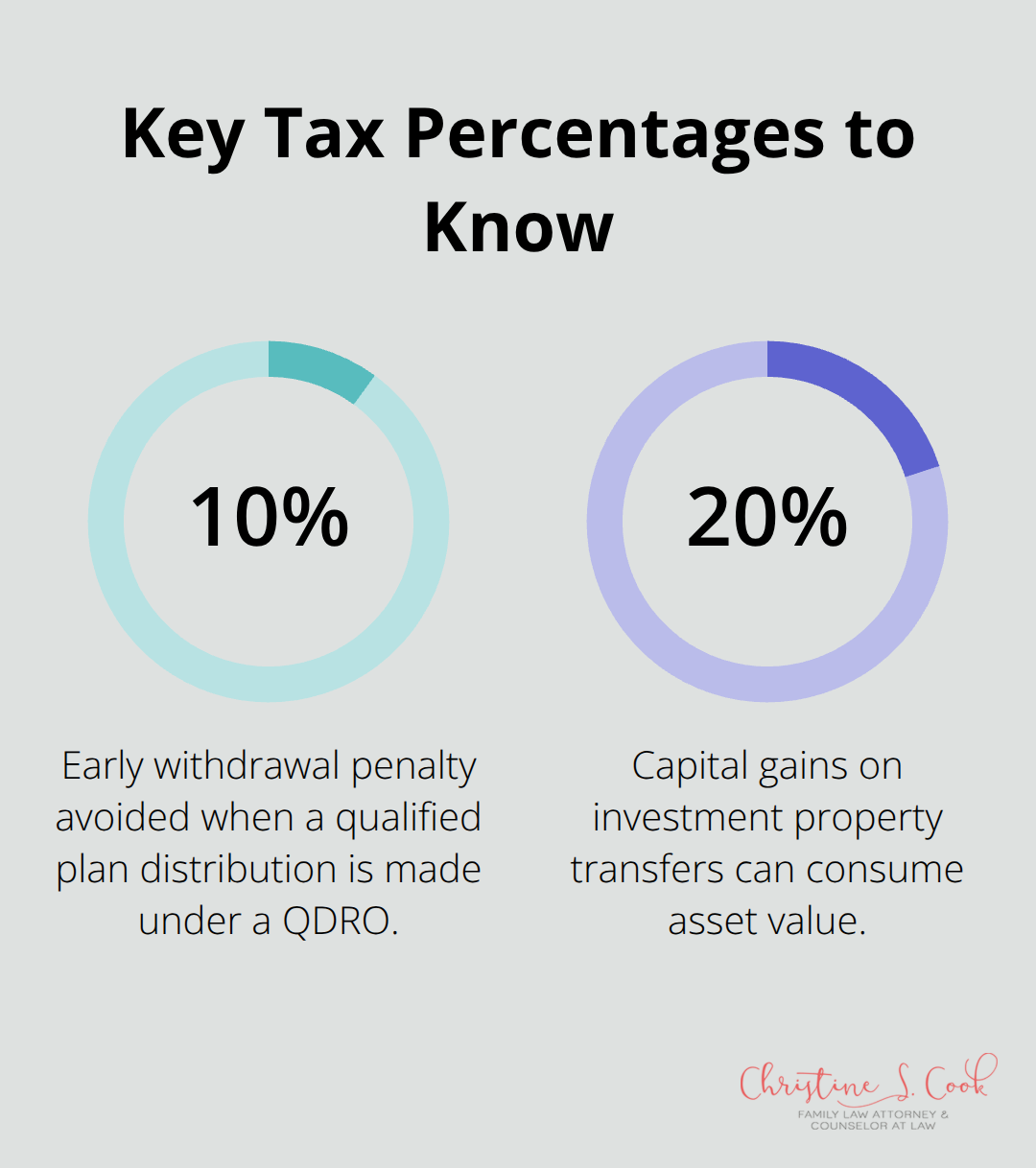
Retirement account transfers trigger immediate tax penalties when couples handle them incorrectly during property division. Assets distributed from a qualified plan under a QDRO are exempt from the 10% early withdrawal penalty. Capital gains taxes on investment property transfers can consume 20% of asset value, which makes some divisions financially devastating for both spouses.
Real estate transfers between spouses during divorce remain tax-free under current IRS regulations, but post-divorce sales trigger capital gains based on original purchase price rather than division value. Stock option valuations require careful analysis since vesting schedules affect actual transfer value significantly.
Rental properties generate ongoing income streams that standard market valuations completely ignore during division negotiations. Business ownership stakes produce future earnings potential that current asset values fail to capture accurately. Professional practices (including medical, dental, and legal firms) contain goodwill value that extends far beyond tangible asset valuations.
Pension benefits with survivor options provide lifetime income streams worth hundreds of thousands more than lump-sum present values suggest. Investment accounts with systematic contribution plans grow substantially over time, which makes percentage-based divisions more valuable than fixed dollar amounts for long-term financial security.
Couples frequently overlook digital assets during initial property inventories. Cryptocurrency wallets, online business accounts, and valuable domain names often escape detection during standard asset searches. Loyalty program points from business travel can hold substantial value (particularly airline miles and hotel rewards accumulated over years).
Forensic accountants use specialized software to trace hidden assets through financial records and digital footprints. Professional investigation becomes necessary when one spouse suspects asset concealment or when complex business structures obscure true ownership.
A structured divorce property division spreadsheet eliminates guesswork and reduces conflicts during asset negotiations. Organized documentation prevents costly oversights while automated calculations maintain accuracy throughout the division process. This systematic approach saves couples an average of $15,000 in legal fees according to family law statistics.
Professional legal guidance becomes necessary when business valuations exceed $100,000, when one spouse suspects hidden assets, or when retirement accounts require QDRO preparation. Complex tax implications from asset transfers also warrant attorney consultation to prevent expensive mistakes. Courts require precise documentation standards that professional attorneys understand completely.
We at Christine Sue Cook, LLC provide expert guidance for property division cases in Pensacola. Our firm specializes in family law matters with a client-centered approach. Your next steps include asset valuation completion, spreadsheet calculation finalization, and professional consultation scheduling for complex assets.