Divorce decisions shape your family’s future, and the path you choose matters. At Christine Sue Cook, LLC, we help clients understand whether collaborative divorce is a good idea for their specific situation.
This guide walks you through what collaborative divorce actually involves, its real advantages, and the situations where it falls short.
Collaborative divorce is a structured legal process where both spouses hire separate attorneys and commit upfront to resolving disputes outside court. The core mechanism is straightforward: you and your spouse sign a participation agreement stating that if negotiations fail and either party decides to litigate, both attorneys must withdraw. This creates real accountability. You cannot use the collaborative process as a trial run and then switch to litigation with the same legal team. That commitment shapes how both parties negotiate.
In collaborative divorce, each spouse brings their own attorney to four-way meetings with both parties present. This differs fundamentally from traditional litigation, where attorneys often communicate through written discovery, depositions, and court filings while clients remain largely removed from direct negotiation. In litigation, the court ultimately decides property division, custody, and support. In collaborative divorce, you and your spouse make those decisions together, supported by your attorneys and other professionals. The difference in control is substantial. A 2023 survey of collaborative divorce practitioners found that 78 percent of collaborative cases resulted in agreements, compared to significantly lower settlement rates in traditional litigation where discovery disputes and positioning often escalate costs and conflict.

The collaborative team typically includes mental health professionals who help couples communicate about parenting and emotional issues, and financial advisors who analyze asset division and tax implications. If you own a business or have complex investments, a financial professional can model different division scenarios before you commit to terms. This prevents costly mistakes. Both spouses and both attorneys sit together to identify issues, exchange financial documents voluntarily, and work toward agreement. Between meetings, each spouse meets privately with their own attorney to discuss strategy and concerns.
The pace depends on your family’s complexity and willingness to cooperate. Some couples reach full agreement in six to eight meetings over three to four months. Others with significant asset disputes or custody disagreements take longer. The collaborative divorce process is generally faster than traditional litigation. The key difference from mediation is that you have your own attorney present at every joint meeting to protect your interests and challenge proposals. Understanding what collaborative divorce demands before committing to it helps you evaluate whether this path aligns with your family’s needs and circumstances.
Collaborative divorce eliminates the financial drain of traditional litigation. In court, you pay for discovery-the formal process where attorneys exchange documents, conduct depositions, and file motions-which routinely costs $5,000 to $15,000 before trial even begins. Collaborative divorce uses informal, voluntary disclosure instead. Both spouses exchange financial documents upfront, and the team reviews them together in joint meetings. A financial advisor sits at the table to analyze assets in real time, answering questions about business valuations, retirement accounts, and tax consequences immediately rather than through written interrogatories. This directness saves hundreds of attorney hours.
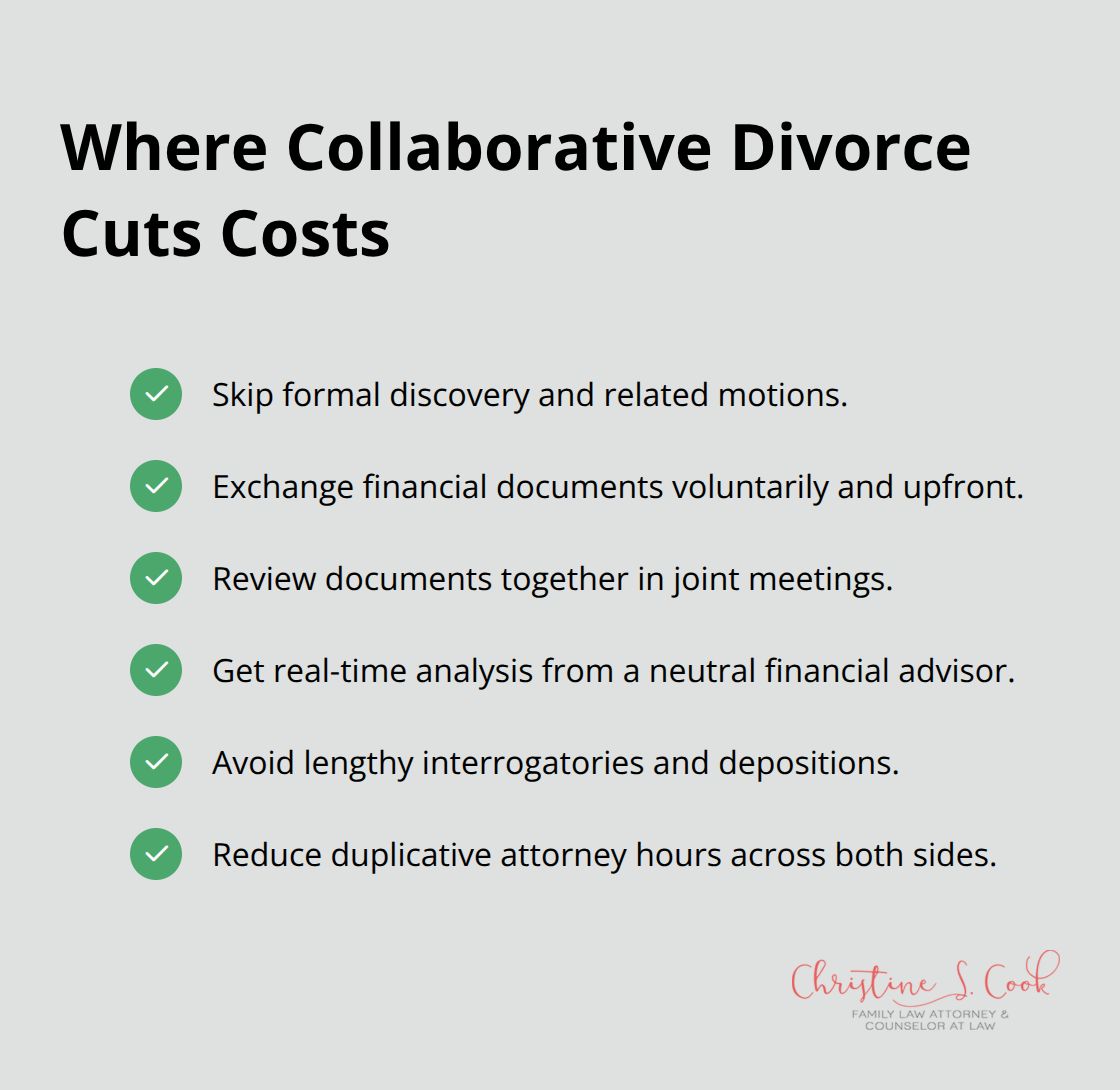
Collaborative cases typically cost 40 to 60 percent less than contested litigation because the parties avoid formal discovery, expert depositions, and court appearances. The timeline difference is equally stark. Collaborative cases often resolve in four to eight months, while contested divorces average 18 to 24 months or longer when court backlogs and scheduling conflicts pile up. You control the meeting schedule; if both parties commit, you can meet weekly instead of waiting months between court dates.
The real advantage extends beyond speed and cost to the decisions you actually keep. In court, a judge decides custody arrangements, property splits, and support amounts based on state law and what they hear in a 30-minute hearing. That judge knows nothing about your family’s routines, your children’s school schedules, or why your spouse values the family business over the retirement accounts. In collaborative divorce, you design a parenting plan that reflects your children’s actual needs-including transportation logistics, holiday preferences, and how each parent’s work schedule affects availability.
One study of collaborative practitioners found that parents who negotiate custody arrangements directly report higher satisfaction with parenting plans and better adherence to agreements post-divorce. Financial outcomes improve too. A neutral financial advisor models different division scenarios, showing you the after-tax impact of keeping the house versus taking retirement assets, or how spousal support affects long-term cash flow. You see the numbers before committing, not after a judge’s order locks you into a decision you cannot change.
These financial and timeline advantages matter, but they point to something larger. Collaborative divorce shifts power from the courtroom back to your family. The process respects your knowledge of what works for your children and your financial situation. This foundation-where you retain control and build agreements based on real information-shapes whether the path ahead actually serves your family’s long-term stability. Understanding whether your situation supports this level of cooperation becomes the next critical question.
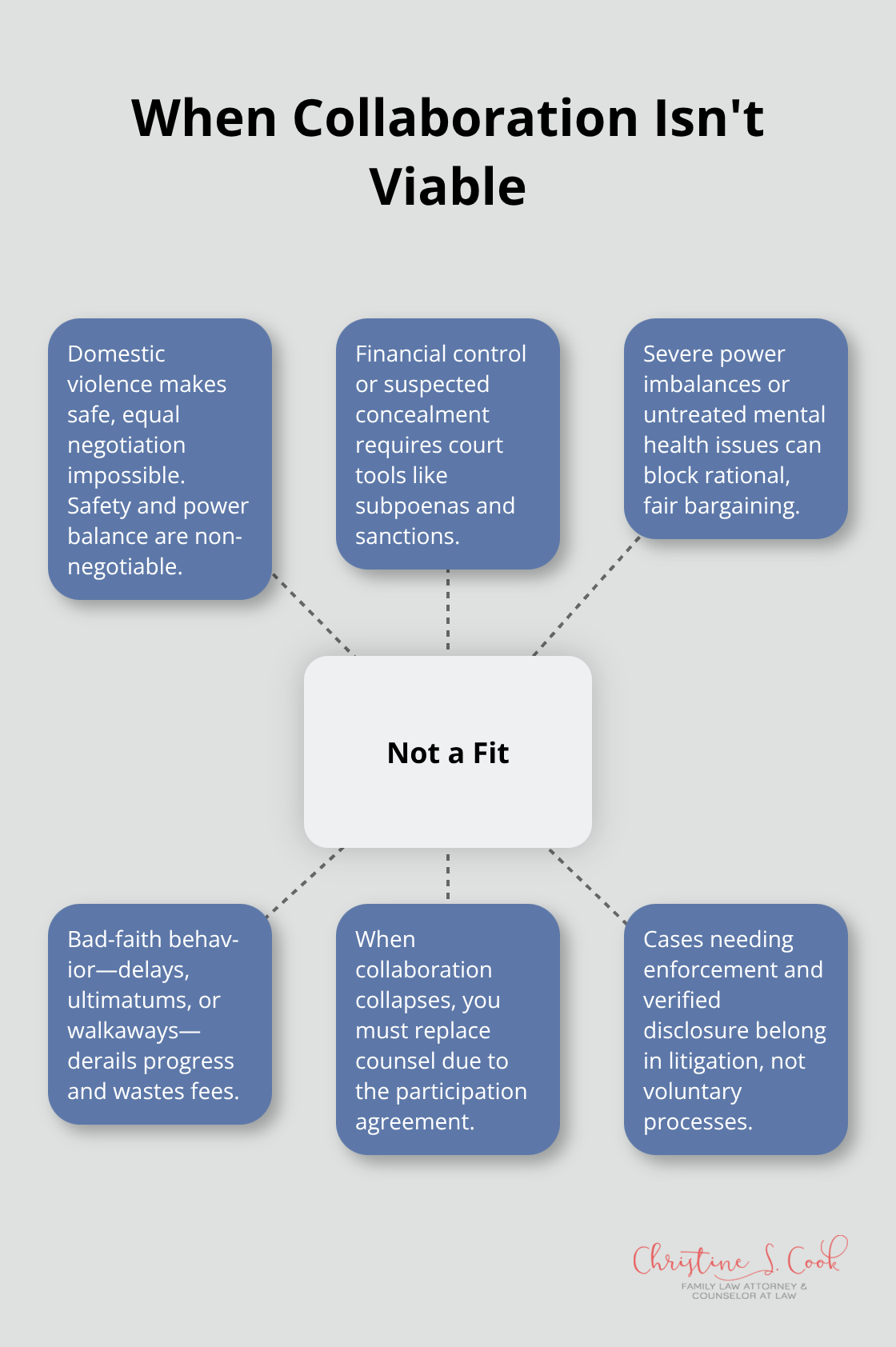
Collaborative divorce requires a foundation that not every situation possesses: the ability and willingness of both parties to negotiate honestly and safely. When that foundation cracks, the process fails. Domestic violence fundamentally disqualifies collaborative divorce. An abused spouse cannot negotiate as an equal when fear shapes every decision. The National Domestic Violence Hotline reports that approximately one in four women and one in ten men experience severe intimate partner violence in their lifetime, and those dynamics make four-way meetings dangerous, not productive.
If you have experienced physical abuse, threats, or controlling behavior from your spouse, collaborative divorce places you at risk. The process assumes both parties will disclose finances voluntarily and negotiate in good faith. An abuser uses control over money as a weapon, and the informal discovery process in collaborative divorce gives them room to hide assets without the court oversight that litigation provides.
If you suspect your spouse has concealed income, diverted funds, or uses financial control as abuse, traditional litigation with formal discovery and a judge’s authority to compel disclosure protects you far better than collaborative negotiation. The court system enforces transparency through subpoenas, depositions, and sanctions for non-compliance. Collaborative divorce relies on voluntary cooperation-a mechanism that fails when one party acts in bad faith.
Severe power imbalances short of outright abuse also undermine collaboration. These include situations where one spouse has significantly greater income, education, or business sophistication and uses that advantage to dominate discussions, or where one party has undiagnosed or untreated mental health conditions that prevent rational negotiation. If your spouse refuses to engage honestly, delays meetings repeatedly, makes unreasonable demands without movement, or simply walks away from the process, you waste thousands in professional fees before realizing collaboration cannot work.
At that point, you must hire new attorneys to litigate, doubling your legal costs. The participation agreement that creates accountability in good-faith cases becomes a trap when one party abandons the process. You lose your original legal team and start over in court.
If you question whether your spouse will participate in good faith, discuss your concerns with an experienced family law attorney before committing to collaborative divorce. A straightforward assessment of your spouse’s willingness to cooperate honestly, your own safety, and the transparency of your financial situation determines whether this path serves your interests or leaves you vulnerable. Some cases require the court system’s enforcement mechanisms and protections that collaborative divorce cannot provide.
Choosing between collaborative divorce and traditional litigation comes down to three core questions: Can both parties negotiate honestly? Is your situation safe for direct engagement? Do you want to retain control over the outcome? If you and your spouse maintain basic respect, can disclose finances transparently, and share a commitment to resolving disputes outside court, collaborative divorce typically delivers faster results, lower costs, and outcomes tailored to your family’s actual needs. The process works because it shifts decision-making power from a judge back to you-you design parenting plans that fit your children’s routines, you model financial scenarios before committing to asset division, and you build agreements based on real information rather than courtroom positioning.
But collaborative divorce is not a good idea if domestic violence, severe power imbalances, or bad-faith behavior characterize your relationship. The process depends entirely on voluntary cooperation and honest disclosure, and when those conditions are absent, the informal structure that makes collaboration efficient becomes a liability. You lose your legal team mid-process and face higher total costs when you must restart litigation with new attorneys.
The honest assessment happens before you commit. Ask yourself whether your spouse will engage transparently about finances, whether you feel safe in direct negotiations, and whether both of you genuinely want to cooperate rather than win. Contact us for a free consultation to discuss your situation without financial pressure, and we’ll help you determine whether collaborative divorce aligns with your needs or whether traditional litigation better protects your interests.