
Make a Payment
850-572-3443
Divorce in Florida means your home could be divided between you and your spouse, but the outcome isn’t automatic or equal. State law gives courts specific guidelines for who gets the house in a divorce in Florida, and understanding these rules puts you in a stronger position.
At Christine Sue Cook, LLC, we’ve seen how quickly homeowners lose their property rights by missing deadlines or making costly mistakes. This guide walks you through Florida’s division process, strategies to protect your home, and the pitfalls that derail your case.
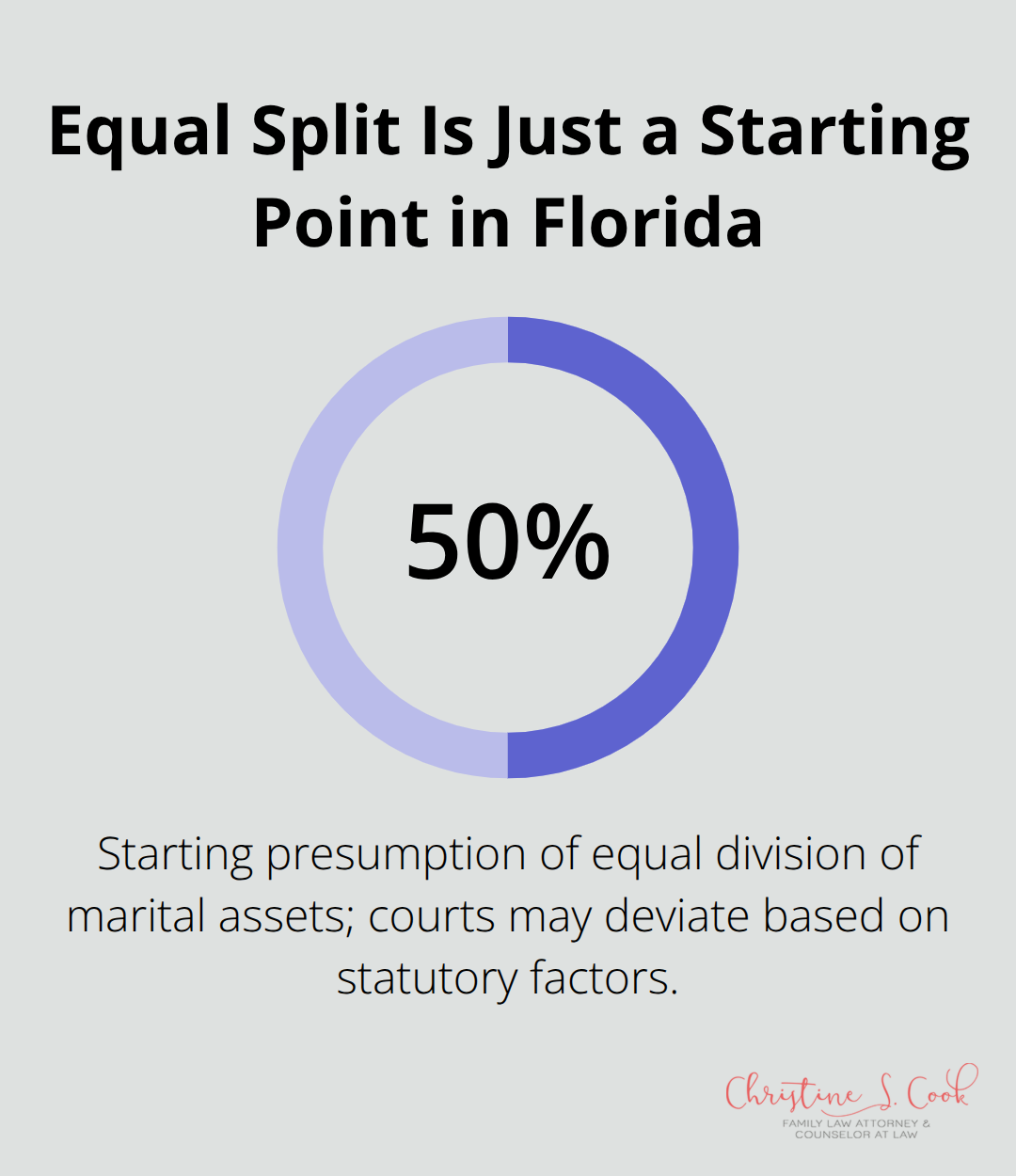
Florida courts start from a position that marital assets should be split equally, but that’s where the simplicity ends. Florida Statute 61.075 gives judges authority to deviate from a 50-50 split based on equitable distribution based on economic circumstances and marriage length. The home acquired during your marriage is presumed marital property regardless of whose name appears on the deed, which means it’s subject to division unless you can prove otherwise.
The critical cutoff date is the earliest of your separation date, any separation agreement date, or your divorce filing date. Assets acquired after that date are presumed nonmarital, but this presumption favors the spouse claiming nonmarital status, so the burden falls on you to prove the home was acquired before marriage or through nonmarital funds. If you contributed to the mortgage, renovations, or improvements using marital funds after the cutoff date, those contributions increase the marital portion of the home’s value.
Courts also examine whether you intentionally wasted or depleted marital assets within two years before filing. A home neglected or damaged during that period can factor into the judge’s decision about how to divide it fairly.
Courts justify departing from equal division by examining your economic circumstances after divorce, your contributions to the marriage including homemaking and childcare, and the length of your marriage. A 15-year marriage with one spouse managing the home while the other built a career looks different from a five-year marriage with two equal earners. Courts also weigh who can more easily afford alternative housing and whose custody arrangement requires housing stability.
The judge can order one spouse to buy out the other’s share, award the home to one party while the other receives greater assets elsewhere, or order a sale with proceeds divided according to each spouse’s ownership percentage.
Professional appraisals and valuation dates establish the home’s current value, which directly affects how much one spouse owes the other in a buyout scenario. Courts use valuation dates strategically: if appreciation occurred passively after your separation, the judge might value the home at separation to avoid giving one spouse unearned gains. However, if marital efforts caused appreciation, the full current value applies to the marital estate. This distinction can shift thousands of dollars between spouses, making the valuation date one of the most contested issues in home division cases.
Understanding these mechanics helps you anticipate what a judge might order and what options remain available to you. The next section explores concrete strategies you can use to keep the house rather than accept whatever a court decides.
Refinancing the mortgage in your name and paying your spouse their equity stake represents the most direct route to keeping the house. If the home is worth $400,000 and you each own 50 percent, you owe your spouse $200,000. You’ll need to qualify for a new mortgage that covers both the existing loan balance and the buyout amount, which means your income and credit must support the higher payment.
A professional appraisal costs $400 to $600 but prevents disputes about value that can cost thousands in legal fees. Once you refinance, your spouse’s name comes off the deed, and you own the home outright. This approach works best when you have stable income, equity in the home, and the ability to qualify for financing on your own.

Trading assets offers a second option when you lack refinancing capacity or want to preserve cash. You keep the house while your spouse receives retirement accounts, investment accounts, or other property of equal value. Courts accept this arrangement because both parties receive equivalent assets.
Accurate valuation across different asset types matters significantly. When dividing retirement accounts, valuing retirement accounts requires determining their worth at a specific date, typically the date of separation or filing. A financial advisor or divorce specialist helps you structure trades that account for these differences. This path requires negotiation skills and willingness to give up assets you might prefer to keep, but it avoids refinancing and leaves you with full ownership immediately. If you have substantial retirement savings or investment accounts, this strategy often produces faster settlements than waiting for mortgage approval.
The hybrid approach combines both methods: refinance for a lower buyout amount and trade other assets for the remainder of your spouse’s equity claim. This structure gives you flexibility when refinancing capacity is limited or when asset distribution favors both parties. You might refinance for $100,000 and transfer $100,000 in retirement accounts to your spouse, splitting the buyout obligation across two mechanisms.
Each path carries different financial and timing implications. Your choice depends on your income stability, available assets, and how quickly you want to finalize the division. The mistakes you avoid during this process-and the ones homeowners commonly make-often determine whether you actually retain the house or lose it to poor planning.
Hidden assets and undisclosed debts are the fastest way to lose credibility with a Florida judge and forfeit your home in the process. When you fail to fully disclose what you own, what you owe, or where your money has gone, the court assumes you’re hiding something worse than what surfaces later. Florida Statute 61.075 requires complete financial disclosure, and judges routinely penalize spouses who conceal assets by awarding the other party a larger share of marital property as a sanction.
One spouse who failed to report a hidden savings account lost an additional amount in the final judgment because the judge viewed the concealment as intentional waste. Courts also examine whether you transferred funds to family members, paid down personal debts, or liquidated accounts within two years before filing. These actions trigger the dissipation doctrine, which allows judges to add the value of depleted assets back into the marital estate and award them entirely to your spouse.
Preparation protects you from accusations of hiding and gives you a complete picture of what you’re actually dividing. List every bank account, investment, retirement account, real estate holding, vehicle, and outstanding debt months before any conversation about divorce. Request six months of bank statements, credit card bills, and loan documents.

This transparency demonstrates good faith to the court and prevents the judge from imposing sanctions that shift thousands of dollars away from you.
Professional home appraisals are not optional expenses-they are investments that prevent thousands in losses during negotiation and trial. A professional appraisal conducted early in your case establishes the home’s value before emotions escalate and positions harden. Without an appraisal, your spouse’s estimate controls the conversation, and judges often split the difference between competing valuations when both lack professional support.
Accurate property valuation in divorce directly impacts the financial outcomes for both parties. Appraisers also identify structural issues, deferred maintenance, or improvements that affect value and support your negotiating position. This professional documentation shifts the burden of proof onto your spouse to challenge the appraisal with evidence of their own.
Missing court deadlines and filing requirements costs you the house in ways that feel invisible until it’s too late. Florida’s civil procedure rules impose strict deadlines for responding to discovery requests, filing financial affidavits, and submitting mandatory disclosures. Miss a deadline by five days and the judge can bar you from presenting evidence about the home’s value, your contributions to it, or your spouse’s hidden assets.
One homeowner missed the deadline to file a response to a motion for temporary use and possession, and the judge awarded the house to the other spouse for the duration of the case-effectively deciding the outcome before trial began. Your attorney tracks these deadlines obsessively, but you must understand that every filing has consequences. If you represent yourself, the court extends no mercy for missed deadlines. Christine S. Cook, LLC manages every filing requirement and deadline to protect your position on the home and every other asset.
Florida’s equitable distribution framework gives you multiple pathways to keep your home, but only if you act strategically and avoid the mistakes that derail most homeowners. Who gets the house in a divorce in Florida depends on timing, disclosure, valuation, and the choices you make during settlement negotiations. A 50-50 split is the starting point, not the final answer, and judges routinely adjust based on your economic circumstances, contributions to the marriage, and the length of your relationship.
The three strategies outlined here-refinancing for a buyout, trading assets, or combining both approaches-work because they give you control over the outcome rather than leaving the decision to a judge. Professional appraisals, complete financial disclosure, and strict adherence to court deadlines separate homeowners who retain their property from those who lose it. These aren’t theoretical concerns; they’re the practical mechanics that determine whether you walk away with your home or watch it get divided in ways you didn’t anticipate.
Your next step is to consult with an attorney who understands Florida’s property division rules and can evaluate your specific situation. At Christine Sue Cook, LLC, we provide free consultations to discuss your home division concerns without financial pressure. Contact us today to protect your property rights and move forward with confidence.